
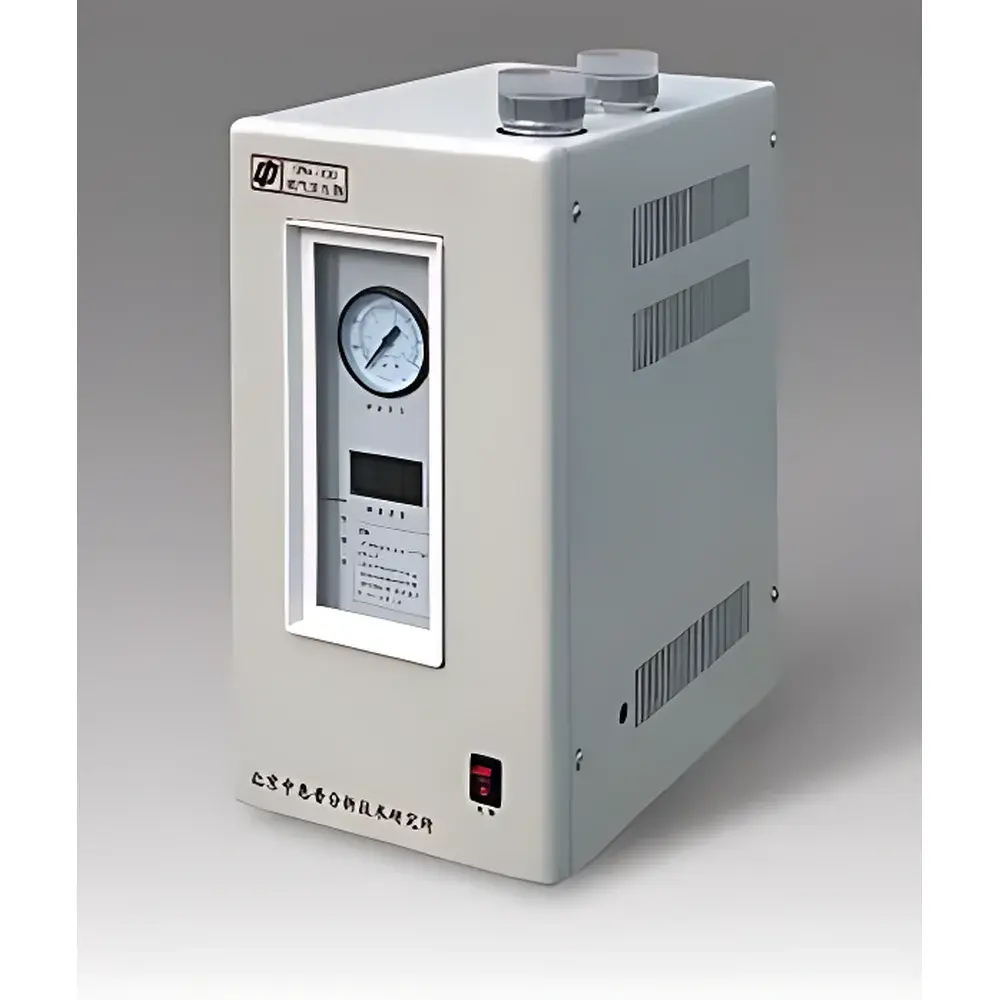
Zhonghuipu SPN-300/500 Membrane-Based Nitrogen Generator
| Brand | Zhonghuipu |
|---|---|
| Origin | Beijing, China |
| Manufacturer Type | Direct Manufacturer |
| Model | SPN-300/500 |
| Output Flow Rate | 0–300 mL/min (SPN-300) / 0–500 mL/min (SPN-500) |
| Output Pressure | 0–0.4 MPa (dependent on inlet compressed air pressure) |
| Nitrogen Purity | <3 ppm O₂, dew point ≤ −56 °C |
| Pressure Stability | <0.003 MPa (subject to inlet air stability) |
| Power Supply | 220 V ±10%, 50 Hz |
| Power Consumption | 60 W (SPN-300) / 100 W (SPN-500) |
| Operating Environment | 1–40 °C, RH <85% |
| Dimensions (W×D×H) | 370 × 180 × 330 mm |
| Net Weight | ~11 kg |
| Filtration | Dual stainless-steel filters with integrated trace-oxygen scavenger (pre-activated, maintenance-free) |
| Sealing Material | Low-sulfur silicone elastomer gaskets |
Overview
The Zhonghuipu SPN-300/500 is a compact, membrane-based nitrogen generator engineered for continuous, on-demand production of high-purity nitrogen gas in analytical laboratory environments. It utilizes hollow-fiber membrane separation technology to selectively permeate oxygen, water vapor, CO₂, and other trace contaminants from compressed ambient air, retaining nitrogen with exceptional selectivity and stability. This principle relies on differential gas permeation rates across polymeric membranes—oxygen and moisture diffuse faster through the membrane wall, while nitrogen remains in the non-permeate stream. The system is designed for integration with gas chromatography (GC), liquid chromatography–mass spectrometry (LC-MS) nitrogen drying/cleaning manifolds, FTIR purge lines, and inert atmosphere glove boxes requiring consistent, low-oxygen, low-moisture nitrogen supply. Unlike PSA-based systems, membrane generators offer inherently pulse-free flow, minimal moving parts, and no adsorbent regeneration cycles—making them ideal for applications demanding long-term unattended operation and baseline stability.
Key Features
- Auto-regulating flow and pressure control: Integrated electronic sensors and proportional solenoid valves maintain constant output pressure (0–0.4 MPa) and user-set flow rate (0–300 or 0–500 mL/min), dynamically adapting to downstream demand without manual intervention.
- Dual-stage stainless-steel filtration: Primary particulate filter (0.01 µm) followed by secondary catalytic trace-oxygen removal cartridge—pre-activated, sulfur-free, and maintenance-free for ≥12 months under typical lab usage.
- Low-sulfur sealing architecture: All internal wetted seals employ medical-grade silicone elastomers with certified low sulfur content (<1 ppm), eliminating sulfur-induced GC column degradation and baseline drift in sensitive detection modes (e.g., ECD, SCD).
- Integrated safety logic: Real-time monitoring of inlet air pressure, membrane backpressure, and temperature triggers automatic shutdown and visual alarm if conditions exceed operational thresholds—preventing membrane over-pressurization or thermal degradation.
- Compact footprint & low power draw: Occupies <0.022 m³ of bench space and consumes only 60 W (SPN-300) or 100 W (SPN-500), enabling deployment in fume hoods, instrument racks, or mobile labs without dedicated HVAC support.
Sample Compatibility & Compliance
The SPN-300/500 delivers nitrogen meeting ASTM D6624-22 specifications for carrier and purge gas in chromatographic analysis. Its verified oxygen residual (<3 ppm v/v) and dew point (≤−56 °C) comply with ISO 8573-1:2010 Class 2.2.1 for compressed gases used in analytical instrumentation. The unit conforms to IEC 61010-1:2010 for electrical safety in laboratory equipment and includes CE-marked components. While not FDA 21 CFR Part 11–certified as a standalone data system, its analog pressure/flow outputs are compatible with LIMS-integrated environmental monitoring systems supporting GLP/GMP audit trails when paired with validated data loggers.
Software & Data Management
This generator operates as a stand-alone hardware device with local analog instrumentation—no embedded firmware, touchscreen interface, or network connectivity. Pressure and flow are displayed via calibrated analog meters (±1.5% FS accuracy), providing deterministic, EMC-immune readouts unaffected by software latency or cybersecurity vulnerabilities. For laboratories requiring digital logging, optional 4–20 mA analog outputs (available upon request) enable seamless integration with PLCs, SCADA systems, or third-party data acquisition platforms compliant with ISA-88/ISA-95 frameworks. All calibration certificates—including flowmeter NIST-traceable verification and dew point sensor factory calibration—are supplied with each unit.
Applications
- GC carrier gas supply for capillary columns (especially PLOT, porous polymer, and metal oxide phases sensitive to oxygen exposure)
- Nitrogen blanket for LC mobile phase degassing and solvent storage reservoirs
- Purge gas for FTIR spectrometer optical benches and ATR accessories
- Inerting of sample vials, autosampler trays, and headspace GC ovens
- Zero-air generation support (when coupled with hydrocarbon scrubbers and catalytic oxidizers)
- Backup nitrogen source for TOC analyzers and elemental combustion instruments requiring stable, low-humidity purge streams
FAQ
What compressed air quality is required for optimal membrane performance?
Inlet air must meet ISO 8573-1 Class 3.2.3 (oil ≤ 0.1 mg/m³, particles ≤ 5 µm, dew point ≤ +3 °C). A refrigerated dryer and coalescing filter are strongly recommended upstream.
Can the SPN-300/500 be used with GC-MS systems requiring ultra-high purity?
Yes—when paired with an optional in-line 0.003 µm sub-micron filter and copper catalyst purifier, it achieves <0.5 ppm O₂ and <−70 °C dew point, satisfying ASTM D4084 requirements for MS ion source protection.
Is routine maintenance required beyond filter replacement?
Only the dual stainless-steel filters require replacement every 12–18 months; the oxygen scavenger is pre-activated and non-regenerable—no user servicing or reactivation is needed.
Does ambient temperature affect nitrogen dew point consistency?
Yes—operation above 35 °C may elevate dew point by up to 3 °C due to reduced membrane selectivity; sustained use above 40 °C voids warranty and risks irreversible flux decline.
How is pressure stability maintained during variable downstream demand?
A feedback-controlled pneumatic regulator modulates inlet air pressure to the membrane module in real time, compensating for flow transients with <500 ms response time and limiting pressure deviation to <0.003 MPa under steady-state conditions.



