
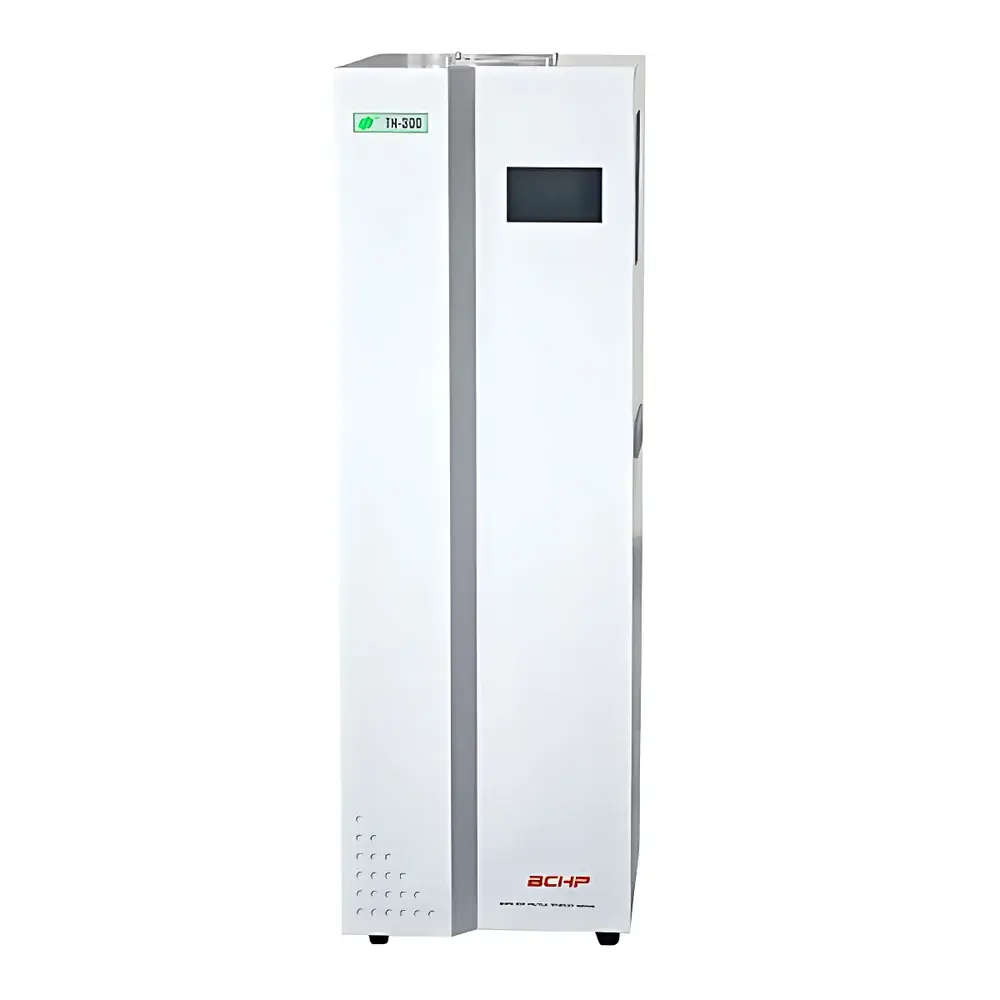
Zhonghuipu TN-300/TN-600 High-Purity Nitrogen Generator (Pressure Swing Adsorption Type)
| Brand | Zhonghuipu |
|---|---|
| Origin | Beijing, China |
| Manufacturer Type | OEM Manufacturer |
| Instrument Type | Nitrogen Generator |
| Nitrogen Generation Principle | Pressure Swing Adsorption (PSA) |
| Output Flow Rate | 0–300 mL/min (TN-300) / 0–600 mL/min (TN-600) |
| Output Pressure | 0–0.4 MPa |
| Nitrogen Purity | 99.999% to 99.9999% |
| Hydrocarbon Content | ≤0.1 ppm |
| Power Supply | 220 V ±10%, 50 Hz |
| Peak Power Consumption | 525 W |
| Operating Temperature | 1–40 °C |
| Relative Humidity | <85% RH |
| Dimensions (W×D×H) | 350 × 320 × 900 mm |
| Net Weight | ~28 kg |
Overview
The Zhonghuipu TN-300 and TN-600 are laboratory-grade, on-demand nitrogen generators engineered for continuous, high-purity gas supply in analytical instrumentation environments. Utilizing pressure swing adsorption (PSA) technology, these units separate nitrogen from compressed ambient air by selectively adsorbing oxygen, carbon dioxide, water vapor, and hydrocarbons onto a high-efficiency carbon molecular sieve (CMS). The dual-tower PSA architecture enables uninterrupted nitrogen delivery—while one tower adsorbs impurities, the other undergoes rapid depressurization and purging to regenerate the CMS bed. This cyclic operation ensures stable output of nitrogen with purity ranging from 99.999% (5.0 grade) to 99.9999% (6.0 grade), meeting stringent requirements for electron capture detection (ECD), polar GC columns, FTIR purge systems, and inert blanketing in sample preparation workflows.
Key Features
- Dual-tower PSA design with intelligent microcontroller-based sequencing for zero-downtime operation and extended CMS service life.
- Imported high-capacity, high-crush-strength carbon molecular sieve with proprietary packing technology to minimize attrition and prevent channeling or powdering during repeated pressure cycling.
- Dual-stage pressure regulation system delivering consistent output pressure (0–0.4 MPa) with minimal fluctuation—even during flow transients—enabling direct interfacing with sensitive detectors and pneumatic actuators.
- Stainless steel construction for critical components including adsorption towers, buffer tanks, and internal manifolds—resistant to corrosion and compliant with ISO 8573-1 Class 2 solid particle and Class 2 oil contamination standards.
- Integrated safety architecture featuring overpressure relief valves, thermal overload protection, real-time fault diagnostics, and audible/visual alarm outputs for abnormal dew point, pressure deviation, or CMS saturation.
- Auto-initiation sequence upon power-up: includes timed pre-purge, CMS conditioning, and purity ramp-up—achieving specification-grade nitrogen within ≤15 minutes of startup.
Sample Compatibility & Compliance
The TN-300/TN-600 is designed for integration into regulated analytical laboratories where gas quality directly impacts data integrity. Its verified hydrocarbon content (≤0.1 ppm) and residual moisture level (<−40 °C dew point, typical) ensure compatibility with electron-capture detectors (ECD), nitrogen-phosphorus detectors (NPD), and highly polar stationary phases such as polyethylene glycol (PEG)-based capillary columns. The unit meets general requirements for ISO/IEC 17025-compliant environments and supports GLP/GMP documentation through built-in event logging (power cycles, alarms, maintenance prompts). While not certified to FDA 21 CFR Part 11 out-of-the-box, its deterministic control logic and non-volatile fault history enable traceable audit trails when deployed with validated LIMS or chromatography data systems (CDS).
Software & Data Management
Operation is managed via an embedded 8-bit microcontroller with no external PC dependency. All process parameters—including tower status, output pressure, purity estimation (via O2 sensor feedback loop), and cumulative runtime—are displayed on a backlit LCD interface. System events—including CMS regeneration timing, pressure deviations >±0.02 MPa, and temperature excursions beyond 40 °C—are timestamped and stored in non-volatile memory for up to 1,000 entries. Optional RS-232 or 4–20 mA analog outputs (available on request) allow connection to building management systems (BMS) or centralized gas monitoring platforms for predictive maintenance scheduling and remote alarm notification.
Applications
- Carrier and makeup gas for gas chromatography (GC), especially with ECD, NPD, and pulsed discharge helium ionization detectors (PDHID).
- Purge gas for Fourier-transform infrared (FTIR) spectrometers and cavity ring-down spectroscopy (CRDS) systems requiring ultra-low hydrocarbon background.
- Inert atmosphere generation for glove boxes, sample vial crimping stations, and solvent evaporation systems.
- Blanketing gas in HPLC mobile phase reservoirs and autosampler trays to prevent oxidation of labile analytes.
- Supply gas for nitrogen laser excitation sources and plasma cleaning equipment in microfabrication labs.
FAQ
What is the expected service life of the carbon molecular sieve under normal operating conditions?
Typical CMS lifespan exceeds 20,000 hours (≈2.3 years of continuous operation) when inlet air meets ISO 8573-1 Class 4 particulate and Class 4 water specifications and oil-free compression is used.
Can the TN-600 be used as a drop-in replacement for liquid nitrogen dewars in GC applications?
Yes—provided the instrument’s required flow rate and pressure fall within the TN-600’s 0–600 mL/min and 0–0.4 MPa range; however, users must verify compatibility with manufacturer-specified gas quality thresholds (e.g., Agilent 7890B ECD requires ≤0.1 ppm total hydrocarbons).
Is external air drying required prior to feeding compressed air into the generator?
A refrigerated dryer and coalescing filter are strongly recommended upstream to maintain inlet air at ≤3 °C pressure dew point and ≤0.01 µm particulate—critical for maximizing CMS longevity and preventing premature breakthrough.
Does the unit include validation documentation for IQ/OQ protocols?
Factory test reports (including flow calibration certificates, pressure decay test records, and O2 sensor verification logs) are supplied standard; full GxP-compliant IQ/OQ templates can be provided upon request for qualified laboratories.
Related Products



