
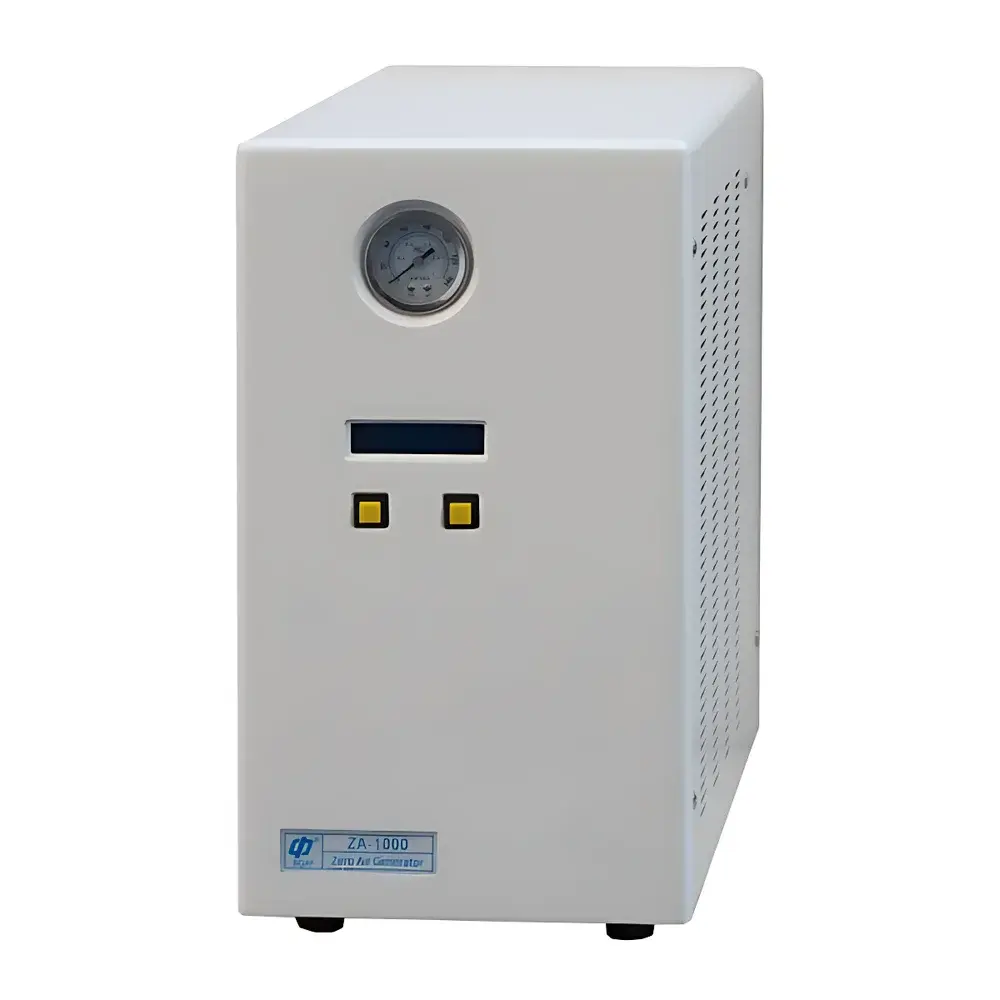
Zhonghuipu ZA-1000 Zero-Air Generator with Hydrocarbon Removal
| Brand | Zhonghuipu |
|---|---|
| Origin | Beijing, China |
| Manufacturer Type | Direct Manufacturer |
| Model | ZA-1000 |
| Hydrocarbon Removal Principle | High-temperature catalytic oxidation using Pt/Pd-based catalysts |
| Output Flow Rate | 0–1000 mL/min |
| Output Pressure | 0–0.6 MPa (air-pressure-dependent, no built-in compressor) |
| Residual Hydrocarbon Content | <0.1 ppm (as methane equivalent) |
Overview
The Zhonghuipu ZA-1000 Zero-Air Generator is an engineered solution for producing ultra-pure air compliant with ASTM D6216 and ISO 8573-1 Class 1 (hydrocarbon-free) specifications. It functions as a post-compression air purification system, designed specifically to meet the stringent gas purity requirements of analytical instrumentation—particularly gas chromatography (GC), GC–mass spectrometry (GC–MS), flame ionization detection (FID), and chemiluminescence NOx analyzers. The unit employs high-temperature catalytic oxidation (400–450 °C) in a fixed-bed reactor containing platinum–palladium catalysts supported on inert ceramic substrates. In this environment, trace hydrocarbons—including methane, ethane, propane, and aromatic compounds—are quantitatively oxidized to CO2 and H2O. Subsequent desiccant-based moisture removal ensures final output air contains <0.1 ppm total hydrocarbons (reported as methane-equivalent) and dew point ≤ –40 °C at 0.6 MPa. Unlike integrated air compressors, the ZA-1000 operates as a pressure-driven purifier: it requires externally supplied compressed air (0–0.6 MPa inlet pressure) and delivers conditioned zero-air at up to 1000 mL/min without introducing oil vapors, particulates, or volatile organic compounds.
Key Features
- High-efficiency Pt/Pd catalyst system optimized for complete hydrocarbon conversion across C1–C8 range at sustained 400–450 °C operating temperature
- No internal compressor—eliminates oil carryover, vibration, and maintenance associated with mechanical compression stages
- Low-sulfur silicone O-rings and fluoropolymer-sealed internal pathways minimize sulfur-containing contaminants that could interfere with sulfur-sensitive detectors
- Thermally stabilized catalytic chamber with redundant overtemperature protection and real-time heater monitoring
- Compact footprint (400 × 360 × 220 mm) and lightweight design (~12 kg) suitable for benchtop integration in analytical labs and mobile testing units
- Compliant with IEC 61010-1 safety standards; CE-marked for laboratory use within EU regulatory frameworks
Sample Compatibility & Compliance
The ZA-1000 accepts inlet air with hydrocarbon concentrations up to 100 ppm (methane equivalent) and inlet pressures from ambient to 0.6 MPa. Its output meets the zero-air specification defined in EPA Method TO-15, ASTM D6216 Annex A1, and USP for instrumental gas supply. When paired with certified pre-filters (coalescing + activated carbon), the system supports GLP/GMP environments requiring documented traceability. All wetted materials—including stainless-steel tubing, alumina desiccant beds, and low-outgassing elastomers—are selected per ASTM F2299 and ISO 10993 biocompatibility guidelines where applicable. Unit operation is compatible with continuous unattended runtime under controlled ambient conditions (0–40 °C, <85% RH).
Software & Data Management
The ZA-1000 operates as a stand-alone hardware module without embedded firmware or digital interface. Temperature setpoint, status indicators (catalyst heater active, flow presence), and fault alarms (overtemperature, low-flow cutoff) are communicated via front-panel LED indicators and dry-contact relay outputs (optional). For integration into automated lab environments, analog 4–20 mA temperature feedback and digital I/O signals support connection to SCADA, LIMS, or building management systems. While no proprietary software is provided, operational logs—including cumulative run time and thermal cycle count—can be recorded manually or via external data loggers compliant with FDA 21 CFR Part 11 when used in regulated QC/QA workflows.
Applications
- FID and NPD detector air supply in environmental, petrochemical, and pharmaceutical GC laboratories
- Carrier and makeup gas conditioning for multi-dimensional GC systems requiring hydrocarbon-free background
- Calibration gas dilution systems where blank air must exhibit negligible baseline interference
- Zero-air reference generation for ambient air quality monitoring stations (e.g., ozone photometers, NOx chemiluminescence analyzers)
- Research applications involving surface science, catalysis studies, and atmospheric simulation chambers
FAQ
Does the ZA-1000 include an integrated air compressor?
No. It is a catalytic purifier only and requires externally supplied clean, dry compressed air.
What is the recommended inlet air quality prior to ZA-1000?
Inlet air should be filtered to ISO 8573-1 Class 4:3:4 (particulates, moisture, oil) using coalescing and activated carbon pre-filters.
How often does the catalyst require replacement?
Under typical operation with inlet hydrocarbons <10 ppm, catalyst service life exceeds 12,000 hours; replacement interval is determined by periodic hydrocarbon verification testing.
Can the ZA-1000 be used with corrosive or reactive gases?
No. It is designed exclusively for ambient air purification; introduction of halogenated, acidic, or reducing gases will irreversibly poison the catalyst.
Is the unit suitable for Class A/B cleanroom environments?
Yes—provided installation follows ISO 14644-1 protocols and inlet air complies with cleanroom-grade filtration requirements.



