
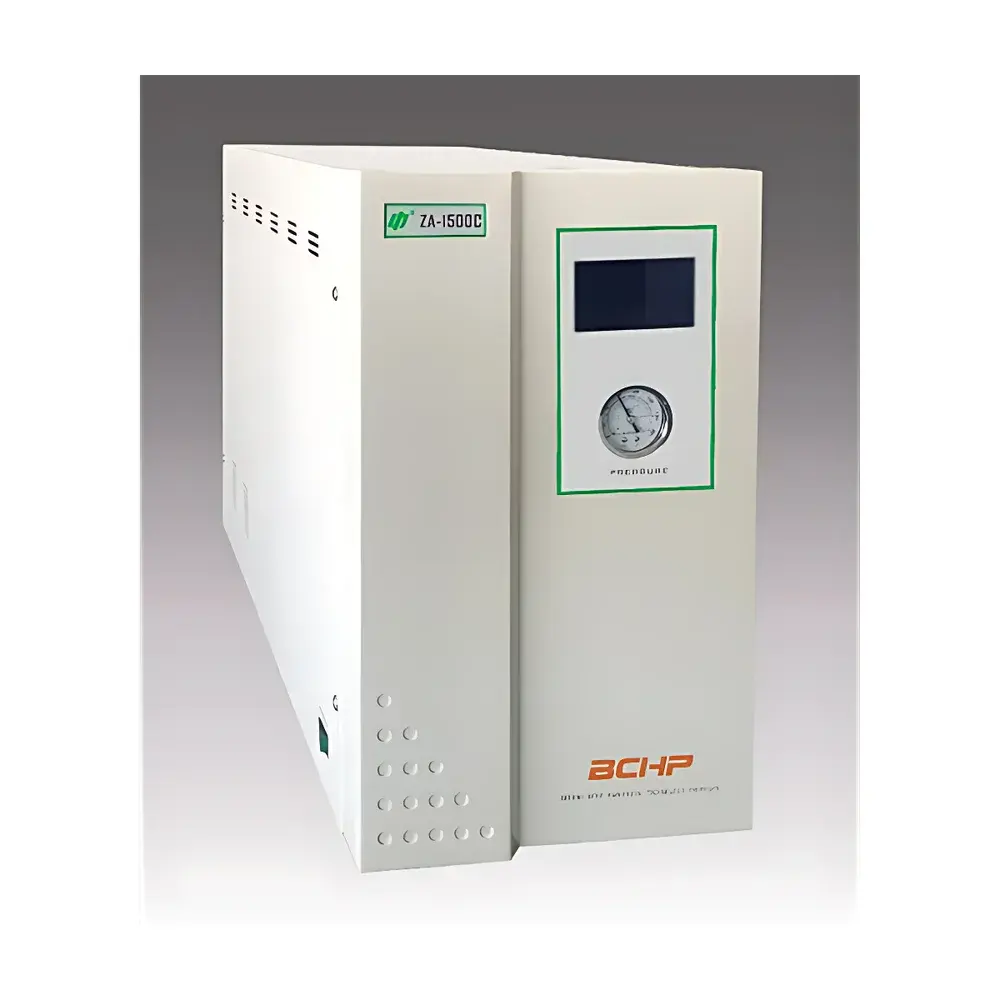
Zhonghuipu ZA-1500C Zero Air Generator
| Brand | Zhonghuipu |
|---|---|
| Origin | Beijing, China |
| Manufacturer Type | Direct Manufacturer |
| Model | ZA-1500C |
| Hydrocarbon Removal Principle | High-temperature catalytic oxidation using multi-metallic noble metal catalysts |
| Output Flow Rate | 0–1500 mL/min |
| Output Pressure | 0–0.4 MPa |
| Hydrocarbon Content (as CH₄) | <0.1 ppm(v) |
| Dew Point | < −10 °C |
| Pressure Stability | ±0.003 MPa |
| Power Consumption | 530 W |
| Input Voltage | 220 V ±10% AC |
| Dimensions (L×W×H) | 450 × 250 × 420 mm |
| Net Weight | 27 kg |
Overview
The Zhonghuipu ZA-1500C Zero Air Generator is an engineered solution for laboratories and analytical instrumentation requiring ultra-low hydrocarbon background air. It produces high-purity zero air via high-temperature catalytic oxidation—a well-established gas purification principle in environmental monitoring, gas chromatography (GC), and trace-level calibration applications. Ambient air is drawn into the system, filtered to remove particulates and moisture, then passed over a heated noble-metal catalyst bed (e.g., Pt/Pd-based) operating at controlled temperatures above 350 °C. Under these conditions, volatile organic compounds—including methane, ethane, benzene, and other C₁–C₆ hydrocarbons—are quantitatively oxidized to CO₂ and H₂O, which are subsequently removed by integrated desiccant and CO₂ scrubbing stages. The resulting output meets stringent specifications for zero air used in EPA Method TO-14/TO-15, ASTM D6420, and ISO 8573-1 Class 1 compressed air purity requirements.
Key Features
- Stable output flow regulation from 0 to 1500 mL/min with precision mass-flow control and real-time digital display
- Consistent pressure delivery up to 0.4 MPa (60 psi), maintained within ±0.003 MPa under dynamic load conditions
- Hydrocarbon residual level ≤0.1 ppm(v) as methane-equivalent—verified by flame ionization detection (FID) or GC-FID trace analysis
- Dew point maintained below −10 °C, ensuring compatibility with moisture-sensitive detectors and cold traps
- Integrated dual-stage filtration: coarse particulate pre-filter + high-efficiency coalescing filter prior to catalytic chamber
- Thermally stabilized catalyst oven with redundant over-temperature protection and automatic cool-down sequence
- Low-noise operation (<55 dB(A)) and compact footprint (450 × 250 × 420 mm) optimized for benchtop integration in analytical labs
- Energy-efficient design consuming only 530 W at full output, compliant with IEC 61000-3-2 harmonic emission standards
Sample Compatibility & Compliance
The ZA-1500C is compatible with ambient intake air containing up to 100 ppm(v) total hydrocarbons—making it suitable for urban, industrial, or laboratory corridor environments where inlet air quality is variable. Its output is validated for use with gas chromatographs (GC), gas chromatography–mass spectrometers (GC-MS), ozone generators, photometric analyzers (e.g., UV-Vis NOx monitors), and calibration gas dilution systems. The unit conforms to key regulatory and methodological frameworks including U.S. EPA Compendium Method TO-14A (for VOC analysis), ASTM D6420-22 (Standard Test Method for Determination of Gaseous Compounds by GC), and ISO 8573-1:2010 Class 1 for solid particle, water, and oil content. While not inherently 21 CFR Part 11 compliant, its analog control architecture supports external audit logging when integrated into validated laboratory networks.
Software & Data Management
The ZA-1500C operates via embedded microcontroller-based logic without proprietary software dependency. All operational parameters—including flow rate, outlet pressure, catalyst temperature, and runtime hours—are displayed on a backlit LCD interface with non-volatile memory retention. Optional RS-232 or 4–20 mA analog output modules (available upon request) enable connection to SCADA systems, LIMS, or building management platforms for remote status monitoring and preventive maintenance scheduling. Event logs—including thermal fault alerts, filter saturation warnings, and power interruption timestamps—are stored locally for GLP-aligned troubleshooting and equipment qualification (IQ/OQ documentation).
Applications
- Carrier and makeup gas supply for GC-FID, GC-ECD, and GC-PDHID systems requiring hydrocarbon-free baseline stability
- Zero air source for ambient air monitoring stations (e.g., regulatory PM₂.₅, O₃, SO₂ analyzers per EN 14625)
- Calibration gas generation via dynamic dilution systems (e.g., certified gas standards preparation per ISO 6142)
- Instrument purge and detector cooling in FTIR, laser absorption spectroscopy, and cavity ring-down (CRDS) platforms
- Reference air stream in indoor air quality (IAQ) testing chambers and HVAC validation protocols
- Support gas for flame photometric detectors (FPD) and chemiluminescence NOx analyzers demanding sub-ppb hydrocarbon interference limits
FAQ
What is the maximum allowable inlet hydrocarbon concentration?
The ZA-1500C accepts inlet air with total hydrocarbons up to 100 ppm(v) as methane; higher concentrations may reduce catalyst service life and require more frequent regeneration cycles.
How often does the catalyst require replacement?
Under typical lab conditions (≤50 ppm(v) inlet HC, 8 h/day operation), the noble-metal catalyst maintains performance for ≥12 months; replacement intervals are tracked via built-in runtime counter and thermal history profiling.
Is the unit suitable for cleanroom environments?
Yes—the unit emits no oil vapor or metallic particulates, and its exhaust contains only CO₂ and water vapor at trace levels; it complies with ISO 14644-1 Class 8 (100,000) particle limits when installed with proper ventilation.
Can output pressure be regulated externally?
Yes—output pressure is adjustable via front-panel knob or optional 0–5 VDC analog input; downstream pressure regulators may be added for fine-tuned instrument-specific setpoints.
Does the generator include certification documentation?
Each unit ships with factory test report (including hydrocarbon verification data, pressure stability curve, and dew point measurement), CE marking, and RoHS compliance statement.



