
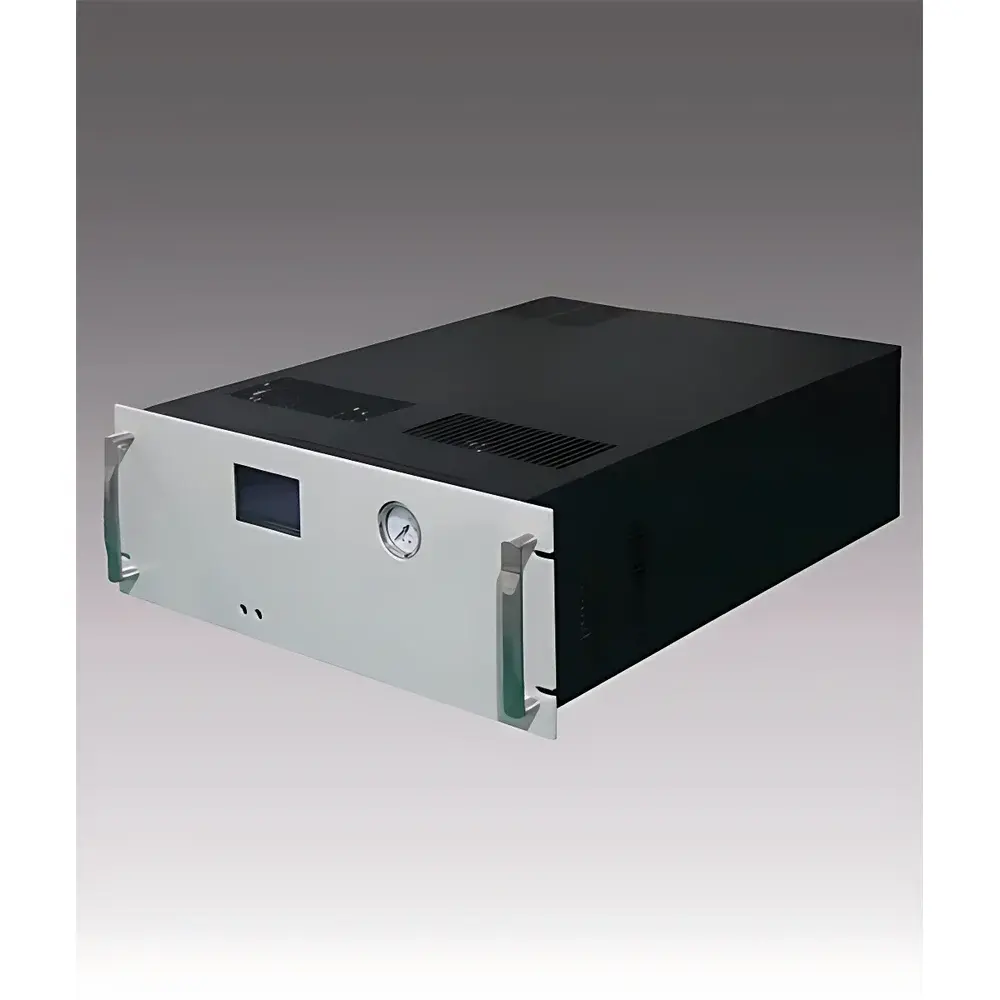
Zhonghuipu ZA-5000 Rack-Mounted Zero Air Generator
| Brand | Zhonghuipu |
|---|---|
| Origin | Beijing, China |
| Manufacturer Type | Direct Manufacturer |
| Model | ZA-5000 |
| Hydrocarbon Removal Principle | High-Temperature Catalytic Oxidation using Multi-Metallic Noble Metal Catalysts |
| Output Flow Rate | 0–5000 mL/min |
| Output Pressure | 0.1–0.6 MPa (Air-Pressure-Dependent |
| Total Hydrocarbon Content | <10 ppb (as methane equivalent) |
| Dew Point | <−20 °C |
| Particulate Filtration | <0.01 µm |
| Operating Ambient Temperature | 1–40 °C |
| Relative Humidity | <80% RH |
| Power Supply | 220 V ±10%, 50–60 Hz |
| Peak Power Consumption | 500 W |
| Dimensions (W×D×H) | 450 × 430 × 177 mm |
| Net Weight | ~18 kg |
Overview
The Zhonghuipu ZA-5000 is a rack-mountable zero air generator engineered for precision analytical laboratories requiring ultra-pure, hydrocarbon-free air as a carrier, purge, or calibration gas. It operates on the principle of high-temperature catalytic oxidation—where ambient compressed air passes through a heated noble-metal catalyst bed (Pt/Pd/Rh-based), converting trace volatile organic compounds (VOCs) and hydrocarbons quantitatively into CO₂ and H₂O. This process ensures consistent, stable zero air generation without consumable adsorbents or periodic media replacement. Unlike compressor-integrated systems, the ZA-5000 is designed for integration with external clean, oil-free compressed air sources (e.g., laboratory central air networks or dedicated membrane/dry scroll compressors), enabling pressure regulation within 0.1–0.6 MPa while maintaining strict compliance with ASTM D1941, ISO 8573-1 Class 1 particulate and Class 2 moisture specifications.
Key Features
- High-efficiency catalytic oxidation core utilizing multi-metallic noble catalysts operating at controlled elevated temperatures (>350 °C), achieving >99.999% hydrocarbon removal down to <10 ppb (as methane)
- Integrated dual-stage purification: a selective hydrophobic membrane dryer reduces dew point to <−20 °C, followed by sub-0.01 µm absolute particulate filtration meeting ISO 8573-1:2010 Class 1 requirements
- Rack-mount form factor (19″ EIA standard, 3U height) optimized for centralized gas supply infrastructure in analytical labs and environmental monitoring stations
- Embedded microcontroller with real-time status monitoring, fault diagnostics, and thermal safety interlocks—including overtemperature cutoff and flow-pressure anomaly detection
- RS232 serial interface for remote status interrogation and integration with lab-wide gas management or LIMS platforms
- Stainless-steel internal buffer tank (0.5 L) provides pulse-dampened, pressure-stabilized output suitable for driving GC pneumatic valve manifolds and FID make-up gas circuits
- Catalyst lifetime rated ≥3 years under continuous operation at nominal flow (3000 mL/min), with no scheduled regeneration or catalyst replacement required
Sample Compatibility & Compliance
The ZA-5000 delivers zero air compatible with trace-level analytical instrumentation including gas chromatographs (GC), gas chromatography–mass spectrometers (GC-MS), Fourier-transform infrared (FTIR) spectrometers, chemiluminescence NOx analyzers, and ozone photometers. Its output meets critical regulatory benchmarks: hydrocarbon content <10 ppb satisfies U.S. EPA Method TO-14/TO-15 and EU EN 13649-1 requirements for ambient air VOC analysis; dew point <−20 °C prevents condensation in chilled-mirror hygrometers and cold traps; and particulate cleanliness aligns with ISO 8573-1:2010 Class 1 (≤0.1 µm particles). The system supports optional add-on modules for CO₂ scrubbing (soda lime + molecular sieve), NOx reduction (catalytic converter), and inorganic sulfur removal (zinc oxide bed), enabling customization for specialized applications such as ASTM D6348 or ISO 12965 compliance testing.
Software & Data Management
The ZA-5000 features an embedded control firmware with non-volatile event logging, recording operational hours, catalyst temperature profiles, inlet/outlet pressure differentials, and fault timestamps. Through the RS232 interface, users can retrieve logs via ASCII protocol commands or integrate with third-party SCADA or laboratory information management systems (LIMS) for audit-ready traceability. While the device does not include proprietary PC software, its command set is documented per ANSI/TIA-232-F standards and supports automated health-check routines within GLP/GMP environments. All logged data elements satisfy FDA 21 CFR Part 11 requirements when deployed with validated timestamping and user-access controls at the host system level.
Applications
- Carrier and makeup gas supply for flame ionization detectors (FID) and electron capture detectors (ECD) in environmental and petrochemical GC analysis
- Purge gas for dynamic headspace and purge-and-trap sample introduction systems
- Zero calibration gas for continuous emission monitoring systems (CEMS) and ambient air quality analyzers (e.g., O₃, NO₂, SO₂)
- Instrument air for FTIR spectrometer interferometer purging and optical path drying
- Reference gas in method validation studies per ISO/IEC 17025 and EPA 40 CFR Part 60 Appendix B
- Support gas for semiconductor metrology tools requiring low-hydrocarbon inert atmospheres
FAQ
Does the ZA-5000 include an integrated air compressor?
No. The ZA-5000 requires an external source of clean, oil-free compressed air supplied at 0.1–0.6 MPa. It is not equipped with a built-in compressor.
What maintenance is required during normal operation?
Routine maintenance is limited to periodic inspection of inlet filters and verification of catalyst temperature stability. No adsorbent replacement or catalyst servicing is needed within the first three years under specified operating conditions.
Can the ZA-5000 be used with GC-MS systems requiring ultra-low hydrocarbon background?
Yes. With total hydrocarbon content <10 ppb and particulate filtration <0.01 µm, it meets the stringent air purity requirements for high-sensitivity GC-MS applications, particularly in environmental forensics and residual solvent analysis.
Is the RS232 interface compatible with modern Windows/Linux-based lab automation platforms?
Yes. The interface uses standard TTL-level RS232 signaling with configurable baud rates (9600–115200 bps) and ASCII command syntax, supporting integration via Python, LabVIEW, or custom C# applications.
How is catalyst performance validated over time?
Catalyst efficacy is verified through periodic hydrocarbon challenge testing using certified permeation tubes or dynamic dilution systems per ISO 10156, with performance logs retained for QA/QC audits.



