
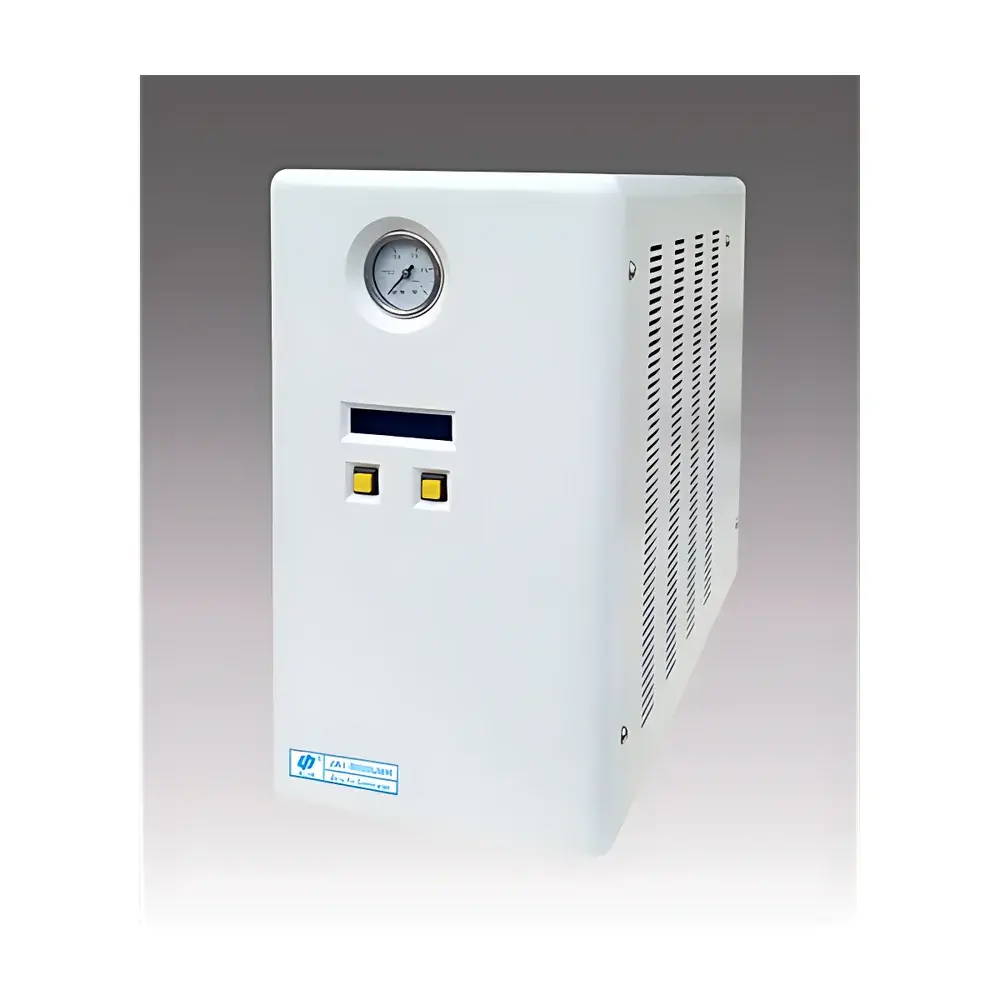
Zhonghuipu ZAT-5000UBR Zero-Air Generator with Hydrocarbon Removal
| Brand | Zhonghuipu |
|---|---|
| Origin | Beijing, China |
| Manufacturer Type | Direct Manufacturer |
| Country of Origin | China |
| Model | ZAT-5000UBR |
| Output Flow Rate | 0–5000 mL/min |
| Output Pressure | 0–0.6 MPa (requires external compressed air supply) |
| Total Hydrocarbon Content (as methane) | <0.1 ppm(v) |
| Hydrocarbon Removal Principle | High-temperature catalytic oxidation using Pt/Pd-based catalysts |
| Catalyst Operating Temperature | 400–450 °C |
| Input Air Hydrocarbon Tolerance | ≤100 ppm(v) (as methane) |
| Power Supply | 220 V ±10%, 50–60 Hz |
| Power Consumption | 500 W |
| Dimensions (W×D×H) | 400 × 360 × 220 mm |
| Net Weight | ~12 kg |
| Ambient Operating Temperature | 0–40 °C |
| Ambient Relative Humidity | <85% RH |
| Sealing Material | Low-sulfur silicone rubber gaskets |
Overview
The Zhonghuipu ZAT-5000UBR Zero-Air Generator is a precision-engineered gas purification system designed to produce ultra-low-hydrocarbon air for analytical instrumentation requiring stringent background gas purity—particularly gas chromatography (GC), GC–mass spectrometry (GC–MS), flame ionization detection (FID), and other hydrocarbon-sensitive detectors. It operates on the principle of high-temperature catalytic oxidation: incoming compressed air—pre-dried to remove bulk moisture—is passed through a thermally stabilized reaction chamber containing a proprietary platinum-palladium (Pt/Pd) catalyst bed. At sustained operating temperatures of 400–450 °C, trace volatile organic compounds (VOCs), alkanes, alkenes, and aromatic hydrocarbons are quantitatively oxidized to carbon dioxide and water vapor. A downstream desiccant or membrane-based moisture removal stage ensures final output air meets zero-air specifications defined by ASTM D6167 and ISO 8573-1 Class 1 (hydrocarbon fraction). The unit does not incorporate an integrated air compressor; it requires a clean, oil-free, externally supplied compressed air source at up to 0.6 MPa.
Key Features
- Consistent hydrocarbon removal performance: delivers air with total hydrocarbon content <0.1 ppm(v) as methane-equivalent, verified per EPA Method TO-15 and ASTM D6167 protocols
- Dual-stage thermal management: independent heater control and real-time catalyst temperature monitoring ensure stable oxidative efficiency across variable inlet hydrocarbon loads (up to 100 ppm(v))
- Low-sulfur silicone elastomer seals throughout the gas path minimize sulfur-containing outgassing, critical for maintaining baseline stability in sulfur-sensitive FID and pulsed discharge helium ionization detection (PDHID)
- Compact benchtop footprint (400 × 360 × 220 mm) with robust aluminum alloy housing and EMI-shielded electronics for laboratory integration
- Front-panel digital display showing real-time catalyst temperature, status indicators for flow/pressure compliance, and fault diagnostics including thermal runaway protection and low-flow alarm
- Energy-efficient design: nominal 500 W power draw during steady-state operation, with automatic thermal standby mode when airflow falls below 500 mL/min
Sample Compatibility & Compliance
The ZAT-5000UBR is compatible with all standard laboratory-grade compressed air sources meeting ISO 8573-1 Class 3 particulate/oil/water specifications. Its inlet accepts pressure-regulated air between 0.1–0.6 MPa, enabling seamless integration with centralized lab air systems or standalone oil-free compressors. Final output air complies with key regulatory and methodological requirements: US EPA Compendium Method TO-14A/TO-15 for ambient air VOC analysis; ASTM D6167 for zero-air certification in calibration gas preparation; and ISO 8573-1:2010 Class 1 for hydrocarbon content (≤0.1 mg/m³, equivalent to <0.1 ppm(v) for C1–C4 aliphatics). All wetted materials—including catalyst substrate, stainless-steel tubing, and low-sulfur gaskets—are documented per FDA-recommended extractables assessment guidelines for GxP environments.
Software & Data Management
The ZAT-5000UBR operates as a standalone hardware module without embedded software or network connectivity. However, its analog status outputs (0–5 V DC for catalyst temperature, 4–20 mA for outlet flow) support integration into centralized laboratory monitoring systems (e.g., LabVantage, Thermo Fisher SampleManager) via PLC or DAQ interfaces. All operational parameters—including cumulative run time, thermal cycle count, and over-temperature event logs—are stored in non-volatile memory and accessible via front-panel service menu. For GLP/GMP-regulated laboratories, the device supports 21 CFR Part 11-compliant audit trails when paired with validated third-party data acquisition software that captures timestamped sensor readings and operator actions.
Applications
- Carrier and detector gases for GC–FID, GC–TCD, and GC–PDHID systems requiring ultra-low hydrocarbon baselines
- Zero-air dilution standards generation for environmental air quality monitoring (e.g., ozone photometry calibration, NOx analyzer span verification)
- Calibration gas blending systems where hydrocarbon contamination would compromise certified reference material (CRM) integrity
- Indoor air quality (IAQ) testing labs performing TO-15 and TO-17 sampling canister cleaning and purging
- Research applications involving catalytic surface science, where residual organics interfere with XPS or TPD measurements
FAQ
Does the ZAT-5000UBR include an integrated air compressor?
No. It requires an external, oil-free compressed air supply regulated to 0.1–0.6 MPa.
What is the maximum allowable inlet hydrocarbon concentration?
The unit is rated for continuous operation with inlet air containing ≤100 ppm(v) total hydrocarbons (as methane); exceeding this may reduce catalyst lifetime.
How often must the catalyst be replaced?
Under typical lab conditions (inlet air ≤10 ppm(v) HC, 8 h/day operation), the Pt/Pd catalyst maintains specification performance for ≥24 months; replacement is determined by periodic hydrocarbon verification testing.
Is the output air suitable for use with electron-capture detectors (ECD)?
Yes—provided the inlet air is free of halogenated compounds, as the catalytic oxidation process does not remove halocarbons; supplemental halocarbon scrubbing is recommended for ECD applications.
Can the unit be installed in an enclosed cabinet or fume hood?
It must be operated in a well-ventilated area with ≥100 mm clearance around all sides; the 450 °C catalyst housing requires unrestricted convective cooling and cannot be enclosed.



