
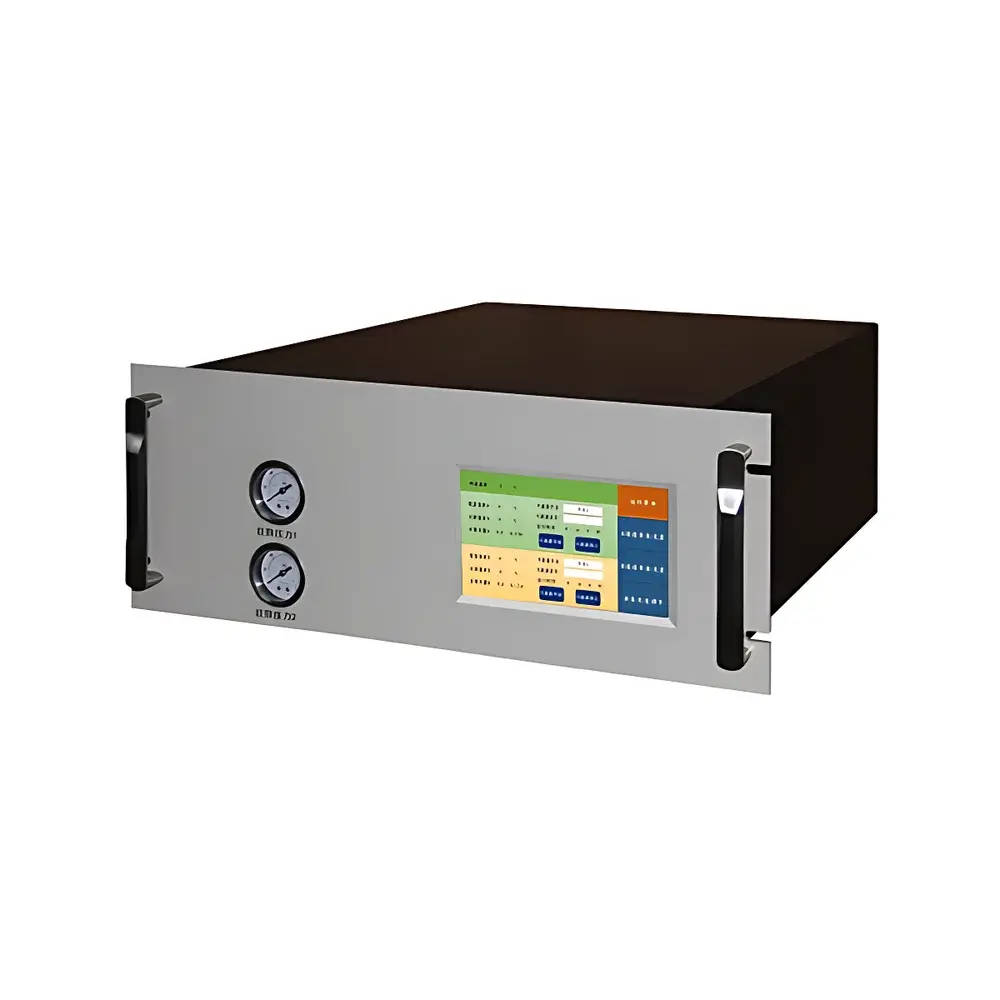
Zhonghuipu ZDD-1 Dual-Channel Online Atmospheric Thermal Desorption Concentrator
| Brand | Zhonghuipu |
|---|---|
| Origin | Beijing, China |
| Manufacturer Type | Manufacturer |
| Product Category | Domestic |
| Model | ZDD-1 |
| Automation Level | Fully Automatic |
| Valve Inlet Temperature Range | 50–240 °C (customizable up to 330 °C), Temperature Control Accuracy: ±1 °C |
| Transfer Line Temperature Range | 40–230 °C, Temperature Control Accuracy: ±1 °C |
| Trap Temperature Range | −35 to 400 °C |
| Flash Heating Rate | >50 °C/s |
| Enrichment Time | 0–60 min |
| Injection Time | 0–10 min |
| Interval Time | 0–60 min |
| Sampling Time | 0–60 min |
| Sampling Flow Rate | 16–160 mL/min |
| RSD | ≤2.5% |
| Power Consumption | 450 W |
| Dimensions | 550 × 484 × 222 mm (5U rack-mount chassis) |
| Cooling Method | Semiconductor-based Peltier cooling |
| Adsorbent Configuration | Dual-trap design with three selective sorbents per trap (A/B) |
| Flow Control | Dual-channel Mass Flow Controller (MFC) |
| Interface | Universal TTL/RS-232 trigger output for GC synchronization |
Overview
The Zhonghuipu ZDD-1 Dual-Channel Online Atmospheric Thermal Desorption Concentrator is an engineered solution for unattended, high-fidelity preconcentration of volatile organic compounds (VOCs) from ambient air or stack emissions prior to gas chromatographic analysis. It operates on the principle of cryogenic trapping followed by rapid thermal desorption—enabling trace-level quantification of VOCs at sub-part-per-trillion (pptv) concentrations. Designed specifically for continuous monitoring applications—including ozone precursor (e.g., PAMS-57) surveillance, fence-line emission profiling, and regulatory compliance sampling—the ZDD-1 integrates dual independent sampling channels to support staggered or parallel enrichment cycles, minimizing downtime and maximizing data continuity. Its architecture eliminates cold spots via fully heated valve manifolds and transfer lines, ensuring quantitative recovery of thermally labile and highly volatile analytes such as formaldehyde, acetaldehyde, vinyl chloride, and methyl mercaptan.
Key Features
- Fully automated dual-channel operation with independent programmable timing for enrichment, desorption, and purge phases—supporting uninterrupted 24/7 monitoring schedules.
- High-inertness sample pathway: All internal tubing and fittings utilize de-activated fused silica or SilcoNert®-treated stainless steel to prevent adsorption, carryover, or catalytic degradation of reactive species (e.g., aldehydes, sulfur compounds).
- Dual cryogenic traps with selectable sorbent configurations: Each trap (A and B) accommodates three-layer packed beds (e.g., Tenax TA, Carbopack B, Carbopack C) optimized for broad-spectrum VOC retention—from C2 hydrocarbons to semi-volatiles up to n-C16.
- Precise thermal management: Valve oven (50–240 °C, ±1 °C; optional 330 °C) and transfer line (40–230 °C, ±1 °C) maintain isothermal integrity across the entire flow path; trap temperature range spans −35 to 400 °C for flexible conditioning and desorption protocols.
- Rapid flash desorption: >50 °C/s heating ramp ensures narrow injection bands and minimal band broadening—critical for resolving co-eluting isomers in complex environmental matrices.
- Integrated mass flow control: Dual MFCs deliver stable, repeatable sampling at 16–160 mL/min, with real-time flow verification and automatic pressure compensation for variable ambient conditions.
- Robust 5U rack-mount chassis (550 × 484 × 222 mm) designed for laboratory or field-deployable enclosures; semiconductor-based cooling enables silent, maintenance-free trap chilling without liquid nitrogen or mechanical compressors.
Sample Compatibility & Compliance
The ZDD-1 supports standardized methodologies including U.S. EPA TO-17, ASTM D6196, ISO 16017-1, and EN 14662 for ambient air VOC monitoring. Its dual-trap architecture and configurable sorbent packs allow method-specific optimization—for instance, low-bleed Tenax for aromatic hydrocarbons (e.g., benzene, xylenes), graphitized carbon black for chlorinated compounds (e.g., vinyl chloride, 1,2-dichloroethane), and enhanced polar phases for oxygenates (e.g., acetone, methanol, epichlorohydrin). The system meets GLP and GMP documentation requirements when paired with compliant chromatography data systems (CDS); its TTL/RS-232 trigger interface supports full audit trail generation per FDA 21 CFR Part 11 when integrated with validated GC workstations.
Software & Data Management
Control is executed via a dedicated embedded firmware platform accessible through a 7-inch resistive touchscreen interface (English language firmware available upon request). All method parameters—including trap conditioning, sampling duration, desorption ramp profiles, and valve sequencing—are stored in non-volatile memory with timestamped versioning. Raw timing logs, temperature setpoint deviations, and MFC flow readings are exportable as CSV for QA/QC review. The universal GC trigger output synchronizes desorption events with instrument start commands, enabling seamless integration with Agilent, Thermo Fisher, Shimadzu, and PerkinElmer GC platforms. Remote monitoring and method updates may be implemented via Ethernet or USB host port under secure network policies.
Applications
- Continuous ambient air monitoring of ozone precursors (PAMS-57 speciation) at urban background, roadside, and industrial perimeter sites.
- Regulatory compliance reporting for EPA Method TO-17 and EU Air Quality Directive (2008/50/EC) VOC measurement campaigns.
- Source identification and apportionment studies using compound-specific isotopic or temporal pattern analysis.
- Indoor air quality (IAQ) assessment in commercial buildings, cleanrooms, and pharmaceutical manufacturing facilities.
- Method development and validation for emerging contaminants including halogenated ethers, unsaturated aldehydes, and heterocyclic VOCs.
FAQ
Does the ZDD-1 support unattended multi-day operation?
Yes—its dual-channel architecture allows alternating trap use with programmable cycle times up to 60 minutes per phase, enabling uninterrupted operation over extended periods when paired with appropriate GC run times and autosampler capacity.
Can the system be calibrated for quantitative analysis?
Absolutely—the ZDD-1 is compatible with certified standard gas cylinders and dynamic dilution calibrators; RSD ≤2.5% across repeated injections confirms suitability for quantitative regulatory workflows.
Is nitrogen purging integrated into the trap desorption sequence?
Yes—each desorption cycle includes a post-desorption bake-out with high-purity carrier gas purge to remove residual matrix components and ensure baseline stability between runs.
What maintenance intervals are recommended for routine operation?
Sorbent traps should be conditioned before first use and reconditioned every 100–200 injections depending on sample matrix complexity; MFCs require annual calibration verification, and semiconductor coolers are rated for >50,000 hours MTBF.
How is system performance verified during routine use?
Built-in diagnostic routines monitor heater resistance, thermocouple feedback loops, and MFC response latency; users may execute daily leak checks and blank runs to confirm trap cleanliness and method reproducibility.
Related Products



