
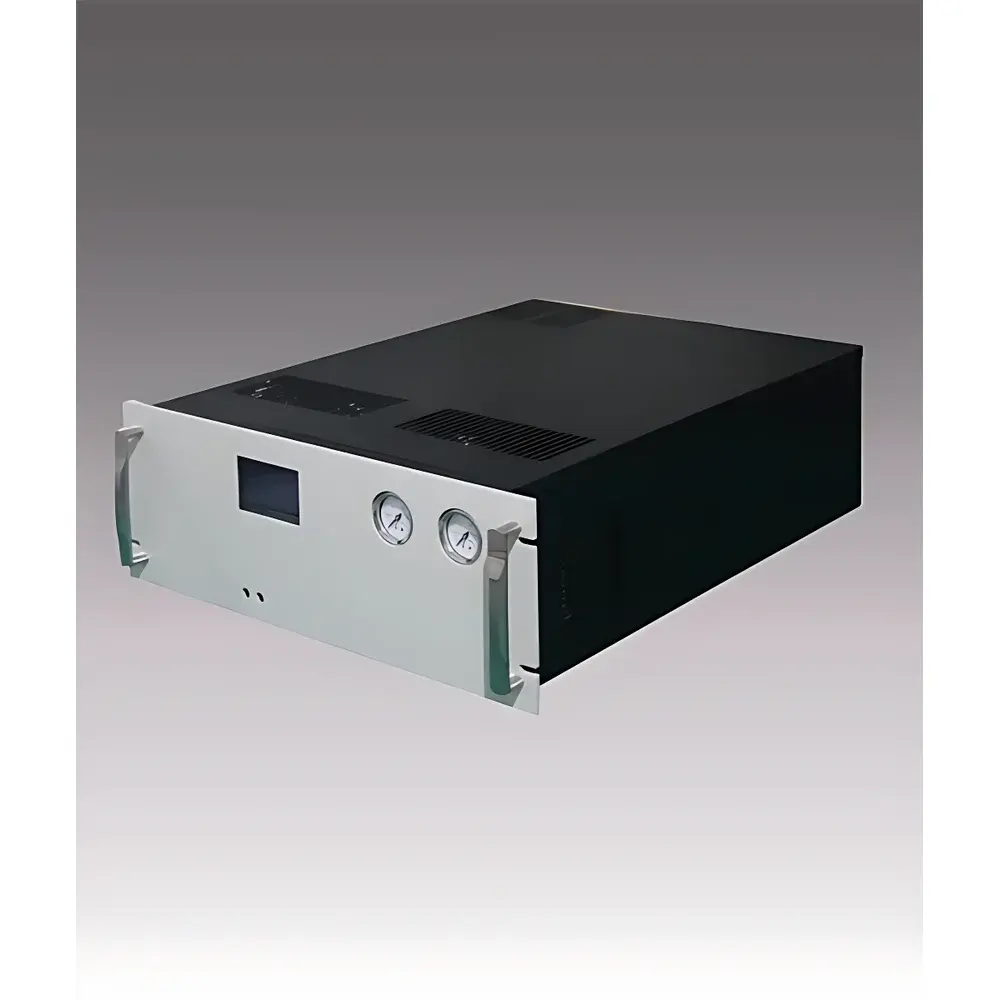
Zhonghuipu ZH-500 Rack-Mounted Pure-Water Electrolysis Hydrogen Generator
| Brand | Zhonghuipu |
|---|---|
| Origin | Beijing, China |
| Manufacturer Type | Direct Manufacturer |
| Country of Origin | China |
| Model | ZH-500 |
| Hydrogen Generation Principle | Pure-water electrolysis |
| Output Flow Rate | 0–500 mL/min |
| Output Pressure | 0–0.4 MPa |
| Hydrogen Purity | 99.9995% |
| Power Consumption | 250 W |
| Dimensions (L×W×H) | 450 × 430 × 177 mm |
| Net Weight | ~15 kg |
| Pressure Stability | < 0.001 MPa |
| Input Power | 220 V ±10%, 50 Hz |
| Interface | RS232 |
Overview
The Zhonghuipu ZH-500 is a rack-mounted hydrogen generator engineered for continuous, on-demand supply of ultra-high-purity hydrogen gas in analytical laboratory environments. It employs membrane-separated pure-water electrolysis — a zero-chemical, corrosion-free generation method that eliminates the need for caustic electrolytes or metal hydride cartridges. This principle ensures stable H₂ output with no organic or metallic contaminants, making it suitable for sensitive applications such as gas chromatography (GC) carrier gas, hydrogenation reactors, and fuel cell testing. The system integrates a Nafion®-based proton exchange membrane (PEM) stack with dual-stage moisture removal (Nafion + activated silica gel) and an integrated oxygen scavenger at the outlet — all contributing to consistent 99.9995% purity without periodic reactivation or consumable replacement. Designed for 19-inch standard rack integration (optional mounting kit available), the ZH-500 occupies minimal bench space while delivering high-reliability gas supply under GLP-compliant operational conditions.
Key Features
- Rack-mountable chassis (450 × 430 × 177 mm) optimized for centralized lab gas infrastructure and modular instrument racks.
- Microprocessor-controlled operation with real-time LCD display (Chinese interface only), enabling fully automated startup, pressure regulation, flow modulation, and self-diagnostic routines.
- Intelligent water management system: automatic make-up water replenishment from external deionized water source; integrated level sensing prevents dry-electrolysis operation.
- Dual-stage dehydration architecture: first-stage Nafion® membrane dehydration followed by regenerable silica gel adsorption, ensuring dew point ≤ –70 °C at outlet.
- Passive oxygen removal via non-regenerable, pre-packed palladium-based catalyst at final output stage — no user intervention required for oxygen suppression.
- Comprehensive safety interlocks: over-pressure cutoff (0.42 MPa threshold), flow anomaly detection, temperature monitoring, and electrolyte-level fail-safes.
- RS232 serial interface supports remote status polling, alarm logging, and integration with LIMS or GC control software for audit-ready data capture.
Sample Compatibility & Compliance
The ZH-500 is compatible with all standard 1/8″ and 1/4″ stainless steel or PTFE gas lines and regulators rated for ≤ 0.4 MPa working pressure. It meets CE marking requirements for electrical safety (EN 61000-6-3, EN 61000-6-4) and complies with ISO 8573-1:2010 Class 1 compressed air quality standards adapted for hydrogen (particulates ≤ 0.1 µm, oil content < 0.01 mg/m³, water content < 0.1 ppmv). While not certified to FDA 21 CFR Part 11, its RS232 logging capability enables traceable operation when paired with validated third-party data acquisition systems compliant with GMP/GLP audit trails. No hazardous chemicals, flammable storage, or high-pressure cylinders are required — aligning with OSHA 1910.103 and local laboratory hydrogen safety guidelines for low-pressure (<1 bar gauge) on-site generation.
Software & Data Management
The ZH-500 operates autonomously via embedded firmware without external PC dependency. Its RS232 port transmits ASCII-formatted telemetry including real-time flow (mL/min), outlet pressure (MPa), internal temperature (°C), electrolyzer voltage (V), and fault codes (e.g., “E03: Low Water”, “E07: Overpressure”). Data can be logged using terminal emulation software (e.g., Tera Term, PuTTY) or integrated into LabVIEW, MATLAB, or custom Python scripts via pySerial. All communication adheres to Modbus RTU protocol (custom register map provided in technical manual). Event timestamps are hardware-generated and synchronized to internal RTC, supporting time-correlated diagnostics during method validation or troubleshooting. No proprietary drivers or cloud connectivity are implemented — preserving network isolation for regulated QC laboratories.
Applications
- Carrier gas for capillary GC and GC-MS systems requiring ultra-high-purity H₂ with negligible hydrocarbon or oxygen interference.
- Hydrogen supply for catalytic hydrogenation reactors operating below 0.4 MPa, especially where cylinder logistics pose contamination or scheduling risks.
- Calibration gas generation for electrochemical hydrogen sensors and leak detectors.
- Fuel cell research platforms requiring stable, low-particulate H₂ feed at variable flow rates (50–500 mL/min).
- On-site hydrogen source for FTIR gas cells, plasma cleaning tools, and semiconductor purge applications demanding consistent dew point control.
FAQ
What type of water must be used for electrolysis?
Deionized water with resistivity ≥ 5 MΩ·cm (ASTM D1193 Type II or better) is mandatory. Tap water, distilled water, or water containing ions will rapidly degrade membrane performance and reduce gas purity.
Is routine maintenance required beyond water refilling?
No scheduled maintenance is needed. The Nafion® membrane and silica gel desiccant are designed for >12 months of continuous operation under recommended water quality and ambient conditions (15–30 °C, <70% RH).
Can the ZH-500 be operated in an enclosed cabinet or fume hood?
Yes — but ventilation must comply with NFPA 55 and local hydrogen dispersion requirements. A minimum air exchange rate of 6 ACH is recommended to prevent accumulation above 1% LEL (4% v/v H₂ in air).
Does the RS232 interface support bidirectional control?
The interface is read-only: it reports status and alarms but does not accept setpoint commands. Flow and pressure are controlled exclusively via front-panel buttons or internal PID logic.
How is hydrogen purity verified during operation?
Purity is validated per batch during factory acceptance testing using calibrated gas chromatography (ISO 8573-5). In-field verification requires periodic sampling with a dedicated H₂ purity analyzer (e.g., Trace Analytical TA-100); no built-in sensor is included.



