
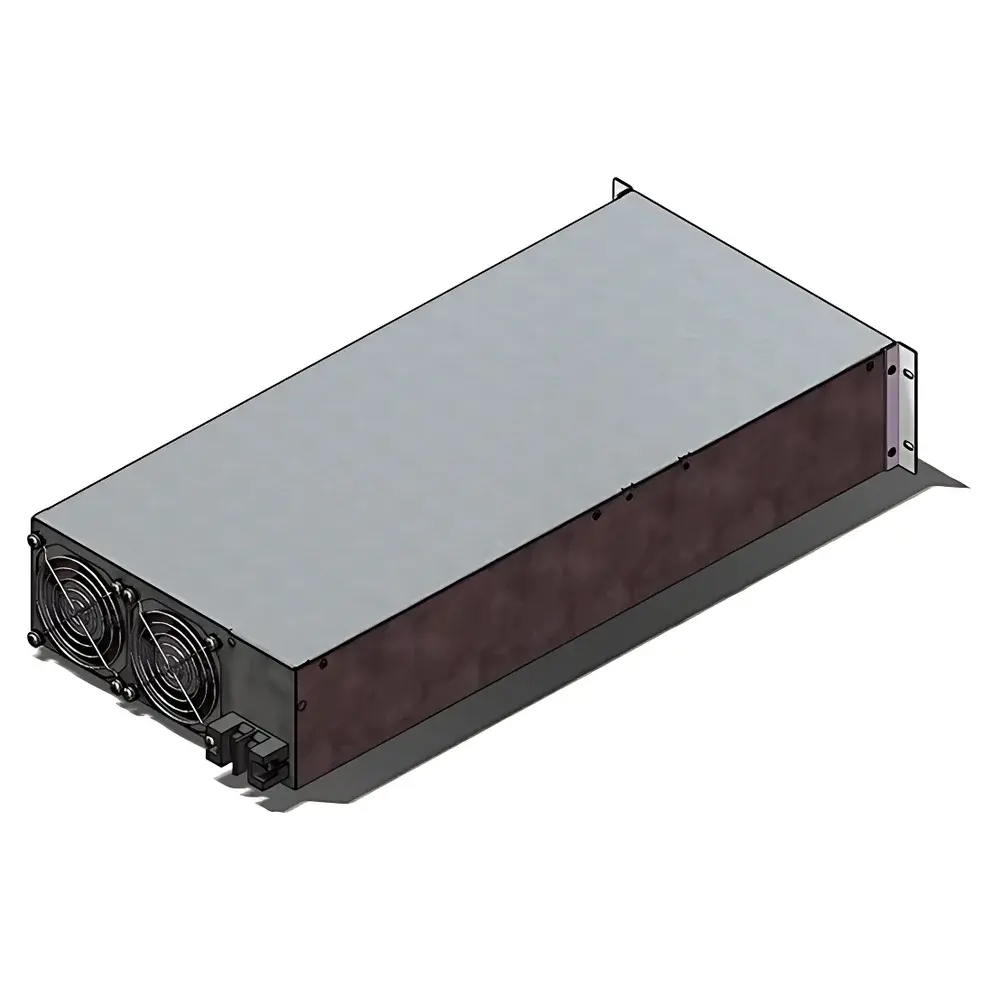
Zhongjiaojinyuan DC-DC Bi-Directional Power Converter Module
| Brand | Zhongjiaojinyuan |
|---|---|
| Origin | Beijing, China |
| Manufacturer Type | Original Equipment Manufacturer (OEM/ODM) |
| Product Origin | Domestic (China) |
| Model | UN_DD800_10K / UN_DD800_30K |
| Price Range | USD 7,000 – 14,000 (FOB China) |
| Application-Specific Compatibility | Electrophoresis Systems (Custom Integration) |
| Topology | Non-Isolated Buck/Boost |
| Rated Power | 10 kW / 30 kW |
| Input Voltage Range (HV Side) | 750–900 VDC |
| Output Voltage Range (LV Side) | 20–800 VDC |
| Voltage Regulation Accuracy | ±0.1% |
| Current Regulation Accuracy | ±0.1% |
| Ripple Voltage | ≤500 mV (peak-to-peak) |
| Peak Efficiency | 96% |
| Cooling Method | Intelligent Variable-Speed Forced Air Cooling |
| Operating Temperature | −10°C to +50°C |
| Dimensions (W×H×D) | 250×70×400 mm / 374×227.5×598 mm |
| Weight | 6 kg / 18 kg |
Overview
The Zhongjiaojinyuan DC-DC Bi-Directional Power Converter Module is an engineered solution for precision-controlled bidirectional energy transfer in high-voltage, medium-power DC systems. Designed around a non-isolated Buck/Boost topology, the module enables seamless, real-time reversal of power flow between two DC voltage domains—supporting both step-up (BOOST) and step-down (BUCK) conversion without hardware reconfiguration. Its core application lies in laboratory-scale and industrial-grade energy storage testing, where strict regulation of voltage, current, and power during charge/discharge cycles is essential for battery characterization, fuel cell emulation, and supercapacitor cycling. Unlike unidirectional supplies, this converter maintains sub-0.1% regulation accuracy under dynamic load transients, ensuring metrological consistency across repeated test protocols. The architecture supports integration into modular rack systems—its mechanical footprint aligns with standard EV charging infrastructure dimensions (508×230×88 mm envelope), enabling scalable deployment in automated test benches and microgrid simulation platforms.
Key Features
- Bi-directional power flow control with automatic mode transition between charging and discharging states
- Precision regulation modes: constant voltage (CV), constant current (CC), and constant power (CP) on both source and sink sides
- High-efficiency conversion up to 96% at rated load, minimizing thermal dissipation and system-level energy loss
- Intelligent forced-air cooling with variable-speed fans, dynamically adjusted per thermal load and ambient conditions
- Robust mechanical design compliant with IEC 60950-1 for safety in laboratory and light-industrial environments
- Modular form factor supporting parallel operation for capacity expansion (N+1 redundancy capable)
- Full digital control via isolated CAN bus or optional RS-485 interface, compatible with SCADA and LabVIEW-based automation
Sample Compatibility & Compliance
The module is specifically adapted for integration with electrophoresis instrumentation requiring stable, low-noise DC bias—particularly high-voltage gel electrophoresis systems demanding programmable ramp profiles and bidirectional polarity control. It meets electromagnetic compatibility requirements per CISPR 11 Class B and adheres to safety standards IEC 61000-4-2 (ESD), -4-4 (EFT), and -4-5 (surge). While not certified for medical or aerospace use out-of-box, its design principles align with GLP-compliant instrument qualification frameworks: traceable calibration paths, deterministic response latency (<10 ms for 10–90% load step), and hardware-enforced current limiting prevent over-stress of connected analytical devices. Environmental ratings support continuous operation within ISO 17025-accredited lab spaces (5–95% RH, non-condensing; altitude <1000 m).
Software & Data Management
Firmware supports dual-mode communication: native CANopen protocol for real-time closed-loop control in automated test systems, and ASCII-based serial command set (AT-style) for manual debugging and script-driven validation. Configuration parameters—including voltage setpoints, slew rate limits, and protection thresholds—are stored in non-volatile memory with write-cycle endurance >100,000 cycles. Event logging captures fault codes (e.g., overvoltage lockout, thermal shutdown), timestamped to microsecond resolution via internal RTC. When deployed in regulated environments, the module’s firmware architecture supports audit-trail generation per FDA 21 CFR Part 11 requirements when paired with validated host software—enabling electronic signatures, user access tiers, and immutable log export (CSV/JSON). No cloud connectivity is embedded; all data remains on-premise unless explicitly routed through external middleware.
Applications
- Battery electrochemical testing: galvanostatic/potentiostatic cycling, impedance spectroscopy pre-biasing, and aging studies under controlled thermal load
- Microgrid DC bus stabilization: interfacing photovoltaic inverters, supercapacitor banks, and grid-tied converters in hardware-in-the-loop (HIL) emulators
- Fuel cell stack characterization: simulating dynamic load profiles while maintaining precise cathode/anode voltage differentials
- Telecom and base station energy storage validation: replicating duty cycles for LiFePO₄ and NMC battery backups under variable ambient conditions
- Electrophoresis system augmentation: providing programmable high-voltage DC with polarity reversal capability for 2D gel separation and capillary electrophoresis modules
- Automotive ECU power supply emulation: replicating 12 V/48 V/800 V vehicle architectures for ADAS sensor validation and OBD-II compliance testing
FAQ
Is this module suitable for use with lithium-ion battery test systems?
Yes—it supports CC/CV charging and regenerative discharge with programmable cut-off thresholds, fully compatible with IEEE 1188 and IEC 62660-2 test methodologies.
Does it include built-in isolation between input and output circuits?
No—this is a non-isolated topology. For applications requiring galvanic isolation, an external DC-DC isolator must be cascaded.
Can multiple units operate in parallel for higher power output?
Yes—CAN bus synchronization enables master-slave configuration with load-sharing accuracy better than ±1.5% across up to 8 units.
What documentation is provided for IQ/OQ/PQ validation?
Factory calibration reports, firmware version logs, and a traceable test certificate per unit are included; full validation protocol templates are available upon request for GxP-regulated labs.
Is remote firmware update supported?
Firmware updates require physical USB-C connection and signed binary verification; no OTA capability is implemented for security and regulatory compliance reasons.



