
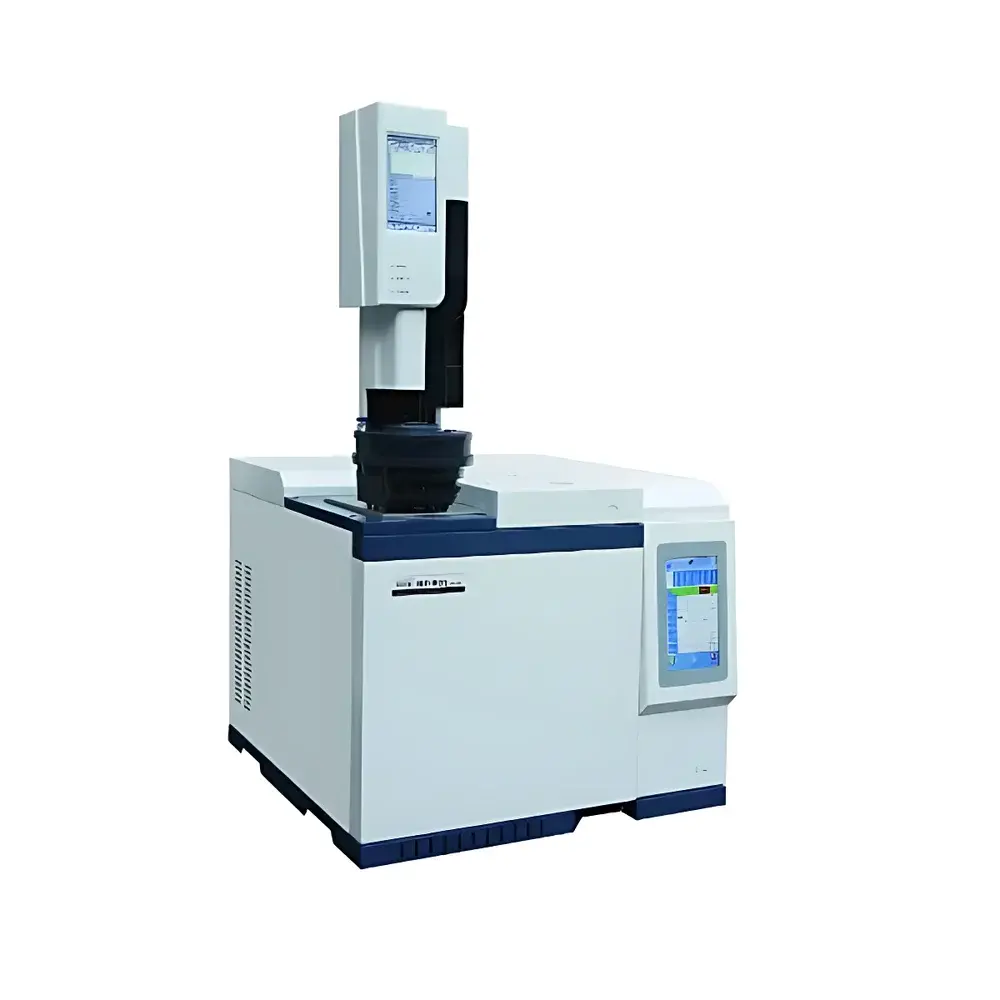
Zhongjiaojinyuan GC7920Pro Gas Chromatograph
| Brand | Zhongjiaojinyuan |
|---|---|
| Origin | Beijing, China |
| Manufacturer Type | Original Equipment Manufacturer (OEM) |
| Product Origin | Domestic (China) |
| Model | GC7920Pro |
| Pricing | Upon Request |
Overview
The Zhongjiaojinyuan GC7920Pro Gas Chromatograph is a high-integration, digitally controlled analytical instrument engineered for precision separation and quantitative analysis of volatile and semi-volatile organic and inorganic compounds. Based on the fundamental principle of gas–solid or gas–liquid partition chromatography, the GC7920Pro separates analytes by differential distribution between a mobile phase (carrier gas) and a stationary phase (capillary or packed column), with detection achieved via interchangeable, high-sensitivity detectors. Designed for continuous laboratory operation in regulated environments, it incorporates Electronic Pressure Control (EPC) and Electronic Flow Control (EFC) across up to five carrier and auxiliary gases—nitrogen, hydrogen, air, helium, and argon—ensuring long-term retention time stability and method reproducibility. Its modular architecture supports dual oven zones, dual back-pressure regulation, and independent temperature control for up to eight heated zones—including dual column ovens and dual rear doors—enabling complex multi-method workflows without hardware reconfiguration.
Key Features
- Full digital EPC/EFC system with dual operating modes: constant pressure and constant flow, delivering pressure control resolution of 0.01 kPa and flow resolution of 0.01 mL/min.
- Vacuum fluorescent display (VFD) with sunlight-readable contrast and bilingual (English/Chinese) menu navigation supported by tactile molded membrane keys for reliable, long-cycle operation.
- Integrated 10/100M adaptive Ethernet interface with embedded TCP/IP stack, enabling remote monitoring, data transfer, and instrument control over LAN or WAN infrastructure.
- Triple-threaded communication architecture allows simultaneous connection to local workstation, departmental supervisor terminal, and central regulatory server—supporting real-time status tracking and audit-ready operational logging.
- Modular detector bay accommodating up to three detectors concurrently: Flame Ionization Detector (FID), Thermal Conductivity Detector (TCD), Electron Capture Detector (ECD), Flame Photometric Detector (FPD), or Nitrogen Phosphorus Detector (NPD).
- 8-stage programmable temperature ramping (0.1–80 °C/min), with zone temperature range from 4 °C above ambient to 450 °C and thermal stability of ±0.01 °C.
- Standardized Modbus/TCP server integration within NETChrom™ workstation, facilitating seamless data export to Distributed Control Systems (DCS) and SCADA platforms per ISA-88/ISA-95 interoperability guidelines.
Sample Compatibility & Compliance
The GC7920Pro accepts diverse sample introduction formats—including packed column, capillary column, six-port valve injection, headspace autosampling, and liquid-phase auto-injection—making it suitable for gaseous, liquid, and solid (via thermal desorption or purge-and-trap) matrices. It complies with core analytical standards including ASTM D3606 (gasoline aromatics), ISO 10301 (volatile organic compounds in indoor air), USP (chromatography system suitability), and EPA Method 8021B (halogenated hydrocarbons). The EPC-controlled pneumatic system meets ISO/IEC 17025 requirements for measurement traceability, while the NETChrom™ software supports 21 CFR Part 11-compliant electronic signatures, audit trails, and role-based access control for GLP and GMP-regulated laboratories.
Software & Data Management
The proprietary NETChrom™ workstation provides centralized control for up to 253 GC units on a single network segment, supporting real-time bidirectional communication (instrument control + data acquisition). It features automated system suitability testing (SST), peak integration with customizable baselines and retention time windows, calibration curve generation (linear, quadratic, or polynomial), and report templates compliant with LIMS export protocols (ASTM E1467, ASTM E1578). Raw data files are stored in vendor-neutral formats (.cdf, .csv) with embedded metadata—including instrument configuration, method parameters, and environmental logs—for full traceability. All software modules undergo annual validation documentation updates aligned with ICH Q2(R2) guidance.
Applications
The GC7920Pro serves as a primary analytical platform in petroleum refining (hydrocarbon speciation, sulfur compound profiling), environmental monitoring (VOCs in ambient air, pesticide residues in soil/water), food safety (mycotoxin screening, solvent residue quantification), public health (blood alcohol testing, toxicology screening), and academic research (polymer degradation product identification, catalyst effluent analysis). Its dual-column capability enables parallel method development for method transfer validation, while its EPC-enabled method portability ensures consistent retention times across instruments—even when operated under varying ambient conditions.
FAQ
Does the GC7920Pro support 21 CFR Part 11 compliance?
Yes—NETChrom™ includes electronic signature enforcement, immutable audit trails, and user access tiering configured per FDA-defined roles.
Can the instrument operate unattended for extended periods?
Yes—scheduled start-up routines, automatic flame ignition/re-ignition logic, and EPC fault self-diagnosis enable >72-hour continuous operation with minimal supervision.
Is external autosampler integration supported?
Yes—the built-in autosampler port supports industry-standard drivers (e.g., CTC PAL, Gerstel MPS) via RS-232 or Ethernet, with method-triggered sequence loading.
What is the maximum number of detectors that can be installed simultaneously?
Three detectors may be physically mounted and electrically powered; detector selection is managed via hardware jumpers and software configuration.
How is temperature uniformity validated across the column oven?
Oven thermal homogeneity is verified during factory calibration using NIST-traceable PT100 sensors at nine spatial points, with results documented in the Certificate of Conformance supplied with each unit.




