
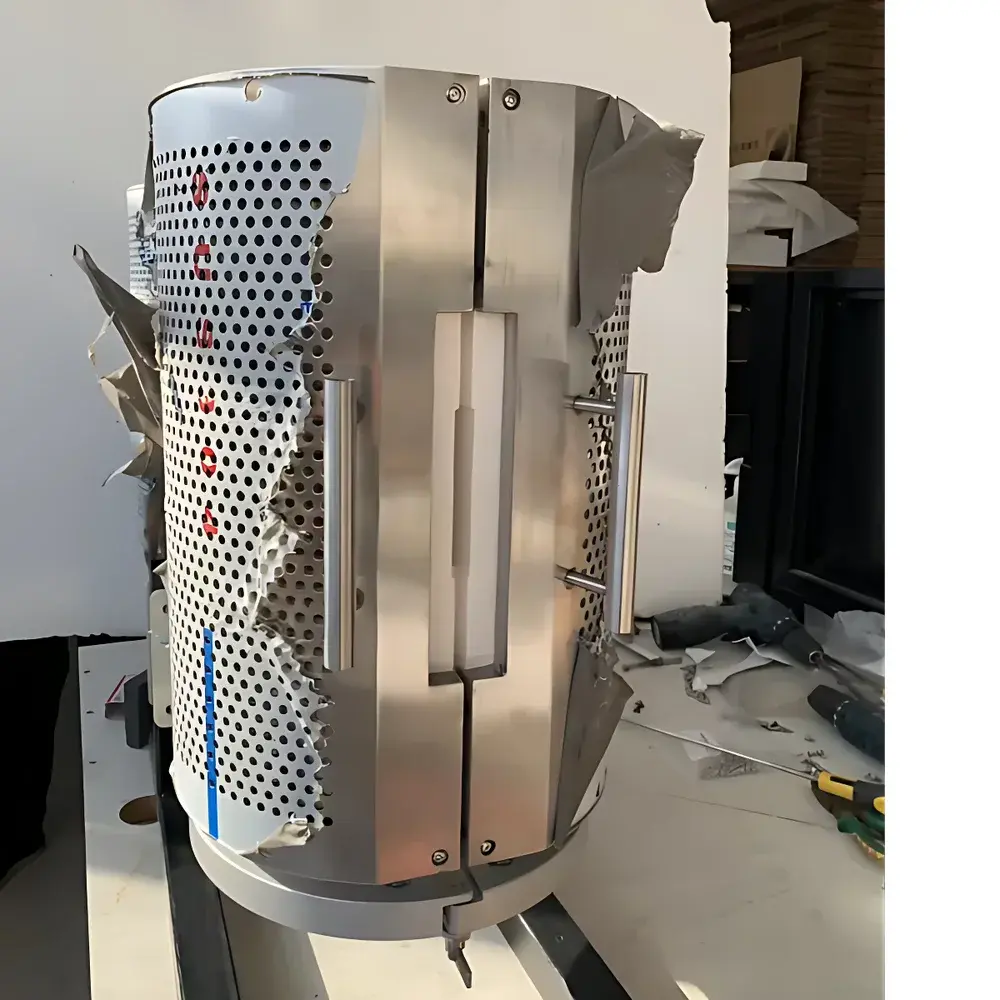
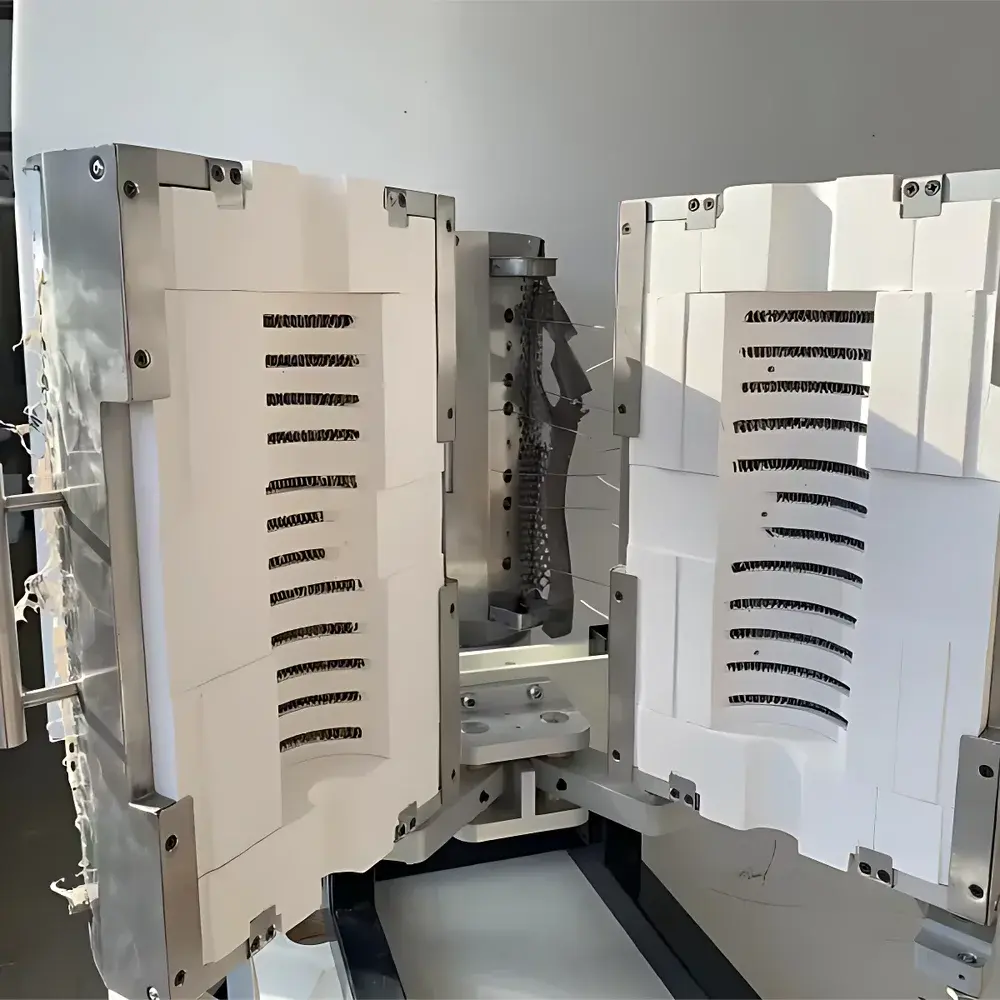
Zhongke Aobo Custom Triple-Zone Vertical Tube Furnace
| Brand | Zhongke Aobo |
|---|---|
| Origin | Beijing, China |
| Model | Custom Triple-Zone Vertical Tube Furnace |
| Instrument Type | Tube Furnace |
| Max Temperature | 1100 °C |
| Temperature Control Accuracy | ±1 °C |
| Max Power | 3000 W |
| Heating Rate (to Max Temp) | 30 °C/min |
| Heating Method | Resistance Wire |
| Internal Dimensions | 120 mm (ID) × 400 mm (L) |
| Control System | PID Intelligent Programmable Temperature Controller |
| Nominal Volume | 10 L |
| Compliance | ASTM E220, ISO/IEC 17025-compatible operation environment, GLP-aligned data logging capability |
Overview
The Zhongke Aobo Custom Triple-Zone Vertical Tube Furnace is an engineered high-precision thermal processing system designed for controlled-atmosphere and vacuum-enabled high-temperature experiments. Based on the fundamental principle of resistive heating via embedded high-stability resistance wire elements, this vertical configuration enables uniform axial thermal distribution across three independently programmable temperature zones—each with dedicated thermocouple feedback (Type K standard), enabling precise thermal gradient establishment, isothermal zone extension, or stepwise thermal profiling. Unlike single-zone furnaces, the triple-zone architecture supports complex thermal protocols such as zone-specific gas quenching, multi-stage sintering, differential thermal annealing, and controlled cooling ramping—critical for reproducible synthesis of functional ceramics, semiconductor precursors, and advanced carbon-based materials. Its vertical orientation optimizes gravitational stability during powder handling and facilitates seamless integration with downstream vacuum pumping systems and gas-distribution manifolds.
Key Features
- Triple independent heating zones with fully decoupled PID control loops, supporting simultaneous or staggered thermal profiles across the 400 mm effective heating length.
- High-density polycrystalline mullite fiber insulation chamber—low thermal mass, rapid heat-up (≤30 °C/min to 1100 °C), and exceptional thermal retention (surface temperature ≤45 °C at full load).
- Robust double-layer steel housing with active air-cooling: integrated thermal-sensing fan activation ensures operator safety and structural integrity during extended high-temperature operation.
- Modular KF-type stainless-steel (304) flange interface with dual O-ring sealing—compatible with standard vacuum systems (<10⁻³ mbar base pressure) and inert/reactive gas lines (N₂, Ar, O₂, CO₂, forming gas).
- 30-segment programmable controller with auto-tuning, power-loss recovery memory, and real-time deviation alarm—compliant with GLP documentation requirements for audit-trail-capable thermal history recording.
- Vertical tube geometry (120 mm inner diameter × 400 mm usable length) accommodates standard quartz or alumina tubes (up to Φ100 mm OD), with optional custom-length configurations.
Sample Compatibility & Compliance
This furnace supports a broad range of sample forms—including powders, pellets, thin films on substrates, fibers, and small-volume crucibles—within chemically inert or reactive atmospheres. It meets mechanical and thermal design benchmarks aligned with ASTM E220 (calibration of thermocouples) and supports operational traceability per ISO/IEC 17025 clause 7.8.2 for temperature-controlled equipment validation. When operated with optional data-logging modules, it satisfies FDA 21 CFR Part 11 requirements for electronic records and signatures in regulated R&D environments. The furnace’s sealed tube configuration and pressure-monitoring compatibility enable compliance with USP for thermal sterilization process development and ASTM C1171 for refractory material testing.
Software & Data Management
The integrated intelligent controller provides local touchscreen operation with USB export of time–temperature–power logs in CSV format. Optional RS485/Modbus RTU or Ethernet TCP/IP interfaces allow integration into centralized lab automation platforms (e.g., LabVantage, Thermo Fisher SampleManager). All temperature programs—including ramp rates, dwell times, and zone offsets—are stored with timestamped metadata and user ID tagging. Audit trails record parameter changes, manual overrides, and alarm events—enabling full GxP-compliant review for QC/QA workflows. Firmware updates are performed via secure authenticated firmware upload, preserving calibration constants and historical configuration integrity.
Applications
- Controlled-atmosphere sintering of Li-ion battery cathode precursors (e.g., NMC, LFP) under N₂/H₂ mixtures.
- Vacuum annealing of graphene oxide films for defect engineering and carrier mobility optimization.
- Thermal decomposition kinetics studies of metal–organic frameworks (MOFs) using multi-zone thermal gradients.
- Carbothermal reduction of SiO₂ to silicon nanowires in graphite crucibles under Ar flow.
- Pre-oxidation treatment of carbon fiber tow prior to polymer matrix impregnation.
- Calibration reference furnace for secondary thermocouple verification in metrology labs.
FAQ
What tube materials are compatible with this furnace at 1100 °C?
Quartz glass (up to 1100 °C continuous), high-purity alumina (99.7% Al₂O₃), and recrystallized silicon carbide (SiC) tubes are recommended. Quartz is standard for inert/vacuum use; alumina is preferred for oxidizing or mildly reducing atmospheres.
Can the three zones be programmed with different ramp rates simultaneously?
Yes—the controller supports independent ramp/soak settings per zone, enabling dynamic thermal profiling such as pre-heating the inlet zone while holding the center zone at dwell temperature and actively cooling the outlet zone.
Is vacuum compatibility built-in or requires external accessories?
The furnace includes KF-25/KF-40 flange ports and vacuum-tight seals; however, vacuum pumping systems (e.g., two-stage rotary vane pump or turbomolecular pump) and pressure gauges must be sourced separately.
Does the system support remote monitoring via LAN or cloud?
With optional communication modules, real-time temperature data and alarm status can be accessed via Modbus TCP or HTTP API endpoints—no proprietary cloud service is required.
What maintenance intervals are recommended for long-term reliability?
Inspect heating element continuity and insulation integrity every 200 operating hours; replace furnace tube gaskets annually or after 50 thermal cycles above 900 °C; recalibrate thermocouples per ASTM E220 every 6 months or after major thermal shock events.



