
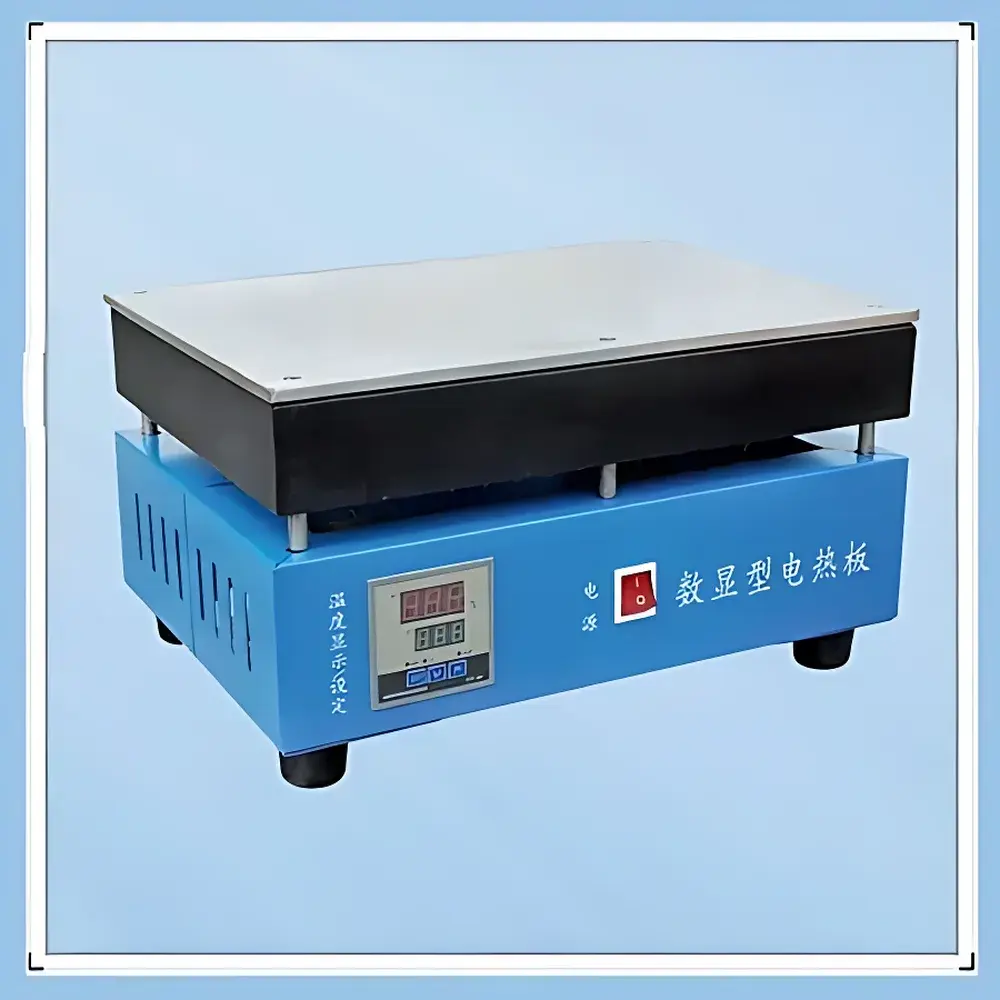
Zhongke Aobo ML-2-4 Stainless Steel Digital Electric Heating Plate
| Brand | Zhongke Aobo |
|---|---|
| Origin | Beijing, China |
| Model | ML-2-4 |
| Heating Power | 2.5 kW |
| Max. Heating Temperature | 400 °C |
| Temperature Uniformity | ±5–10 °C (across plate surface) |
| Plate Dimensions | 450 × 350 mm |
| Heating Zone Dimensions | 450 × 350 mm |
| Display Type | Digital LED |
Overview
The Zhongke Aobo ML-2-4 Stainless Steel Digital Electric Heating Plate is a robust, benchtop thermal platform engineered for precise, repeatable, and contamination-free heating in analytical sample preparation workflows. Designed around resistive heating principles, it delivers uniform thermal energy across its full-surface stainless steel heating zone—eliminating open flames while maintaining stable setpoint control within laboratory-grade tolerances. Its primary operational domain includes acid digestion, solvent evaporation, sample concentration (e.g., “acid赶酸” — acid removal), pre-digestion conditioning, and controlled drying of geological, environmental, food, and biological matrices prior to elemental analysis (ICP-OES, ICP-MS, AAS). The unit operates at standard mains voltage (220 V / 50 Hz) and integrates passive thermal mass design with optimized heat distribution geometry to minimize radial temperature gradients—critical for multi-vessel digestion protocols where inter-vial consistency directly impacts analytical reproducibility.
Key Features
- Full-surface 450 × 350 mm heating zone fabricated from high-purity, corrosion-resistant 304 stainless steel—resistant to HNO₃, HCl, HF (under controlled conditions), and aqua regia exposure during routine digestion cycles.
- Digital PID temperature controller with LED display enables precise setpoint selection (range: ambient to 400 °C) and real-time monitoring; resolution: 1 °C, repeatability: ±2 °C under steady-state conditions.
- Enclosed tubular heating elements embedded beneath the plate surface ensure no exposed coils, reducing oxidation risk and enhancing operator safety per IEC 61010-1 requirements for laboratory electrical equipment.
- Cold-rolled steel housing with epoxy-polyester powder coating provides mechanical durability and resistance to incidental chemical splashes and thermal stress cycling.
- Thermally insulated base minimizes downward heat loss and surface temperature rise on supporting lab benches—compliant with general lab furniture thermal safety guidelines.
Sample Compatibility & Compliance
The ML-2-4 accommodates standard digestion vessels—including PTFE (Teflon™), quartz, borosilicate glass, and ceramic crucibles—up to 1 L capacity per vessel when arranged centrally. Its flat, non-porous surface ensures compatibility with hotplate-stirrer hybrids (when used separately) and facilitates easy cleaning between runs. While not certified to ISO/IEC 17025 calibration standards out-of-box, the unit supports traceable temperature verification using NIST-traceable contact thermometers or infrared calibrators (e.g., ASTM E2847-compliant procedures). It meets basic electrical safety requirements aligned with GB 4706.1 (Chinese national equivalent of IEC 60335-1) and is suitable for use in GLP environments where instrument qualification (IQ/OQ) is performed per internal SOPs.
Software & Data Management
This model operates as a standalone analog-digital hybrid device with no embedded firmware, network interface, or data logging capability. Temperature setpoints and current readings are displayed locally only; no USB, RS-232, or Ethernet connectivity is provided. For laboratories requiring audit trails or electronic records, external validation-grade data loggers (e.g., Omega OM-DAQPRO-5300 series) may be deployed alongside the unit to capture time-stamped temperature profiles—supporting compliance with FDA 21 CFR Part 11 when paired with validated software platforms and appropriate access controls.
Applications
- Wet digestion of soil, sediment, plant tissue, and wastewater sludge per EPA Method 3050B and ISO 11466.
- Acid evaporation (“acid赶酸”) following microwave-assisted digestion to remove residual nitric or hydrochloric acid prior to ICP analysis.
- Controlled drying of filter papers, gravimetric precipitates, or dried standards in QA/QC labs.
- Pre-heating of reaction flasks, distillation apparatus, or extraction thimbles in organic and inorganic synthesis prep.
- Thermal conditioning of reference materials and calibration standards before weighing or dissolution.
FAQ
What is the maximum recommended continuous operating temperature?
The plate is rated for sustained operation up to 400 °C; however, prolonged use above 350 °C may accelerate surface passivation layer degradation in aggressive acid environments.
Can this unit be used with magnetic stirrers?
No—the ML-2-4 does not integrate stirring functionality. It is a dedicated heating-only platform; external stir plates must be used separately.
Is the temperature uniformity specification verified per ASTM E1142?
No—ASTM E1142 applies to ovens and muffle furnaces. Plate uniformity is characterized empirically via multi-point thermocouple mapping per internal QA protocol; typical deviation is ±5–10 °C across the active zone at 250 °C.
Does the unit include over-temperature protection?
Yes—a redundant bimetallic thermal cut-off switch disables power if surface temperature exceeds 450 °C, satisfying basic Class II appliance fail-safe requirements.
What maintenance is required for long-term reliability?
Regular wiping of the stainless steel surface with deionized water and mild detergent; periodic inspection of power cord integrity and housing fasteners; avoidance of thermal shock (e.g., placing cold vessels directly onto 400 °C surface).



