
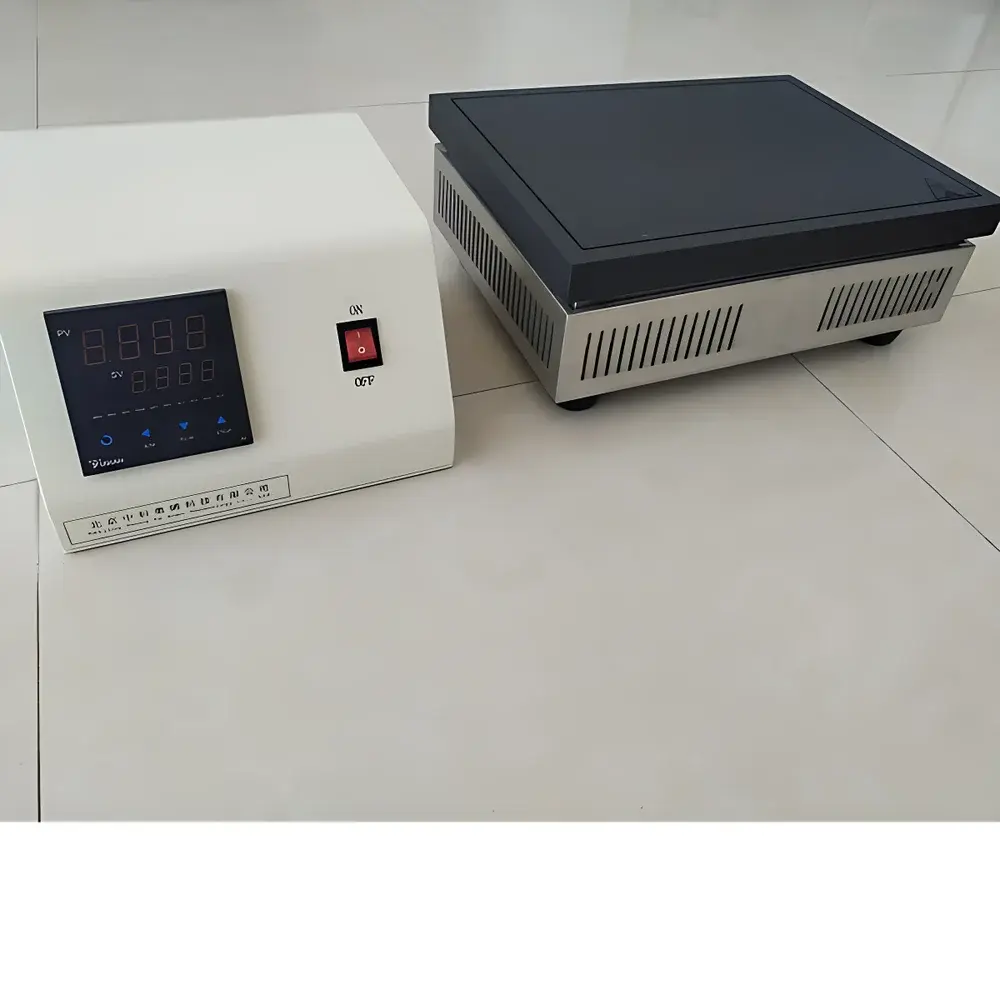
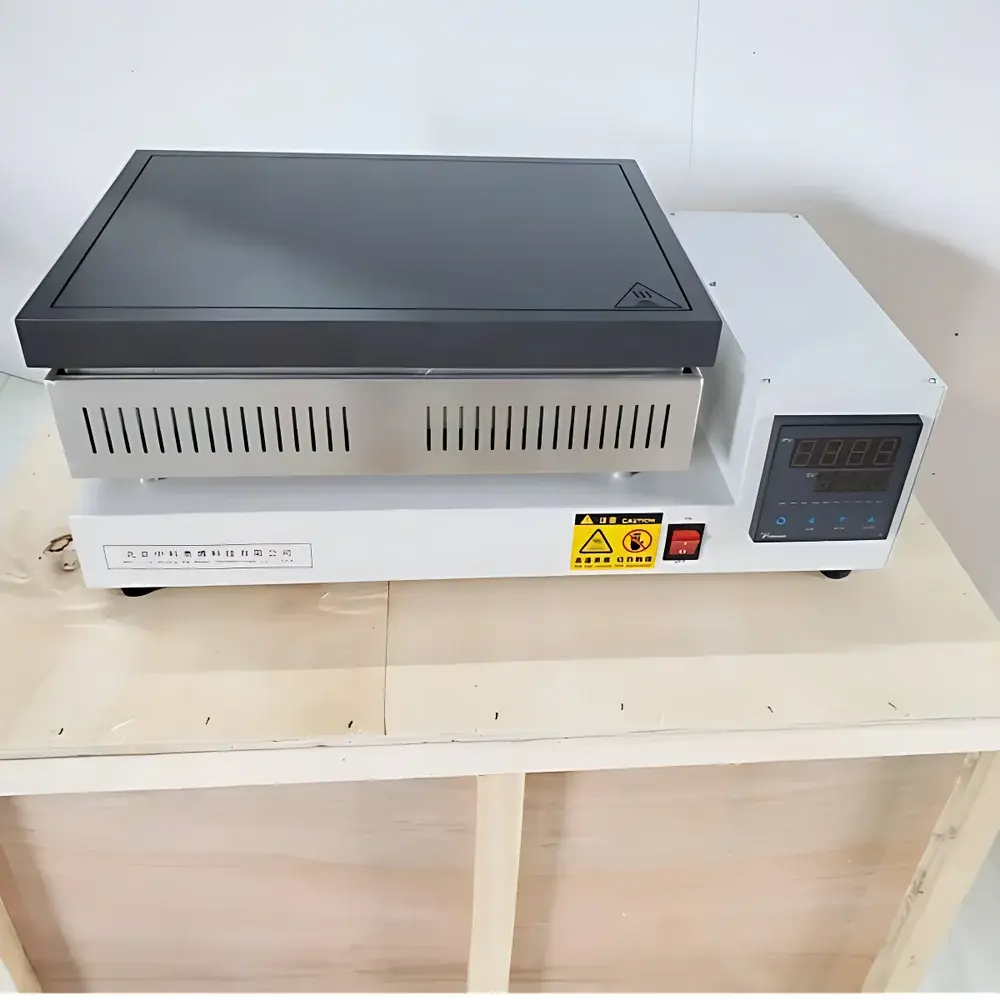
Zhongke Aobo SM35-45F Split-Design Precision Graphite Heating Block for Sample Digestion
| Brand | Zhongke Aobo |
|---|---|
| Model | SM35-45F |
| Heating Power | 3.5 kW |
| Max Temperature | 450 °C |
| Temperature Uniformity | ±1 °C |
| Plate Dimensions | 400 × 300 mm |
| Heating Zone Dimensions | 400 × 300 mm |
| Display | LED |
| Control Method | PID-based 30-segment programmable temperature ramping |
| Plate Material | Isostatically pressed high-purity graphite with PTFE anti-corrosion coating |
| Plate Thickness | 30 mm |
| Voltage | AC 220 V, 50 Hz |
| Weight | 15 kg |
| Connection Cable Length | 2 m |
| Structural Design | Split-type (separate controller and heating block) |
Overview
The Zhongke Aobo SM35-45F Split-Design Precision Graphite Heating Block is engineered for reproducible, contamination-free thermal sample preparation in regulated analytical laboratories. Unlike conventional metal-sheathed or ceramic heating plates, this instrument employs an isostatically pressed high-purity graphite heating surface—thermally homogeneous, chemically inert, and dimensionally stable up to 450 °C. Its split architecture physically isolates the temperature controller from the heated block, minimizing thermal drift in electronics and enhancing long-term calibration stability. The device operates on fundamental conductive heat transfer principles, delivering uniform surface temperature across the entire 400 × 300 mm active zone—critical for parallel digestion of multiple samples under identical thermal conditions. It serves as a primary pre-treatment platform for acid digestion workflows preceding elemental analysis by ICP-OES, ICP-MS, AAS, and AFSS, meeting foundational requirements for trace-metal cleanroom protocols.
Key Features
- Isostatically pressed high-purity graphite plate (30 mm thick) with integrated PTFE anti-corrosion coating—resistant to concentrated HNO₃, HCl, HF, and aqua regia at elevated temperatures
- PID-based 30-segment programmable temperature control with ±1 °C accuracy and adjustable ramp rates (°C/min) and hold times (min)
- Split-system design: independent controller unit connected via 2-meter shielded cable—reduces thermal coupling, improves operator safety, and simplifies benchtop integration
- Dual-layer thermal insulation: air gap + ceramic fiber (aluminosilicate) barrier—reducing surface casing temperature and improving energy efficiency by ~25% vs. single-wall designs
- LED digital display with intuitive menu navigation; real-time temperature feedback and status indicators for program execution, fault detection, and standby mode
- Corrosion-resistant powder-coated steel housing rated for continuous operation in acidic fume environments (validated for >48 h exposure to 10% HNO₃ vapor at 120 °C)
Sample Compatibility & Compliance
The SM35-45F accommodates standard digestion vessels—including 50 mL and 100 mL Teflon (PFA/PTFE) tubes, quartz crucibles, borosilicate glass beakers, and custom-fit graphite inserts—without thermal distortion or edge overheating. Its uniform thermal profile ensures consistent decomposition kinetics across all positions, satisfying method requirements in EPA Method 3050B, ISO 11466, and ASTM D5762 for solid matrix digestion. The instrument complies with IEC 61010-1:2010 for laboratory electrical equipment safety and supports GLP/GMP documentation through optional audit-trail-capable controllers (sold separately). While not inherently 21 CFR Part 11 compliant, its programmable parameters and non-volatile memory enable traceable method storage when paired with validated LIMS interfaces.
Software & Data Management
The embedded firmware stores up to 10 user-defined multi-step temperature programs with name-tagged identifiers. All setpoints, ramp rates, dwell durations, and actual measured temperatures are logged internally with timestamp resolution of 1 second and retained for ≥10,000 cycles. Data export is supported via RS-232 serial interface (optional USB-to-serial adapter) for integration into laboratory data systems. No proprietary software is required—raw CSV-formatted logs can be parsed directly by Excel, Python pandas, or ELN platforms. Firmware updates are performed via UART bootloader using standard terminal emulation tools, ensuring long-term maintainability without vendor lock-in.
Applications
- Open-vessel acid digestion (HNO₃/H₂O₂, HCl/HF mixtures) of soils, sediments, biological tissues, and polymers prior to ICP analysis
- Acid evaporation (“gassing off”) and residue concentration steps in trace metal quantification workflows
- Pre-microwave digestion conditioning—temperature-controlled stabilization of samples before closed-vessel irradiation
- Controlled drying and charring of filter papers, ashing residues, and gravimetric precipitates
- Calibration verification of thermocouple probes and IR thermometers using NIST-traceable reference standards placed directly on the graphite surface
- Method development for novel digestion matrices requiring precise thermal profiling (e.g., carbon nanotubes, battery cathode materials)
FAQ
What is the maximum recommended operating temperature for continuous use?
The graphite block is rated for sustained operation at 450 °C; however, for optimal longevity and minimal outgassing, we recommend limiting prolonged exposure (>4 h) to ≤420 °C.
Can the heating block be cleaned with organic solvents?
Yes—acetone, isopropanol, and ethanol are compatible with the PTFE-coated surface; avoid chlorinated solvents (e.g., chloroform) above 100 °C due to potential coating degradation.
Is the unit suitable for use inside a fume hood?
Yes—the split design and low external surface temperature (<60 °C at ambient 25 °C) make it fully compatible with Class II A2 and B2 hoods; ensure proper cable routing through designated feedthroughs.
Does the controller support remote start/stop via digital I/O?
No—standard configuration includes only local keypad and LED interface; optional relay output module (part #SM-IO-RELAY) enables TTL-level external triggering and alarm signaling.
How often should temperature calibration be verified?
We recommend quarterly verification using a NIST-traceable calibrated thermocouple inserted into a dedicated 6-mm bore in the graphite plate (location marked on underside); deviation >±0.8 °C warrants field recalibration.



