
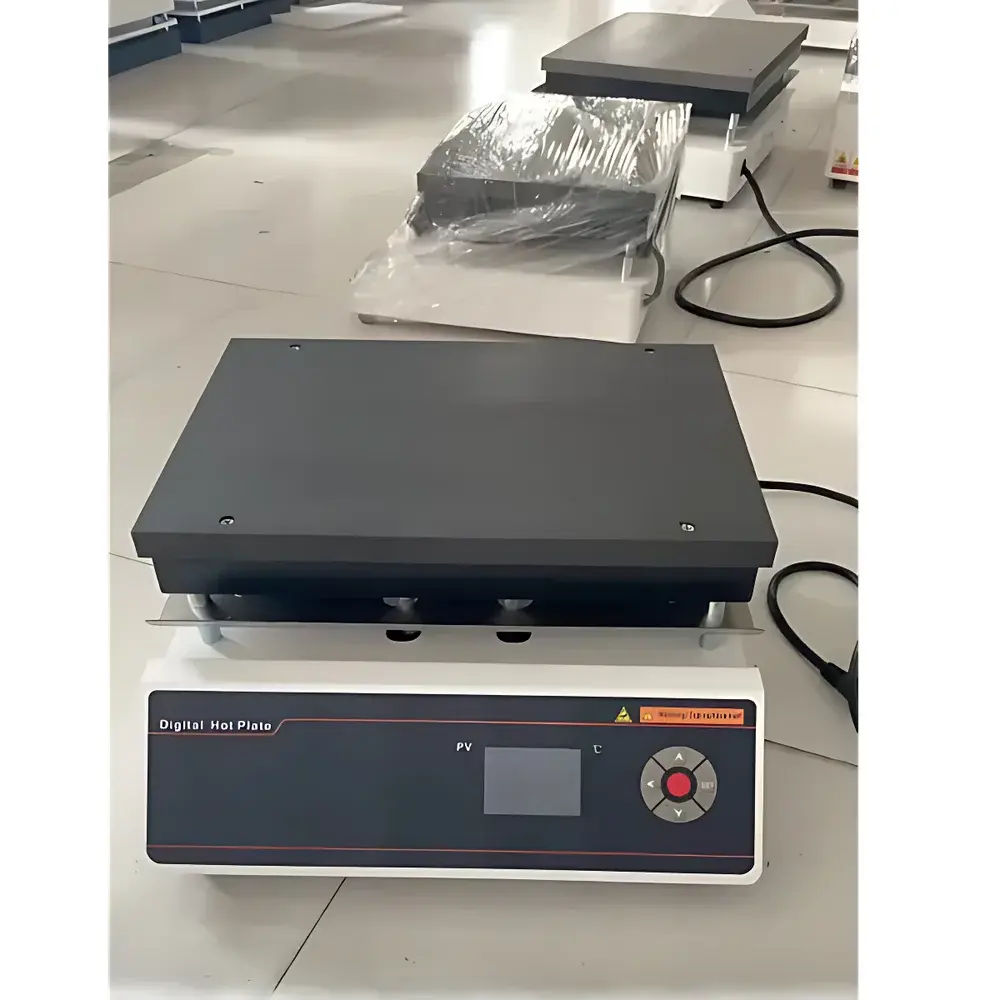
Zhongke Aobo SMP Integrated Graphite Electric Heating Plate
| Brand | Zhongke Aobo |
|---|---|
| Origin | Beijing, China |
| Manufacturer Type | Authorized Distributor |
| Country of Origin | China |
| Model | SMP Integrated Graphite Electric Heating Plate |
| Price | USD 420 (est.) |
| Heating Power | 2000 W |
| Temperature Controller | PID |
| Max. Operating Temperature | 450 °C |
| Temperature Uniformity | ±5 °C across surface |
| Plate Dimensions | 400 × 280 mm |
| Heating Zone Dimensions | 400 × 280 mm |
| Display | LED |
Overview
The Zhongke Aobo SMP Integrated Graphite Electric Heating Plate is a precision-engineered sample preparation platform designed for controlled thermal treatment in analytical laboratories. It operates on resistive heating principles, utilizing high-purity isostatically pressed graphite as the uniform conductive heating medium—ensuring rapid thermal response and minimal thermal gradient across the active surface. Unlike conventional ceramic or aluminum hotplates, graphite offers exceptional thermal conductivity (>150 W/m·K), chemical inertness to aggressive reagents (including concentrated HNO₃, HF, HClO₄, and aqua regia), and structural stability up to 450 °C in oxidizing atmospheres. This makes the SMP series particularly suitable for open-vessel acid digestion, evaporation (‘acid fuming’), pre-digestion conditioning prior to microwave-assisted digestion, and temperature-critical steps in trace metal analysis workflows.
Key Features
- Isostatically pressed high-purity graphite heating plate (99.99% C, density ≥1.85 g/cm³), 20 mm thick, providing mechanical rigidity and long-term dimensional stability under repeated thermal cycling.
- PID-based digital temperature control with ±1 °C accuracy at setpoint (verified per ASTM E220 calibration protocol), enabling reproducible ramp-hold profiles for standardized digestion protocols.
- Dual-layer thermal insulation: outer steel enclosure with air gap + inner ceramic fiber (silica-alumina) barrier, reducing surface casing temperature to <60 °C at full load and improving energy efficiency by ~35% versus single-wall designs.
- Uniform heating zone matching plate dimensions (400 × 280 mm), supporting simultaneous processing of up to 12 × 50 mL PTFE beakers or 6 × 100 mL quartz crucibles without edge cooling effects.
- Acid-resistant industrial-grade epoxy-polyester powder coating (ISO 2093 Class 2) applied to all non-graphite surfaces, validated for continuous exposure to pH 0–1 acidic vapor environments for ≥48 h without blistering or adhesion loss.
- LED display with intuitive parameter navigation, real-time temperature readout, and over-temperature cut-off (OTC) safety circuit compliant with IEC 61000-4-2 ESD immunity standards.
Sample Compatibility & Compliance
The SMP heating plate accommodates standard laboratory vessels including borosilicate glass, quartz, PTFE, PFA, and quartz-fused silica crucibles and beakers. Its flat, non-porous graphite surface resists residue buildup and allows direct cleaning with dilute sodium hydroxide or ethanol—no solvent retention. The unit meets essential safety and electromagnetic compatibility requirements per GB 4793.1–2019 (equivalent to IEC 61010-1:2010) for electrical equipment used in laboratory environments. While not certified to GLP or ISO/IEC 17025 out-of-box, its stable thermal performance supports method validation per USP , EPA Method 3050B, and ISO 11466 for trace element determination in soils and sediments.
Software & Data Management
The SMP series operates as a standalone analog/digital hybrid instrument with no embedded firmware or network interface. Temperature setpoints and real-time readings are local-only via the front-panel LED interface. For laboratories requiring audit trails or electronic records, optional RS-232 or 4–20 mA analog output modules (sold separately) enable integration with LabVIEW, DeltaV, or LIMS platforms. When paired with external data loggers (e.g., Omega OM-DAQPRO-5300), the system supports 21 CFR Part 11-compliant temperature logging—including user ID tagging, time-stamped events, and immutable record storage—when configured with appropriate access controls and electronic signature workflows.
Applications
- Open-beaker acid digestion of environmental samples (soils, sludges, sediments) prior to ICP-MS or ICP-OES analysis.
- Controlled evaporation of digests to near-dryness (“gassing off” excess nitric or perchloric acid) without analyte loss or splattering.
- Pre-heating and temperature equilibration of samples before microwave digestion cavity insertion (per ASTM D5511).
- Constant-temperature drying of filters post-gravimetric analysis (e.g., TSS, TDS, PM₂.₅).
- Calibration verification of thermocouples and RTDs using NIST-traceable reference blocks placed directly on graphite surface.
- Heating baths for solvent extraction systems (Soxhlet, ASE) where precise, vibration-free thermal input is required.
FAQ
What is the maximum recommended continuous operating temperature?
The graphite plate is rated for sustained operation at 450 °C; however, for optimal longevity under acidic conditions, we recommend limiting exposure above 400 °C to ≤2 hours per cycle.
Can the SMP heating plate be used with hydrofluoric acid (HF)?
Yes—the isostatic graphite surface exhibits negligible etching in 10% HF at elevated temperatures is not advised due to potential intercalation effects.
Is the temperature uniformity specification (±5 °C) measured at surface or vessel bottom?
The ±5 °C uniformity is verified at the graphite surface using a 9-point grid (per ASTM E1142) with calibrated PT100 probes; actual vessel-bottom variation depends on vessel material thickness and thermal contact quality.
Does the unit include a calibration certificate?
No factory-issued calibration certificate is included; however, the controller accepts external PT100 input for user-performed verification against NIST-traceable references.
What maintenance is required for long-term reliability?
Annual inspection of power cord integrity, visual check for graphite surface micro-cracking, and verification of PID loop stability using a step-response test are recommended per ISO/IEC 17025 Clause 6.4.3.



