
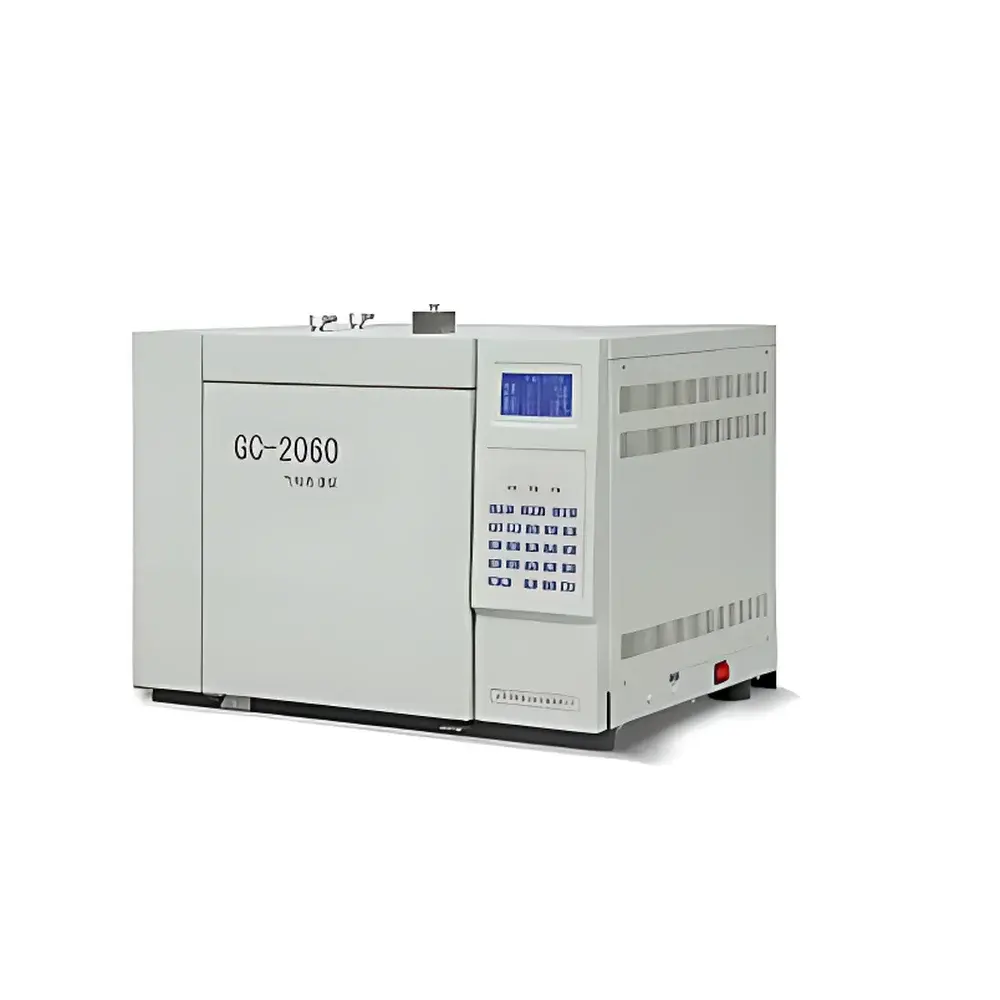
ZHONGKEHUIFEN GC-2060 Micro-Sulfur Gas Chromatograph with Flame Photometric Detector (FPD)
| Brand | ZHONGKEHUIFEN |
|---|---|
| Origin | Beijing, China |
| Model | GC-2060 |
| Temperature Control Range | Ambient + 3 °C to 450 °C |
| Oven Ramp Rate | 0.1–40 °C/min |
| Cooling Time | ~8 min (450 °C → 50 °C) |
| Carrier Gas Flow Range & Control | 0–1200 mL/min |
| Carrier Gas Pressure Range & Control | 0–970 kPa |
| Injector Max Operating Temperature | 450 °C |
| Injector Pressure Setting Range | 0–970 kPa |
| Injector Total Flow Setting Range | 0–1200 mL/min |
| FPD Detection Limit (H₂S) | 0.02 ppm (v/v) |
| FPD Detection Limit (Thiophene) | 0.03 ppm (v/v) |
| Oven Temperature Stability | ±0.1 °C |
| Baseline Noise | ≤0.1 mV |
Overview
The ZHONGKEHUIFEN GC-2060 Micro-Sulfur Gas Chromatograph is a dedicated analytical system engineered for trace-level sulfur speciation in gaseous matrices. It integrates a high-sensitivity flame photometric detector (FPD) with a robust, temperature-programmable gas chromatographic platform optimized for sulfur-selective detection. The instrument operates on the principle that sulfur-containing compounds—when combusted in a hydrogen-rich flame—undergo thermal cleavage to produce excited S₂* species, which emit characteristic luminescence at 394 nm. This emission is isolated via an interference filter and converted into a proportional electrical signal by a photomultiplier tube (PMT), enabling selective, low-background quantification of sulfur species at sub-ppm levels. Unlike generic GC systems, the GC-2060 incorporates a fully inertized gas path—including deactivation-treated stainless steel tubing, sulfur-passivated fittings, and high-inertness packed or capillary columns—to minimize adsorption losses of reactive sulfur compounds such as H₂S, mercaptans, and COS. Its design conforms to fundamental requirements for trace sulfur analysis in industrial process monitoring, catalyst protection, and regulatory compliance workflows.
Key Features
- Flame photometric detector (FPD) with optimized optical path, narrow-band 394 nm interference filter, and low-noise PMT amplifier (baseline noise ≤0.1 mV)
- Programmable oven with precise temperature control (±0.1 °C stability) across ambient + 3 °C to 450 °C, supporting rapid ramping (0.1–40 °C/min) and accelerated cooling (~8 min from 450 °C to 50 °C)
- Dual independent pressure and flow control for carrier, makeup, and hydrogen gases—each adjustable from 0–970 kPa and 0–1200 mL/min respectively
- High-temperature injector (up to 450 °C) with programmable pressure and total flow settings for reproducible sample introduction
- Full inert gas pathway using sulfur-resistant materials throughout sample introduction, column transfer, and detector interface to prevent analyte loss or catalytic decomposition
- Integrated reverse-flush capability for total sulfur determination and column maintenance without manual intervention
- LCD-based local interface with real-time parameter display, coupled with PC-based data acquisition and processing via compliant chromatography software
Sample Compatibility & Compliance
The GC-2060 is validated for quantitative analysis of sulfur species—including H₂S, COS, CS₂, mercaptans (e.g., CH₃SH), sulfides (e.g., C₂H₅SC₂H₅), thiophenes, and SO₂—in complex gaseous samples such as natural gas, refinery off-gas, syngas, food-grade CO₂, coke oven gas, and flue gas. Its detection limits meet stringent industry benchmarks: 0.02 ppm (v/v) for H₂S and 0.03 ppm (v/v) for thiophene. The system supports method development aligned with ASTM D5504 (Standard Test Method for Determination of Sulfur Compounds in Natural Gas and Gaseous Fuels by Gas Chromatography and Chemiluminescence), ISO 8573-6 (Compressed air — Part 6: Test methods for oil content), and USP chromatographic system suitability criteria. All hardware and firmware configurations are compatible with GLP/GMP environments requiring audit trails, electronic signatures, and 21 CFR Part 11-compliant data handling when paired with validated software.
Software & Data Management
Data acquisition and reporting are managed through a Windows-based chromatography workstation supporting multi-channel analog input, peak integration with retention time locking, calibration curve generation (linear, quadratic, or multipoint), and automated report export in PDF, CSV, or XML formats. The software provides full audit trail functionality—including user login logs, method change history, sequence execution records, and raw data integrity verification—ensuring traceability per FDA 21 CFR Part 11 and EU Annex 11 requirements. Raw signal files are stored in vendor-neutral formats (.cdf or .dx) for third-party reprocessing. Optional modules include remote monitoring via Ethernet/IP, scheduled calibration alerts, and integration with LIMS via ODBC or REST API.
Applications
- Monitoring sulfur breakthrough in amine scrubbers and solid desulfurization beds during ammonia, methanol, and hydrogen production
- Verifying sulfur removal efficiency in PSA (pressure swing adsorption) and membrane separation units
- Ensuring food-grade CO₂ meets ISO 8573-1 Class 0 or USP purity specifications for beverage carbonation
- Quantifying SO₂ and organic sulfur compounds in flue gas before and after FGD (flue gas desulfurization) systems
- Diagnosing catalyst poisoning in Fischer–Tropsch, hydrodesulfurization (HDS), and reforming units
- Supporting environmental compliance reporting under EPA Method 16, EN 14791, or China’s GB/T 11060 series standards
FAQ
What sulfur compounds can the GC-2060 reliably separate and quantify?
It resolves H₂S, COS, CS₂, methyl/ethyl mercaptans, dimethyl sulfide, tetrahydrothiophene, thiophene, and SO₂—provided appropriate column chemistry (e.g., porous polymer PLOT or low-polarity fused silica) and temperature programming are applied.
Is the GC-2060 compatible with helium, nitrogen, or hydrogen as carrier gas?
Yes—it supports all three carrier gases; hydrogen is recommended for optimal FPD sensitivity and speed, while helium offers superior resolution for complex sulfur speciation.
How does the system mitigate H₂S adsorption in the gas path?
All internal surfaces—from sampling valve to detector jet—are treated with sulfur-passivated nickel or silanized stainless steel, and flow paths are thermally conditioned prior to analysis to stabilize active sites.
Can the GC-2060 perform total sulfur analysis without speciation?
Yes—using the built-in reverse-flush function, non-retained sulfur compounds elute together as a single total sulfur peak, enabling rapid screening without full chromatographic separation.
Does the instrument support unattended operation over extended sequences?
It supports up to 99-sample autosampler sequences with programmable standby modes, automatic flame ignition/shutdown, and real-time leak detection via pressure decay monitoring.




