
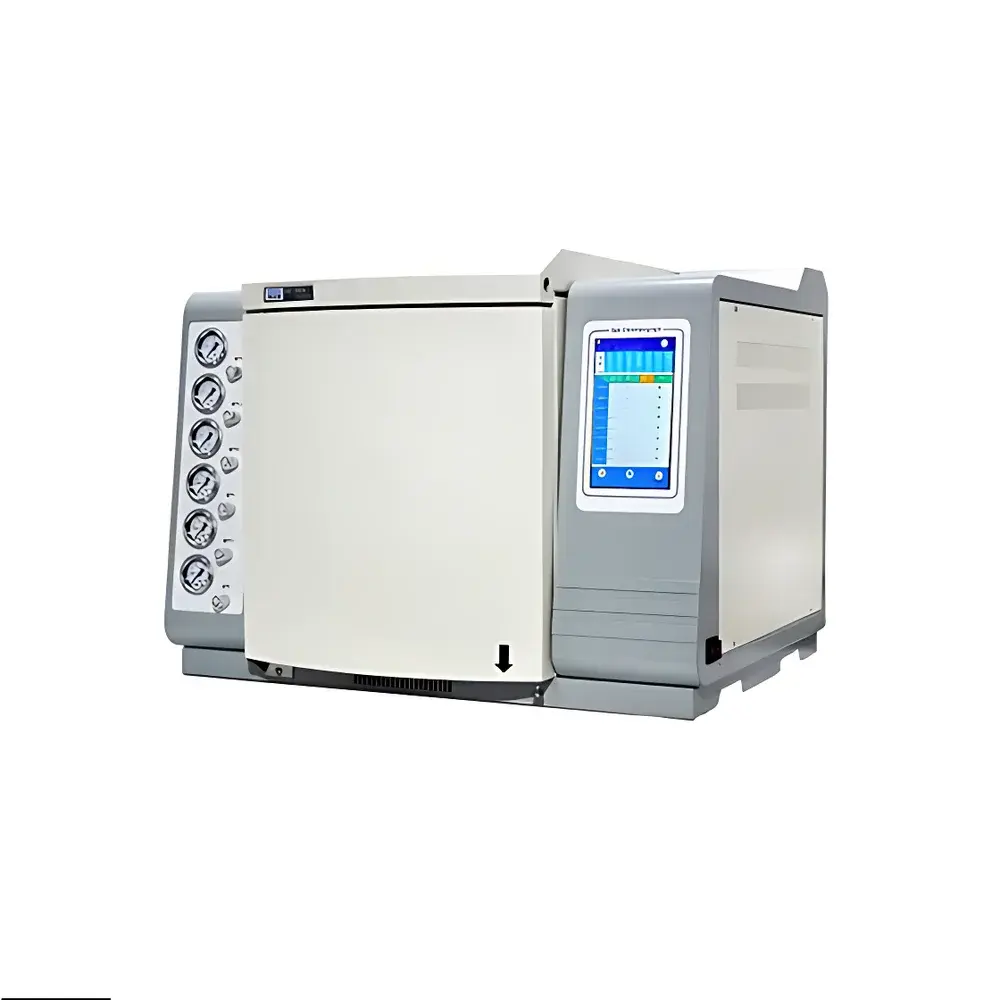
ZHONGKEHUIFEN GC-7820 Methane and Total Hydrocarbons-Specific Gas Chromatograph
| Brand | ZHONGKEHUIFEN |
|---|---|
| Origin | Beijing, China |
| Model | GC-7820 Methane and Total Hydrocarbons-Specific Gas Chromatograph |
| Instrument Type | Laboratory Gas Chromatograph |
| Temperature Control Range | Ambient + 3 °C to 450 °C |
| Oven Ramp Rate | 0.1–40 °C/min |
| Cooling Rate | ~8 min (450 °C → 50 °C) |
| Carrier Gas Flow Range & Control | 0–1200 mL/min |
| Carrier Gas Pressure Range & Control | 0–970 kPa |
| Injector Max Operating Temperature | 450 °C |
| Injector Pressure Setting Range | 0–970 kPa |
| Injector Total Flow Setting Range | 0–1200 mL/min |
Overview
The ZHONGKEHUIFEN GC-7820 Methane and Total Hydrocarbons-Specific Gas Chromatograph is a dedicated laboratory-scale gas chromatographic system engineered for precise, compliant quantification of methane (CH₄), total hydrocarbons (THC), and non-methane hydrocarbons (NMHC) in ambient air and industrial stack emissions. It implements the dual-column, dual-flame ionization detector (dual-FID) configuration mandated by key environmental regulatory methods—including HJ 604–2011 (Determination of Total Hydrocarbons in Ambient Air by Gas Chromatography) and HJ/T 38–1999 (Determination of Non-Methane Hydrocarbons in Exhaust Gas from Pollution Sources). The instrument operates on the principle of selective separation via parallel capillary or packed columns, followed by simultaneous detection using two independently controlled FIDs—enabling single-injection analysis of both total hydrocarbons and methane, with NMHC calculated as their arithmetic difference (THC − CH₄). This architecture eliminates manual re-injection, reduces analytical uncertainty, and ensures high reproducibility across routine environmental monitoring workflows.
Key Features
- Dual-FID detection system with independent electronic pressure/flow control (EPC/EFC) for each detector—ensuring stable baseline, minimized cross-talk, and trace-level sensitivity.
- High-precision oven temperature control: operating range from ambient + 3 °C to 450 °C; temperature setting resolution of 0.01 °C; programmable up to 8 temperature ramps per method; maximum run time of 999.99 minutes.
- Multi-configurable inlet system supporting packed column, split/splitless, and direct liquid injection modes—all equipped with EPC/EFC modules; injector maximum temperature: 450 °C; column head pressure control resolution: 0.01 psi (0.069 kPa).
- Integrated high-speed, high-cycle-life solenoid valve manifold (rated for >1 million actuations, switching time ≤10 ms), configurable with 4-port, 6-port, or 10-port valves for automated sequence operation and column backflushing.
- FID specifications: detection limit <5 pg C/s (n-hexadecane); linear dynamic range 10⁷ (±10%); data acquisition rate: 100 Hz; auto-ignition and H₂ leak protection circuitry.
- TCD optional integration: compatible with both packed and capillary columns; operating temperature up to 400 °C; detection limit <800 pg propane/mL (He carrier); linear dynamic range 10⁵ (±10%).
Sample Compatibility & Compliance
The GC-7820 is validated for gaseous sample matrices including ambient air, flue gas, biogas, and process vent streams. It supports fixed-volume gas loop injection (e.g., 1 mL or 2 mL stainless-steel loops) with quantitative transfer via pressurized carrier gas. Sample introduction complies with ISO 10156, ASTM D1945, and EPA Method 25A requirements for hydrocarbon speciation. The system meets essential hardware prerequisites for GLP-compliant laboratories and supports audit-ready operation when paired with validated software. While the base configuration does not include 21 CFR Part 11–compliant electronic signatures or full audit trail functionality, its modular architecture allows integration with third-party LIMS or chromatography data systems (CDS) that provide such capabilities.
Software & Data Management
Instrument control, method development, and data processing are performed via a Windows-based chromatography workstation supporting real-time signal monitoring, peak integration, calibration curve generation (linear, quadratic, or multi-point weighted), and report export in PDF, CSV, or XML formats. The software enables user-defined calculation templates—for example, automatic NMHC derivation using the formula: NMHC (mg/m³) = THC (mg/m³) − CH₄ (mg/m³), with unit conversion applied per standard temperature and pressure (STP: 0 °C, 101.325 kPa). All method parameters, sequence logs, and raw chromatograms are timestamped and stored with file integrity checksums. Raw data files adhere to ANDI/NetCDF format standards for long-term archival and cross-platform compatibility.
Applications
- Regulatory compliance monitoring of NMHC emissions at municipal wastewater treatment plants, chemical manufacturing facilities, and landfill gas collection systems.
- Stack testing and continuous emission monitoring system (CEMS) validation per Chinese national standards (HJ/T 38–1999, HJ 604–2011) and equivalent EU BREF reference methods.
- Indoor air quality (IAQ) assessment in semiconductor cleanrooms and pharmaceutical production environments where hydrocarbon contamination must be tracked at sub-ppb levels.
- Research applications in atmospheric chemistry, including VOC speciation studies and photochemical smog formation modeling.
- Calibration gas verification and cylinder certification labs requiring traceable, repeatable hydrocarbon quantification down to 0.02 µL/L (ppb-level) for methane.
FAQ
What regulatory standards does the GC-7820 directly support?
It is configured to meet the instrumental requirements of HJ 604–2011 and HJ/T 38–1999, including dual-FID detection, fixed-volume gas injection, and temperature programming profiles specified therein.
Can the system quantify individual VOCs beyond NMHC?
Not natively—the GC-7820 is optimized for total hydrocarbon class measurement. For speciated VOC analysis (e.g., benzene, toluene), a full-capability GC-MS or GC-FID with cryo-focusing and longer capillary columns is recommended.
Is helium required as carrier gas?
No—nitrogen and hydrogen are supported; flow and pressure ranges are calibrated for He, N₂, and H₂, with appropriate adjustments for viscosity and diffusion coefficients.
What is the typical detection limit for NMHC in ambient air?
When operated per HJ 604–2011 protocol with 1 mL loop injection and optimized FID response, the system achieves a practical NMHC detection limit of 0.05 mg/m³ at standard conditions.
Does the instrument include factory calibration certificates?
Yes—each unit ships with a traceable temperature calibration certificate (NIST-traceable RTD sensors) and FID response verification report using certified n-hexadecane standard.





