
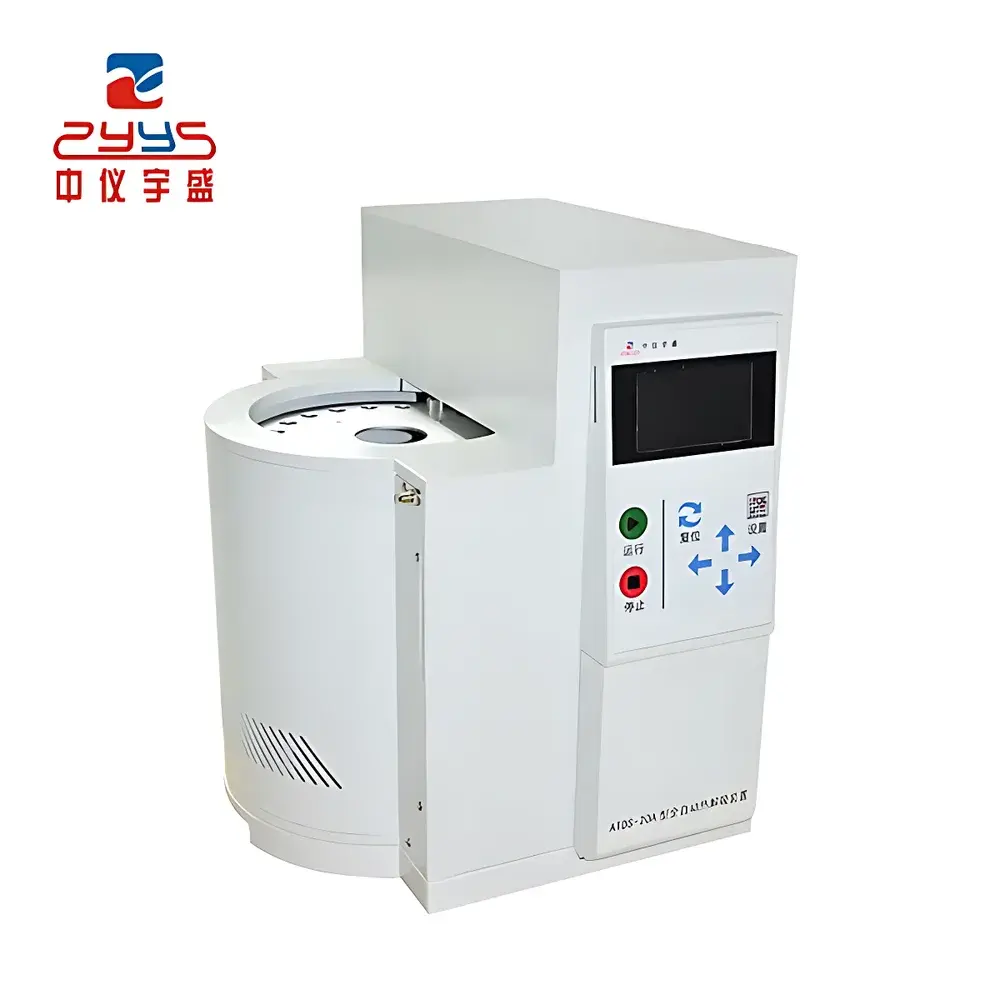
Zhongyi Yusheng ATDS-20A Fully Automated Two-Stage Thermal Desorber
| Brand | Zhongyi Yusheng |
|---|---|
| Origin | Beijing, China |
| Manufacturer Type | Direct Manufacturer |
| Instrument Type | Two-Stage Thermal Desorber |
| Automation Level | Fully Automated |
| Desorption Zone Temperature Range | Ambient to 400 °C |
| Valve Injection Zone Temperature Range | Ambient to 220 °C |
| Transfer Line Temperature Range | Ambient to 240 °C |
| Cryo-Focusing Trap Temperature | −30 °C |
| Temperature Control Accuracy | ±0.1 °C |
| Analyte Recovery Rate | >95% |
| Sample Capacity | 20 adsorption tubes |
Overview
The Zhongyi Yusheng ATDS-20A Fully Automated Two-Stage Thermal Desorber is an engineered solution for quantitative trace analysis of volatile and semi-volatile organic compounds (VOCs and SVOCs) in ambient air, indoor air, vehicle cabin air, and industrial emission samples. Designed around a two-stage thermal desorption principle—comprising primary thermal desorption from the sorbent tube followed by cryogenic focusing and secondary desorption into the gas chromatograph—the system delivers high analyte recovery, narrow peak widths, and minimal carryover. Its architecture supports seamless integration with both domestic and international GC and GC–MS platforms, ensuring compatibility with standardized analytical workflows required under environmental monitoring regulations including HJ 644–2013, HJ 583–2010, HJ 734–2014, and GB 50325–2020. The instrument operates on a fully automated batch-processing paradigm, enabling unattended analysis of up to 20 pre-collected sorbent tubes per sequence.
Key Features
- Fully automated sample handling: Unattended sequential processing of 1–20 sorbent tubes with automatic carousel positioning, self-diagnostic startup, and real-time fault detection with on-screen alerts.
- Independent four-zone temperature control: Precisely regulated heating of the primary desorption oven (ambient to 400 °C), injection valve (ambient to 220 °C), transfer line (ambient to 240 °C), and cryo-focusing trap (−30 °C), each maintained within ±0.1 °C stability.
- Two-stage desorption architecture with electronic cooling: Enables sharp, symmetrical chromatographic peaks through rapid refocusing of desorbed analytes onto a cryogenically cooled trap prior to secondary thermal injection.
- Integrated back-flush functionality: Automatic reverse purging of the transfer line and injection valve between runs minimizes cross-contamination—critical for high-sensitivity analysis of reactive or strongly adsorbing compounds.
- Programmable time-segmented method control: Supports customizable sequences for desorption, inert gas purge, trap refocusing, secondary desorption, GC trigger synchronization, and post-run cleaning—all configurable via intuitive touchscreen interface.
- Standardized GC/GC–MS interfacing: Equipped with universal hardware interfaces compatible with Agilent, Thermo Fisher, Shimadzu, PerkinElmer, and domestic GC systems; optional fused silica transfer lines available for active compound analysis.
- Calibration-ready operation: Built-in standard vapor introduction mode facilitates direct generation of calibration curves without external spiking apparatus.
Sample Compatibility & Compliance
The ATDS-20A accommodates standard 6 mm OD × 89 mm or 115 mm stainless steel or glass sorbent tubes packed with common media (e.g., Tenax TA, Carbopack B/C, Carboxen, or multi-bed configurations). It complies with method requirements for EPA TO-17–aligned sampling protocols and is validated for use in accordance with Chinese national and environmental standards including HJ 644–2013 (VOCs in ambient air), HJ 734–2014 (stack emissions), and GB/T 18883–2002 (indoor air quality). While not certified to ISO/IEC 17025 or FDA 21 CFR Part 11 out-of-the-box, its deterministic timing, audit-trail-capable method storage, and reproducible thermal profiles support laboratory implementation of GLP- and GMP-aligned data integrity practices when paired with compliant chromatography data systems.
Software & Data Management
Operation is managed via an embedded industrial-grade touchscreen HMI running deterministic real-time firmware. All method parameters—including temperature ramps, dwell times, carrier gas flows, and GC synchronization signals—are stored as encrypted binary files with timestamped revision history. Methods support user-defined naming, password-protected editing, and export via USB to external workstations. The system logs operational events (e.g., door open/close, temperature deviation alarms, cycle completion) with UTC timestamps, enabling retrospective review for QA/QC assessment. No cloud connectivity or remote access is implemented—data residency remains local, aligning with institutional IT security policies typical in environmental testing laboratories.
Applications
- Regulatory environmental monitoring: Quantification of benzene, toluene, ethylbenzene, xylenes (BTEX), C2–C12 aliphatics, chlorinated solvents, and oxygenated VOCs in ambient and stack air per HJ 583–2010 and HJ 734–2014.
- Indoor air quality assessment: Compliance testing against GB 50325–2020 and GB/T 18883–2002 for formaldehyde, acetaldehyde, terpenes, and plasticizer residues in residential, commercial, and automotive interior environments.
- Method development and validation: Use of the built-in standard introduction mode to establish linear dynamic ranges, LOD/LOQ determination, and recovery studies across diverse sorbent matrices.
- Industrial hygiene screening: Routine analysis of workplace air samples collected using OSHA or NIOSH-recommended sorbent tubes for exposure limit evaluation.
- Research applications: Coupling with high-resolution GC×GC–TOFMS for non-targeted screening of complex VOC mixtures in emissions profiling or material off-gassing studies.
FAQ
What sorbent tube formats are supported by the ATDS-20A?
Standard 6 mm OD × 89 mm or 115 mm stainless steel or glass tubes packed with single- or multi-bed sorbents (e.g., Tenax TA, Carbopack B, Carboxen 1000) are fully compatible.
Does the system support EPA TO-17 compliance?
Yes—the thermal desorption parameters, flow control, and cryofocusing capability meet the instrumental performance criteria outlined in EPA Method TO-17 for ambient air analysis.
Can the ATDS-20A be integrated with third-party chromatography data systems?
It provides TTL-level GC start/stop triggers and accepts external start commands, enabling synchronization with OpenLab, Chromeleon, Analyst, or custom LabVIEW-based acquisition platforms.
Is the −30 °C cryo-trap temperature adjustable?
No—the cryogenic trap operates at a fixed −30 °C setpoint optimized for broad VOC retention and rapid thermal release; no user adjustment is provided.
How is method reproducibility ensured across long-term operation?
Temperature stability (±0.1 °C), closed-loop valve actuation timing, and automated calibration checks during boot-up collectively ensure inter-run precision consistent with ≤5% RSD for target analytes under routine operating conditions.





