
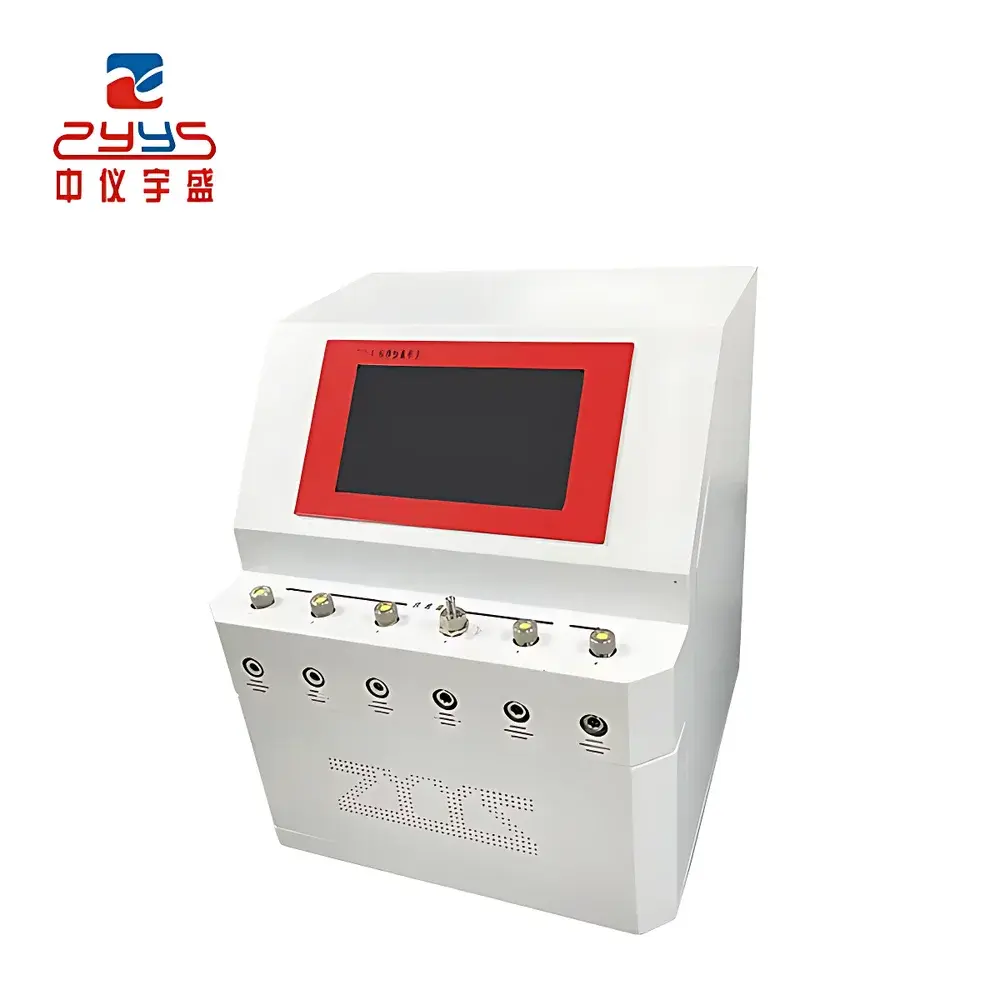
Zhongyi Yusheng STP-6 Multifunctional Standard Sample Loading Platform for Thermal Desorption Tubes
| Brand | Zhongyi Yusheng |
|---|---|
| Origin | Beijing, China |
| Manufacturer Type | Direct Manufacturer |
| Product Category | Domestic |
| Model | STP-6 |
| Instrument Type | Multifunctional Autosampler |
| Maximum Sample Positions | 6 |
| Repeat Injection Capability | Unlimited cycles per tube |
| Flow Control | Mass Flow Controller (MFC) |
| Vaporization Chamber | Heated, Temperature-Controlled |
| Valve Architecture | Integrated Solenoid Valve Manifold |
| User Interface | Standalone Touchscreen Control Panel |
| Power Supply | 220 V / 110 V (±10%), 50 Hz / 60 Hz (±2%) |
Overview
The Zhongyi Yusheng STP-6 Multifunctional Standard Sample Loading Platform is a dedicated benchtop instrument engineered for precise, reproducible loading of certified reference standards—gaseous or liquid—into thermal desorption (TD) sampling tubes. It operates on the principle of dynamic standard addition: analytes are introduced as vapor-phase standards via controlled mass flow, swept through conditioned adsorbent-packed tubes under defined temperature and residence time conditions to replicate real-world sampling kinetics and adsorption equilibria. Unlike passive spiking methods, the STP-6 enables quantitative, trace-level calibration across volatile organic compounds (VOCs), semi-volatile organic compounds (SVOCs), and targeted environmental markers by simulating field collection efficiency—including breakthrough behavior, adsorption capacity, and tube aging effects. Its design supports method development, system suitability testing, and routine QC verification in compliance with EPA TO-17, ISO 16017-1, and ASTM D6196 protocols for thermal desorption–gas chromatography/mass spectrometry (TD–GC/MS) workflows.
Key Features
- Six-position tube carousel with indexed, repeatable positioning for unattended sequential loading of up to six TD tubes per batch.
- Integrated mass flow controller (MFC) enabling programmable, stable flow rates from 10 to 500 mL/min (N₂ or synthetic air), calibrated traceably to NIST-traceable standards.
- Automated solenoid valve manifold for precise, timed introduction of standard gas pulses—eliminating volumetric syringe or pressure-based delivery errors inherent in manual injection.
- Electrically heated vaporization chamber (ambient to 300 °C, ±1 °C stability) ensures complete volatilization of high-boiling-point standards (e.g., naphthalene, phenanthrene, phthalates) without condensation or wall adsorption losses.
- Minimized internal dead volume via integrated stainless-steel valve routing and short-path PTFE-lined transfer lines (<15 cm total length), reducing carryover and improving response linearity.
- Self-contained touchscreen HMI with intuitive icon-driven navigation, onboard method storage (≥100 protocols), and real-time display of flow rate, temperature, valve status, and elapsed loading time.
Sample Compatibility & Compliance
The STP-6 accommodates industry-standard 6 mm OD × 89 mm length stainless-steel or quartz thermal desorption tubes packed with single- or multi-bed sorbents (e.g., Tenax TA, Carbopack B/C, Carboxen 1000). It supports both liquid standard dilutions (via external syringe pump integration) and certified gas mixtures (ppb–ppm range) delivered through certified regulators and crimp-seal fittings. The platform meets mechanical and electrical safety requirements per IEC 61010-1:2010 and complies with electromagnetic compatibility (EMC) Class B limits. While not FDA-cleared, its operational repeatability, audit-ready parameter logging, and deterministic valve sequencing support GLP/GMP-aligned laboratory practices—including full traceability for calibration certificate generation per ISO/IEC 17025:2017 Annex A.5.
Software & Data Management
The STP-6 operates autonomously without PC dependency; however, optional RS-232 or USB-C serial interface enables bidirectional communication with LIMS or chromatography data systems (CDS). All method parameters—including flow setpoint, vaporization temperature, sweep duration, and valve timing—are timestamped and stored locally with firmware-enforced write protection. Exportable CSV logs include operator ID (via optional RFID badge reader), tube barcode (when paired with external scanner), and deviation alerts for out-of-spec conditions (e.g., flow drift >±2% over 30 s). Audit trail functionality satisfies 21 CFR Part 11 requirements when used with validated third-party CDS platforms supporting electronic signatures and secure user access control.
Applications
- Preparation of calibration standards for EPA Method TO-17 analysis of ambient, indoor, and workplace air samples.
- Verification of TD tube performance—adsorption efficiency, breakthrough volume, and thermal desorption recovery—prior to regulatory submission.
- Method validation studies assessing matrix interference, humidity effects, and co-elution risks in complex environmental matrices.
- QC/QA of automated TD–GC/MS systems through daily system suitability tests using trace-level benzene, toluene, ethylbenzene, and xylenes (BTEX) spikes.
- Research-scale investigation of sorbent–analyte interaction thermodynamics using variable temperature and flow ramping protocols.
FAQ
Can the STP-6 load liquid standards directly into the tube?
No—the STP-6 is designed for vapor-phase standard introduction. Liquid standards must first be volatilized externally (e.g., via heated syringe or diffusion source) or introduced using an optional auxiliary liquid injection module (sold separately).
Is tube conditioning supported on the STP-6?
Tube conditioning (baking under inert gas flow) is not a built-in function; however, the platform’s MFC and heating capabilities allow users to configure custom “blank purge” protocols mimicking conditioning steps when paired with compatible oven accessories.
Does the STP-6 require external gas supply?
Yes—a regulated supply of ultra-high-purity nitrogen or synthetic air (≤1 ppb hydrocarbon grade) is required for carrier and purge gas functions. Gas purity directly impacts baseline stability and low-level detection fidelity.
How is calibration of the mass flow controller performed?
The MFC is factory-calibrated against NIST-traceable flow standards. Users may perform field verification using a secondary thermal mass flow meter; recalibration requires return to authorized service center.
What tube types are mechanically compatible?
Standard 6 mm OD × 89 mm length TD tubes with threaded or compression-style end fittings. Custom-length tubes require manual alignment verification and are not guaranteed for repeatable sealing integrity.




