
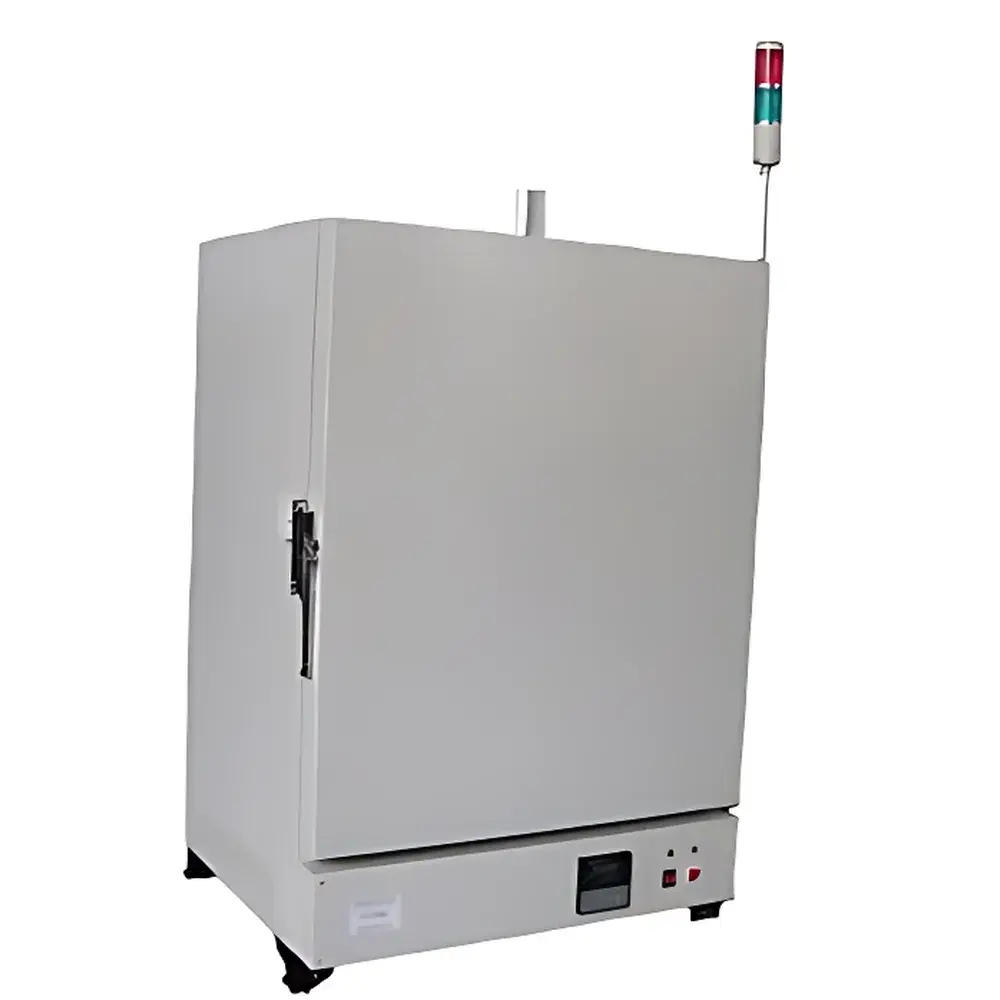
Zhuochi 151B-3X High-Temperature Sintering Oven
| Brand | Zhuochi |
|---|---|
| Origin | Zhejiang, China |
| Model | 151B-3X |
| Temperature Range | 50–600 °C |
| Temperature Uniformity | ≤ ±1.5% |
| Temperature Stability | ±1% of setpoint |
| Rated Power | 7500 W |
| Voltage | 380 V, 50 Hz |
| Interior Dimensions (W×D×H) | 500 × 600 × 750 mm |
| Shelf Capacity | ≥15 kg per shelf (2 adjustable shelves) |
| Control System | LTDE modular programmable PID controller with 30-segment ramp-soak programming |
| Heating Method | Stainless steel heating elements with distributed forced-air circulation (imported point-distribution technology) |
| Insulation | Ceramic fiber (aluminosilicate wool) |
| Safety Features | Dual-stage overtemperature protection, thermal cutoff relay, fuse, earth leakage circuit breaker, door interlock switch, visual alarm indicator |
| Temperature Sensor | Type K thermocouple |
| Timer Range | 0–9999 minutes |
| Exhaust Port | Rear and top mounted |
| Optional | RS-232/RS-485 interface, data logging software, printer output |
Overview
The Zhuochi 151B-3X High-Temperature Sintering Oven is an industrial-grade laboratory furnace engineered for precision thermal processing in materials science, polymer engineering, and electrical insulation testing. Designed to operate continuously within a calibrated temperature range of 50 °C to 600 °C, it employs a robust forced-air convection system based on imported point-distribution airflow architecture—eliminating the need for internal turntables while ensuring uniform thermal distribution across the full working chamber (≤ ±1.5% spatial uniformity). Its core thermal regulation relies on a modular LTDE programmable PID controller, capable of executing up to 30 independent ramp-and-soak segments with user-defined heating/cooling rates. This architecture supports repeatable thermal profiles essential for sintering fluoropolymers (e.g., PTFE, FEP), curing elastomeric compounds, aging insulating materials, and post-processing welding electrodes—applications requiring strict adherence to ASTM D3418, IEC 60216, and ISO 2133 thermal endurance protocols.
Key Features
- Modular LTDE control system with 30-segment programmable PID algorithm, enabling precise definition of heating rate (°C/min), soak duration, and cooling slope
- Distributed forced-air circulation using a gear-driven balanced impeller and optimized duct layout—validated to achieve ≤ ±1.5% temperature deviation across the 500 × 600 × 750 mm working volume without mechanical rotation
- High-efficiency thermal insulation comprising high-purity aluminosilicate ceramic fiber (density ≥128 kg/m³), minimizing standby heat loss and improving energy utilization by >35% versus conventional mineral wool designs
- Double-layer construction: exterior cold-rolled steel with anti-corrosion high-temp powder coating; interior 304 stainless steel chamber with seamless welded corners for chemical resistance and easy decontamination
- Redundant safety architecture including primary and secondary overtemperature cutoffs, ELCB-rated earth leakage protection, door-actuated interlock switch, and visual status indicator with stage-specific LED signaling (heating, soaking, alarm)
- Standard RS-232 port (RS-485 optional via converter) for integration with SCADA systems or third-party data acquisition platforms supporting Modbus RTU protocol
Sample Compatibility & Compliance
The 151B-3X accommodates diverse sample geometries and material classes—including pre-sintered ceramic green bodies, fluoropolymer compression-molded blanks, vulcanized rubber test plaques, and insulated wire specimens—within its 500 × 600 × 750 mm chamber. Two independently adjustable stainless steel shelves support ≥15 kg load per level, with vertical spacing optimized for convective boundary layer development. The oven meets structural and operational requirements referenced in ISO 17025-accredited laboratories for thermal aging validation, and its temperature stability (±1% of setpoint) satisfies calibration traceability needs under ILAC-P14 guidelines. While not certified to UL 61010-1 or EN 61000-6-3 out-of-the-box, its electrical safety design incorporates components compliant with IEC 60335-1 and IEC 61000-4 immunity standards. For GxP environments, optional audit-trail-enabled software (sold separately) supports 21 CFR Part 11-compliant electronic records when deployed with validated timestamping and user authentication modules.
Software & Data Management
The LTDE controller supports local parameter configuration via intuitive membrane keypad and dual-line LCD display. Optional PC-based software enables remote monitoring, real-time graphing, and automated report generation—including CSV export of time-stamped temperature logs at user-selectable intervals (1–600 seconds). When paired with the RS-232/RS-485 interface module, the system transmits live process variables (PV, SV, status flags) using ASCII-based command-response protocol compatible with LabVIEW, MATLAB, and Python-based DAQ frameworks. All stored programs and runtime logs are retained during power interruption due to non-volatile EEPROM memory. Firmware updates are performed via USB-to-serial adapter without hardware modification, ensuring long-term maintainability and compatibility with evolving laboratory IT infrastructure.
Applications
- Sintering of polytetrafluoroethylene (PTFE) and fluorinated ethylene propylene (FEP) compacts under controlled ramp-hold-cool cycles per ASTM D4894
- Thermal aging of electrical insulation materials (e.g., silicone rubber, polyimide films) per IEC 60216 and UL 746B accelerated life testing protocols
- Post-cure stabilization of heat-resistant elastomers and thermoset composites used in aerospace sealing applications
- Drying and binder burnout of ceramic injection molding (CIM) feedstocks prior to furnace sintering
- Pre-conditioning of welding electrodes per AWS A5.1 and ISO 2560 specifications
- Stability testing of high-temperature adhesives and encapsulants in electronics packaging R&D
FAQ
What is the maximum continuous operating temperature of the 151B-3X?
The oven is rated for continuous operation up to 600 °C, with thermal stability maintained within ±1% of the setpoint across the full range.
Does the unit include validation documentation for IQ/OQ protocols?
Factory-installed temperature mapping reports and calibration certificates (traceable to NIM, China) are provided. Full IQ/OQ documentation packages are available upon request and require on-site execution by qualified service engineers.
Can the forced-air system be disabled for static-heating applications?
No—the point-distribution blower operates continuously during active heating and soaking phases to ensure uniformity; however, airflow velocity is dynamically modulated to match thermal load conditions.
Is the interior chamber resistant to halogenated acid vapors generated during PTFE sintering?
Yes—the 304 stainless steel liner exhibits high resistance to HF and HCl off-gassing under typical sintering conditions; for extended exposure, optional passivation treatment and dedicated exhaust ducting are recommended.
What maintenance intervals are specified for the heating elements and thermal insulation?
Heating elements require visual inspection every 500 operating hours; ceramic fiber insulation has a service life exceeding 10,000 hours at ≤550 °C and does not require replacement under normal use.



