
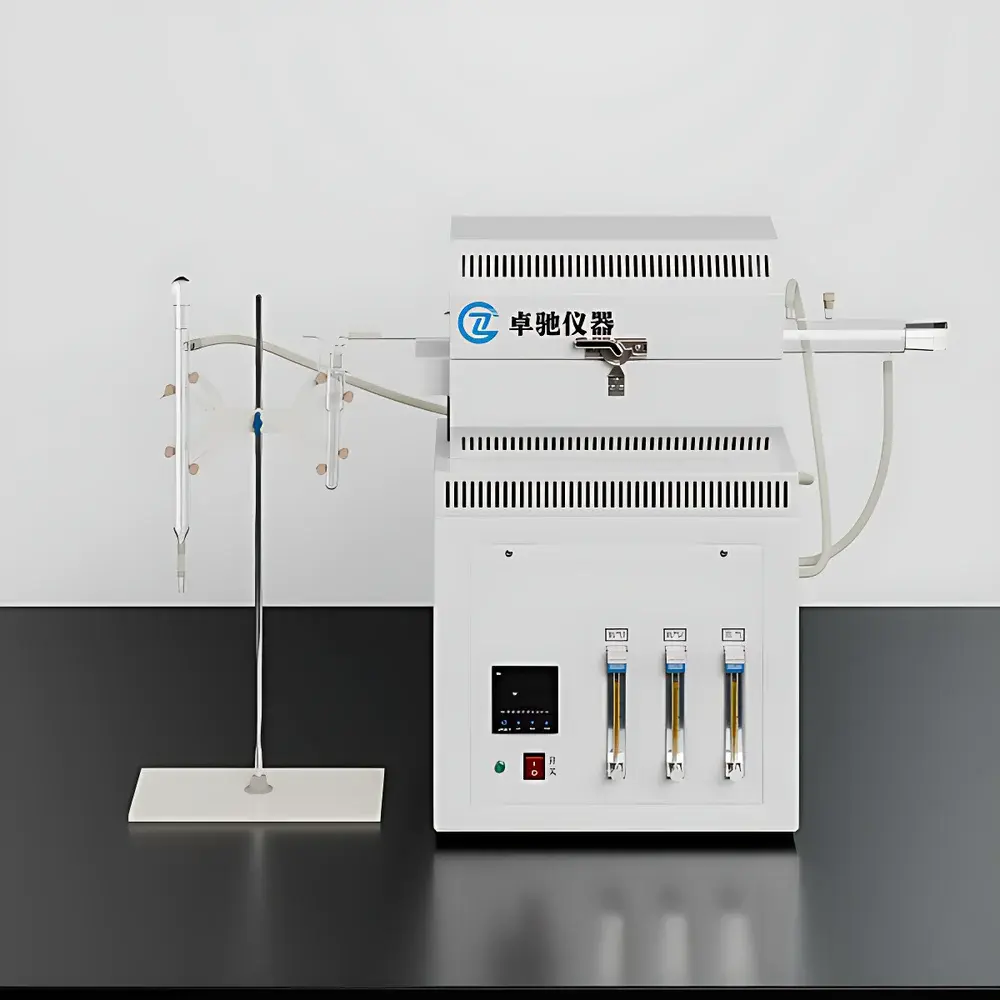
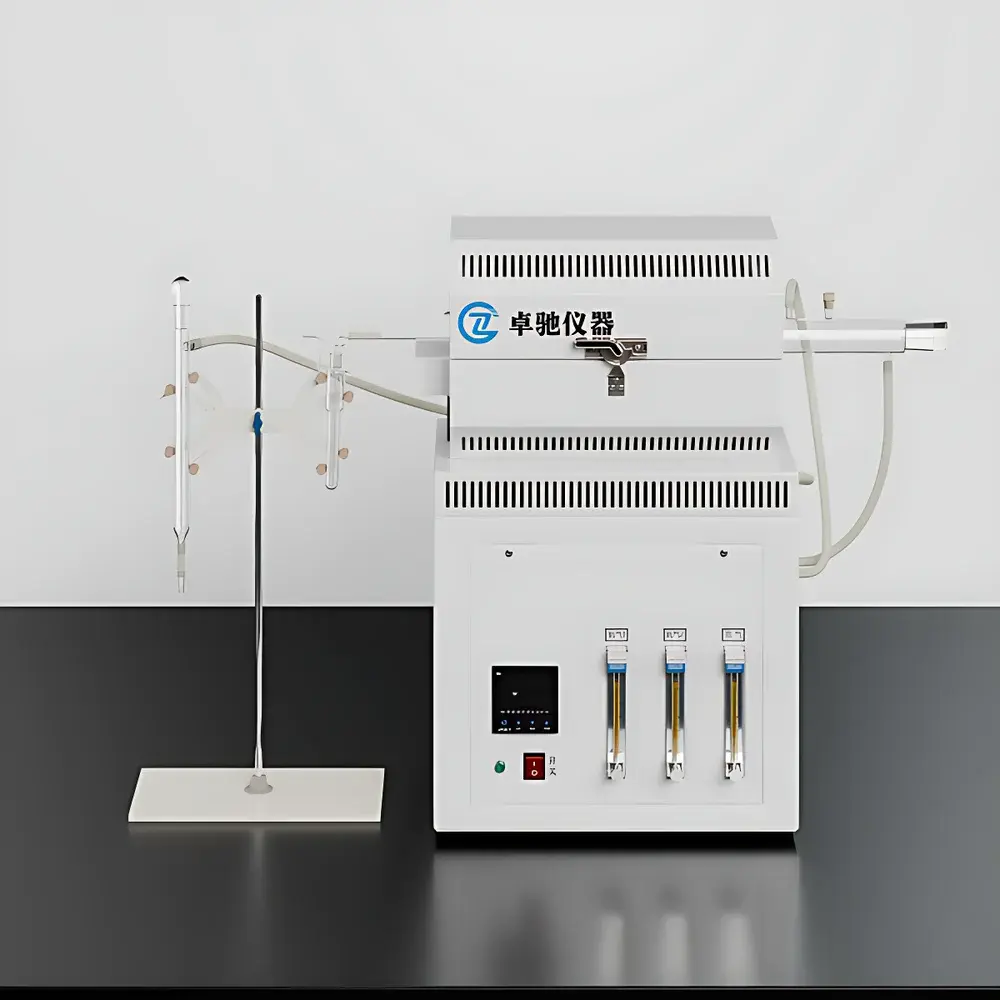
Zhuochi AOX-3 High-Temperature Combustion Furnace for Adsorbable Organic Halogens (AOX) Analysis
| Brand | Zhuochi |
|---|---|
| Model | AOX-3 Standard |
| Origin | Zhejiang, China |
| Instrument Type | Laboratory Water Quality Analyzer |
| Detection Principle | High-Temperature Catalytic Combustion Coupled with Ion Chromatography or Microcoulometric Detection |
| Measurement Range | 0.8 µg/L to 1000 µg/L |
| Combustion Temperature | Up to 1150 °C |
| Sample Introduction | Nitrogen-pressurized Column Adsorption (Activated Carbon Cartridge) |
| Sample Mass | 5–1000 mg |
| Analysis Time (Combustion & Detection Cycle) | 3–10 min (excluding sample pre-concentration) |
| Carrier Gas | Oxygen ≥99.6% (99.999% recommended) |
| Sample Boat | Modified Quartz Boat for Direct Injection |
| Compliance | HJ/T 83–2001, ISO 9562:1989, GB/T 15959–1995 |
Overview
The Zhuochi AOX-3 High-Temperature Combustion Furnace is a dedicated laboratory instrument engineered for the quantitative determination of Adsorbable Organic Halogens (AOX) in environmental water and solid matrices. It operates on the principle of high-temperature catalytic combustion (up to 1150 °C) under controlled oxygen atmosphere, converting organically bound halogens (Cl, Br, I) into inorganic halide ions (Cl⁻, Br⁻, I⁻), which are subsequently trapped in an alkaline absorption solution and quantified using either ion chromatography (IC) or microcoulometric titration. This method aligns rigorously with internationally recognized standard protocols—including HJ/T 83–2001 (China EPA), ISO 9562:1989, and GB/T 15959–1995—ensuring analytical traceability, inter-laboratory comparability, and regulatory acceptability for environmental compliance reporting.
Key Features
- Thermally stable furnace architecture with precise digital temperature control (±5 °C) across the full operational range (800–1150 °C), enabling reproducible thermal decomposition of refractory organic halogen compounds.
- Integrated nitrogen-pressurized adsorption module compatible with standardized activated carbon cartridges (e.g., XAD-4 or equivalent), supporting consistent sample loading and minimizing breakthrough during pre-concentration.
- Modified quartz sample boat design allows direct injection of liquid, slurry, or finely ground solid samples—eliminating manual transfer steps and reducing contamination risk and analyst variability.
- Optimized gas flow path with calibrated oxygen delivery (99.6% minimum purity; 99.999% recommended for low-background analysis) and integrated moisture trap to prevent interference from combustion byproducts.
- Compact benchtop footprint (W × D × H: 420 × 380 × 520 mm) with front-access service panel and ceramic-insulated heating zone for safe, long-term operation in regulated laboratory environments.
Sample Compatibility & Compliance
The AOX-3 supports diverse sample types per standard method requirements: drinking water, surface water, groundwater, wastewater (including industrial effluents and pulp mill discharges), seawater, treated effluent, soil extracts, sediment slurries, sludge digests, and waste oils. All analyses adhere to the column adsorption–combustion–absorption workflow specified in HJ/T 83–2001 and ISO 9562. The system is fully compatible with GLP-compliant workflows when paired with validated IC or microcoulometric detection systems that support audit trails, electronic signatures, and 21 CFR Part 11–compliant data handling. Routine performance verification includes system suitability testing using certified AOX reference standards (e.g., chlorophenol mixtures) and procedural blanks at ≤0.5 µg/L detection limit confidence.
Software & Data Management
As a hardware-only combustion interface, the AOX-3 does not include embedded firmware or proprietary software. It functions as a deterministic, analog-output-free thermal module designed for seamless integration into existing analytical platforms. Users connect the absorption solution outlet directly to their ion chromatograph’s autosampler or microcoulometer’s injection port. Full traceability is maintained through laboratory information management systems (LIMS) or chromatography data systems (CDS) that log furnace run parameters (temperature setpoint, duration, gas flow rate), sample ID, operator, and calibration history. Method templates for AOX analysis can be configured in common CDS platforms (e.g., Thermo Chromeleon, Metrohm MagIC Net, or Dionex IC solutions) to enforce sequence validation and automatic calculation of AOX concentration (µg/L or µg/g dry weight) based on detector response and sample volume/mass.
Applications
The AOX-3 serves critical roles in environmental quality assurance and regulatory monitoring programs. It is routinely deployed in municipal water utilities for source water screening, in industrial pretreatment labs for effluent characterization prior to discharge permitting (e.g., pulp/paper, pharmaceutical, agrochemical sectors), and in third-party environmental testing laboratories accredited to ISO/IEC 17025. Its rapid cycle time (3–10 minutes per combustion event) enables high-throughput batch processing—particularly advantageous for daily compliance monitoring of wastewater treatment plants operating under national AOX discharge limits (e.g., EU BAT conclusions for pulp industry, China’s Integrated Wastewater Discharge Standard GB 8978). Additionally, it supports research applications such as fate-and-transport studies of halogenated pollutants in sediments and bioaccumulation assessments in aquatic biota tissues.
FAQ
What detection methods are compatible with the AOX-3 furnace?
Ion chromatography (with suppressed conductivity detection) and microcoulometric titration are the two primary detection techniques validated for use with this system, per HJ/T 83–2001 and ISO 9562.
Is the AOX-3 suitable for solid samples like soils or sludges?
Yes—when combined with standardized extraction protocols (e.g., ultrasonic-assisted leaching or Soxhlet extraction followed by pH adjustment), solid-phase samples are loaded onto the activated carbon cartridge using the nitrogen-pressurized adsorption module.
Does the furnace require routine calibration with certified standards?
While the furnace itself does not require calibration, system performance must be verified before each analytical batch using AOX reference materials (e.g., 2,4-dichlorophenol) to confirm recovery (85–115%) and method detection limit (MDL ≤0.8 µg/L).
Can the AOX-3 be operated unattended for extended periods?
It is designed for supervised operation; continuous unattended runs are not recommended due to manual sample loading, absorption solution replacement, and post-run cooling requirements—though up to 20–30 sequential runs per day are feasible with trained personnel.
What maintenance intervals are recommended for long-term reliability?
Quartz combustion tube inspection every 200 runs, ceramic insulation check annually, oxygen line filter replacement quarterly, and full gas-path leak test prior to each calibration verification cycle.







