
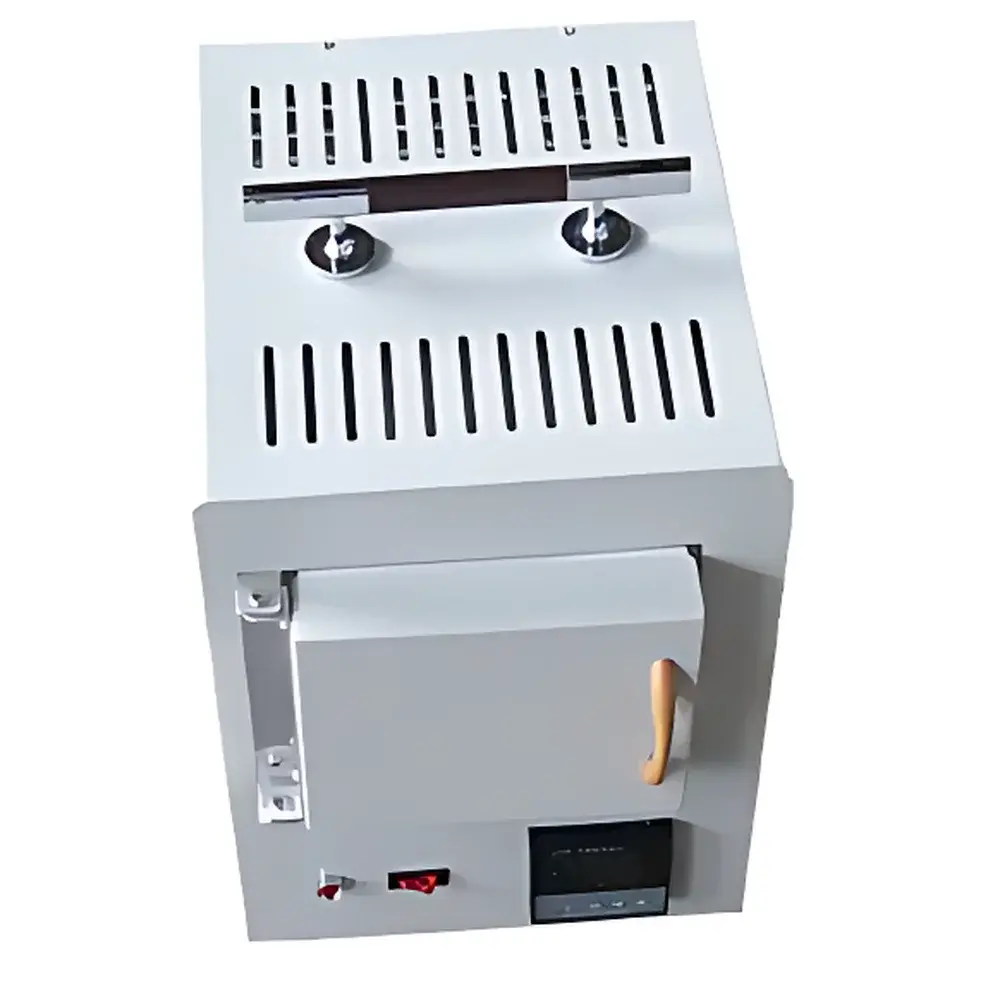
Zhuochi Ceramic Fiber Muffle Furnace SX3-1.5-10
| Brand | Zhuochi |
|---|---|
| Origin | Zhejiang, China |
| Model | SX3-1.5-10 |
| Type | Box-type Muffle Furnace |
| Max Temperature | 1000 °C |
| Temperature Uniformity | ±1 °C |
| Power Rating | 1.5 kW |
| Heating Rate (to max temp) | ≤50 min |
| Heating Element | High-temp Resistance Wire |
| Internal Chamber Dimensions | 165 × 120 × 105 mm |
| External Dimensions | 320 × 260 × 420 mm |
| Net Weight | ~20 kg |
| Voltage/Frequency | 220 V, 50 Hz |
| Temperature Sensor | K-type Thermocouple |
| Control System | LTDE 30-segment Programmable PID Controller with Dual Over-Temperature Protection |
| Insulation | Six-sided Modular Ceramic Fiber Board |
| Cooling Method | Natural Air Convection |
Overview
The Zhuochi Ceramic Fiber Muffle Furnace SX3-1.5-10 is a compact, high-efficiency box-type laboratory furnace engineered for precise thermal processing in academic, industrial, and quality control environments. Utilizing advanced ceramic fiber insulation technology, this muffle furnace achieves rapid thermal response and exceptional energy efficiency—reducing heat loss by over 70% compared to traditional refractory brick-lined furnaces. Its core operating principle relies on resistive heating via high-purity resistance wire elements, coupled with real-time feedback from a calibrated K-type thermocouple positioned at the rear upper wall of the chamber. The furnace maintains stable operation across its full working range (100–1000 °C), delivering consistent thermal profiles essential for ashing, calcination, sintering, heat treatment, and pre-conditioning of materials prior to elemental or structural analysis.
Key Features
- Ceramic fiber chamber construction: Six-sided modular ultra-lightweight alumina-silica fiber board (density < 200 kg/m³) enables rapid heating (≤50 min to 1000 °C), low thermal mass, and high thermal shock resistance—capable of repeated cycling between ambient and maximum temperature without degradation.
- Precision programmable control: Integrated LTDE 30-segment programmable controller supports ramp-hold-soak profiles, automatic shutdown, and time-based operation. PID + SSR (Solid-State Relay) coordinated regulation ensures temperature stability within ±1 °C at setpoint, with display resolution of 1 °C.
- Dual-stage over-temperature protection: Independent secondary safety circuit interrupts power if primary control fails, complying with IEC 61000-4-2/4-4 immunity standards and supporting GLP-compliant lab practices.
- Plug-and-play design: Fully pre-wired assembly eliminates field wiring errors; controller housed beneath furnace base with factory-installed compensation leads and terminal connections—ready for immediate 220 V AC operation upon installation.
- Optimized ergonomics & footprint: External dimensions (320 × 260 × 420 mm) enclose an unusually spacious internal chamber (165 × 120 × 105 mm), achieving >50% greater usable volume than conventional furnaces of comparable external size.
Sample Compatibility & Compliance
The SX3-1.5-10 accommodates standard crucibles (alumina, quartz, stainless steel), petri dishes, and small-volume sample boats up to 100 mL capacity. Its sealed muffle configuration isolates samples from combustion byproducts and external atmosphere, making it suitable for ASTM E1868 (ash content determination), ISO 1171 (determination of ash in coal and coke), and USP <231> heavy metal testing protocols. The furnace meets CE marking requirements for electromagnetic compatibility (EMC Directive 2014/30/EU) and low-voltage safety (LVD Directive 2014/35/EU). While not certified for hazardous location use, its air-cooled enclosure and non-explosive heating method align with OSHA 1910.1200 (HCS) and NFPA 45 laboratory safety guidelines.
Software & Data Management
This model operates as a standalone instrument with no embedded data logging or USB/RS-485 interface. However, the LTDE controller supports analog output (0–5 V or 4–20 mA) for connection to external chart recorders or SCADA systems. For regulated environments requiring audit trails (e.g., pharmaceutical QC labs), users may integrate third-party data acquisition hardware compliant with FDA 21 CFR Part 11—provided validation documentation covers sensor calibration traceability (NIST-traceable K-type thermocouples), controller firmware versioning, and electronic signature implementation. All operational parameters—including ramp rates, hold durations, and final soak temperatures—are fully configurable and repeatable per batch.
Applications
- Ash residue quantification in food, feed, and environmental samples (AOAC 942.05, EPA Method 200.7)
- Pre-treatment of catalysts and battery electrode materials prior to XRD or BET surface area analysis
- Thermal gravimetric conditioning of polymer composites and ceramics
- Residue ignition in pharmaceutical excipient purity testing (Ph. Eur. 2.2.34)
- Calibration verification of thermocouples and RTDs using fixed-point reference materials (e.g., Al, Zn melting points)
- Small-batch annealing of thin-film substrates in microelectronics R&D
FAQ
What is the recommended maintenance schedule for the ceramic fiber chamber?
Inspect the chamber lining annually for cracks or compression deformation; replace if visible fiber shedding occurs or if dimensional stability degrades beyond ±2 mm tolerance.
Can this furnace be used under inert gas purge?
No—this model lacks gas inlet/outlet ports or pressure-rated seals. For controlled-atmosphere applications, consider dual-shell variants (e.g., SX3-3-12) with optional quartz tube inserts.
Is the LTDE controller compatible with LabVIEW or MATLAB?
Not natively; analog voltage/current output must be interfaced via external DAQ hardware with appropriate signal conditioning and driver support.
Does the furnace meet ISO/IEC 17025 calibration requirements?
The unit itself is not accredited, but its K-type thermocouple and controller can be calibrated per ISO/IEC 17025 by an accredited lab—documentation must include as-found/as-left data, uncertainty budgets, and traceability to national standards.
What is the expected service life of the heating element under continuous 1000 °C operation?
Resistance wire elements typically last 3,000–5,000 hours at rated temperature; lifespan increases significantly when operated below 900 °C or with intermittent duty cycles.



