
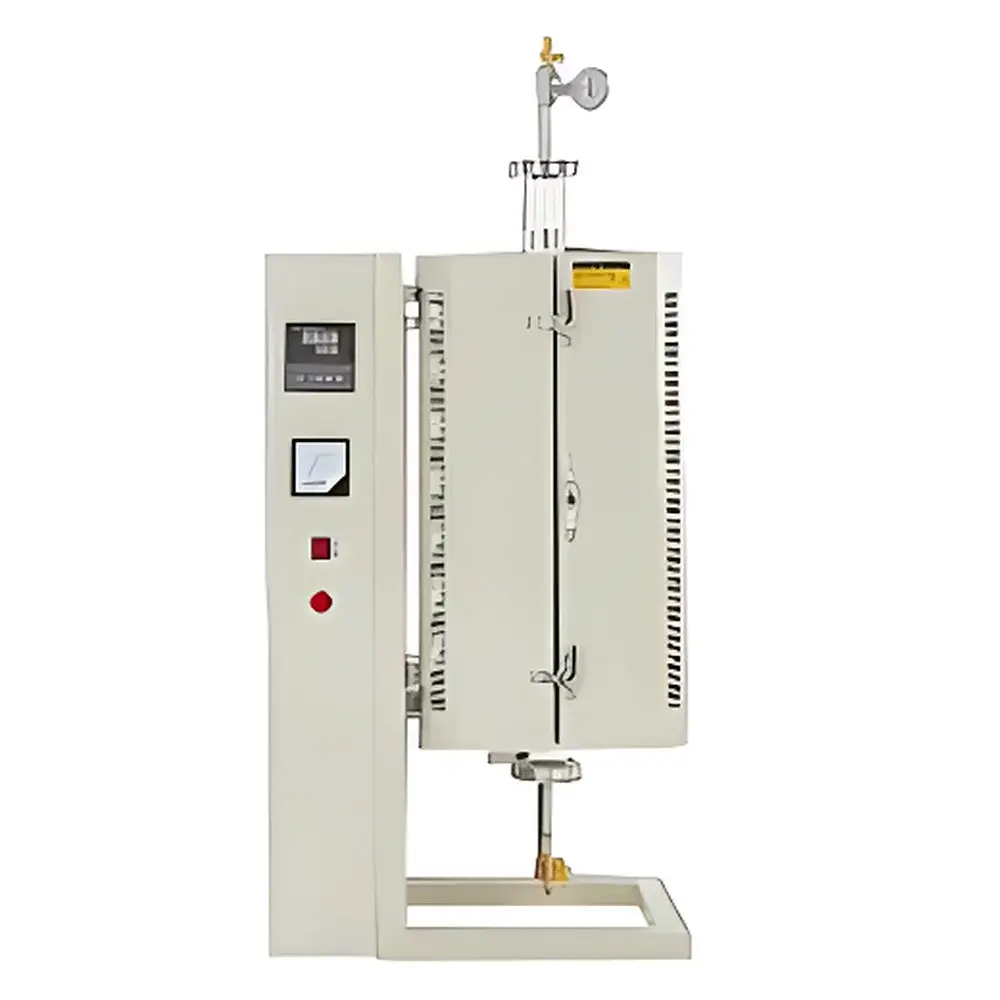
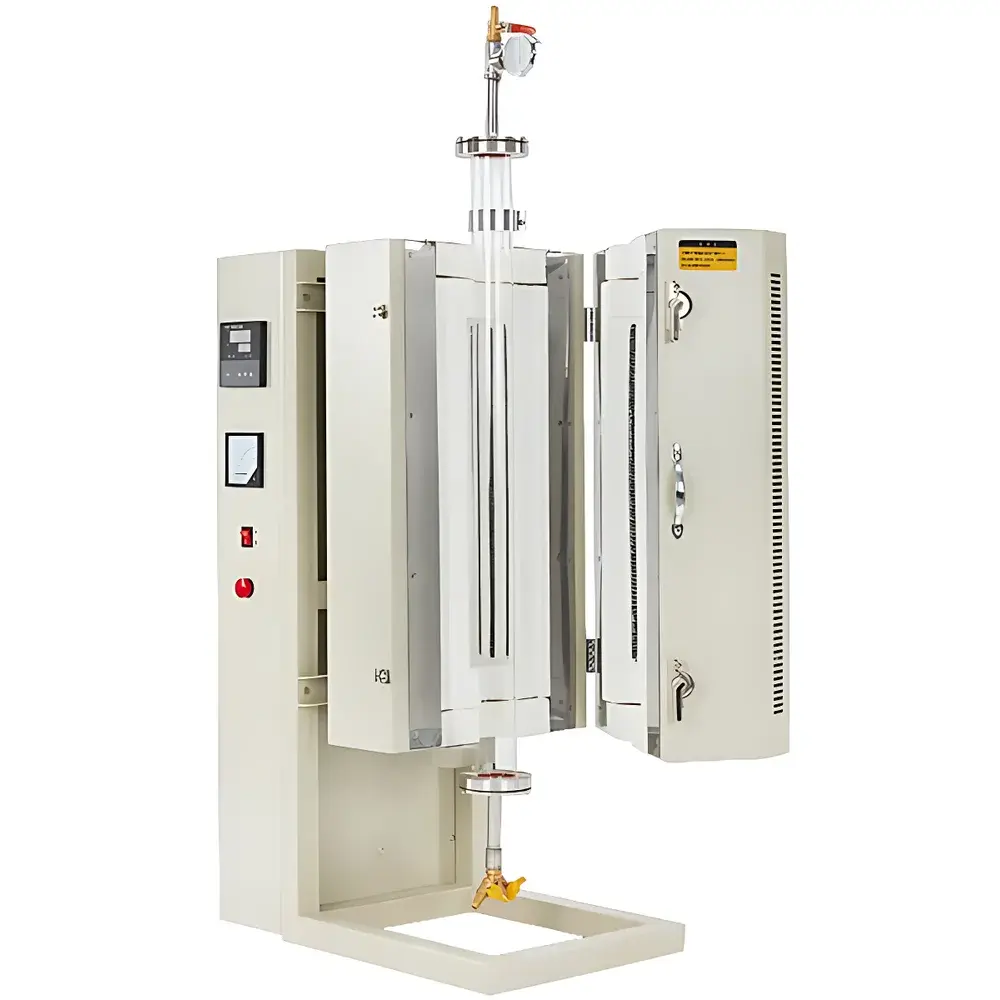
Zhuochi SG-GL1100K Vertical High-Precision Vacuum Tube Furnace
| Brand | Zhuochi |
|---|---|
| Origin | Zhejiang, China |
| Model | SG-GL1100K (Vertical) |
| Max Temperature | 1100 °C |
| Temperature Uniformity | ±1 °C |
| Control Accuracy | ±1 °C |
| Max Power | 2.5 kW |
| Heating Rate | ≤30 °C/min (adjustable) |
| Heating Element | 0Cr27Al7Mo2 alloy wire |
| Internal Chamber Diameter | φ40 mm / φ60 mm |
| Vacuum Level | −0.1 MPa |
| Thermocouple Type | K-type |
| Power Supply | 220 V, 50 Hz |
| Furnace Length (Heating Zone) | 500 mm |
| Overall Dimensions | 430 × 590 × 1010 mm |
Overview
The Zhuochi SG-GL1100K Vertical High-Precision Vacuum Tube Furnace is a rigorously engineered thermal processing system designed for controlled-atmosphere and vacuum-based high-temperature experiments in academic laboratories, materials research centers, and R&D facilities. Built upon the principles of resistive heating and precise thermoelectric feedback control, this vertical tube furnace delivers stable, repeatable thermal profiles across a working range of 100 °C to 1100 °C. Its vertical orientation optimizes space utilization and facilitates gravity-assisted sample loading—particularly advantageous for powder sintering, CVD precursor decomposition, and gas-phase reaction studies. The furnace integrates a dual-layer thermal architecture: an outer cold-rolled steel shell with phosphate conversion coating and electrostatic polymer finish (computer gray), and an inner high-purity alumina polycrystalline fiber insulation chamber offering low thermal conductivity (<0.08 W/m·K at 1000 °C) and exceptional thermal shock resistance. This design ensures energy efficiency, rapid cooldown, and long-term structural integrity under cyclic thermal stress.
Key Features
- Vertical configuration with bottom-access heating zone and top-loading tube port—enabling safe, ergonomic handling of fragile quartz or ceramic tubes.
- High-stability temperature control via LTDE programmable PID controller with K-type thermocouple input; ±1 °C accuracy over full range and <±1 °C temperature fluctuation during steady-state operation.
- Multi-stage programmable ramp-soak profiles (up to 30 segments), with independent control of heating rate (0.1–30 °C/min), dwell time, and cooling logic.
- Integrated dual-level overtemperature protection: primary electronic cutoff at setpoint +10 °C and secondary mechanical fuse activation at 1150 °C.
- Vacuum-compatible flange assembly (CF or ISO-KF compatible per custom request) with Viton O-rings rated to 200 °C and −0.1 MPa absolute vacuum performance.
- Modular tube compatibility: supports standard quartz tubes (φ40 mm, φ60 mm, φ80 mm, φ100 mm OD) with optional alumina or silicon carbide alternatives for aggressive chemical environments.
- Robust electrical architecture featuring industrial-grade solid-state relays, electromagnetic contactors, and forced-air cooling fans—designed for continuous duty cycles in GLP-compliant environments.
Sample Compatibility & Compliance
The SG-GL1100K accommodates powdered, granular, and pelletized specimens up to 500 mm in axial length within its uniformly heated zone. It is routinely deployed in ASTM C1171 (sintering behavior of advanced ceramics), ISO 11507 (UV/weathering simulation support heating), and USP (thermal stability testing of pharmaceutical excipients). The furnace’s sealed atmosphere capability supports inert gas purging (N₂, Ar), reducing atmospheres (H₂/N₂ mixtures), and reactive gas delivery (NH₃, O₂) when coupled with mass flow controllers. All electrical components comply with IEC 61000-6-3 (EMC emission standards) and IEC 61000-6-2 (immunity requirements). Optional documentation packages include Factory Acceptance Test (FAT) reports and traceable calibration certificates aligned with ISO/IEC 17025 guidelines.
Software & Data Management
While the base model utilizes the standalone LTDE controller with local keypad interface and LED display, optional RS485/Modbus RTU communication enables integration into centralized lab data acquisition networks. Third-party SCADA systems (e.g., LabVIEW, Ignition, or Siemens SIMATIC) can log real-time temperature, power draw, and alarm status with timestamped records. Audit trails—including operator ID, parameter changes, and event timestamps—are configurable to meet FDA 21 CFR Part 11 requirements when paired with validated software extensions. Data export is supported via USB memory stick (CSV format) for offline analysis in MATLAB, Python (NumPy/Pandas), or Excel.
Applications
- Controlled-atmosphere calcination of metal oxide precursors (e.g., LiCoO₂, Ni-rich NMC cathodes).
- Vacuum annealing of semiconductor wafers and thin-film substrates prior to PVD/CVD deposition.
- Thermal gravimetric analysis (TGA) pre-conditioning and post-synthesis stabilization of MOFs and COFs.
- Graphitization and carbonization of polymer-derived ceramics under argon or nitrogen.
- Low-pressure catalytic testing (e.g., Fischer–Tropsch synthesis, ammonia decomposition kinetics).
- High-temperature aging studies for battery electrode materials per IEEE 1625 and SAE J2464 protocols.
FAQ
What tube materials are compatible with the SG-GL1100K?
Standard configuration includes fused quartz tubing (max service temp: 1100 °C). Alumina (Al₂O₃) and silicon carbide (SiC) tubes are available as factory-installed options for applications requiring higher chemical resistance or mechanical strength.
Can the furnace operate under positive pressure?
Yes—when equipped with reinforced flanges and pressure-rated seals, it supports up to 0.5 bar(g) inert gas overpressure; consult engineering team for ASME BPVC Section VIII compliance documentation.
Is NIST-traceable calibration included?
A certificate of conformance with reference to ITS-90 is supplied standard. NIST-traceable calibration with uncertainty budget is available as a value-added service (lead time: 10 business days).
How is cooling managed after high-temperature runs?
Passive air cooling is standard. Forced-air auxiliary cooling kits (with variable-speed fan and thermal cutout) can be added to reduce cooldown time by ~40% without compromising thermal gradient control.
Does the system support remote monitoring via Ethernet or Wi-Fi?
Ethernet (TCP/IP) connectivity is supported through optional gateway modules. Wi-Fi is not natively integrated due to RF interference risks near high-power heating circuits; industrial cellular (LTE-M) telemetry is offered as an alternative for off-site oversight.



