
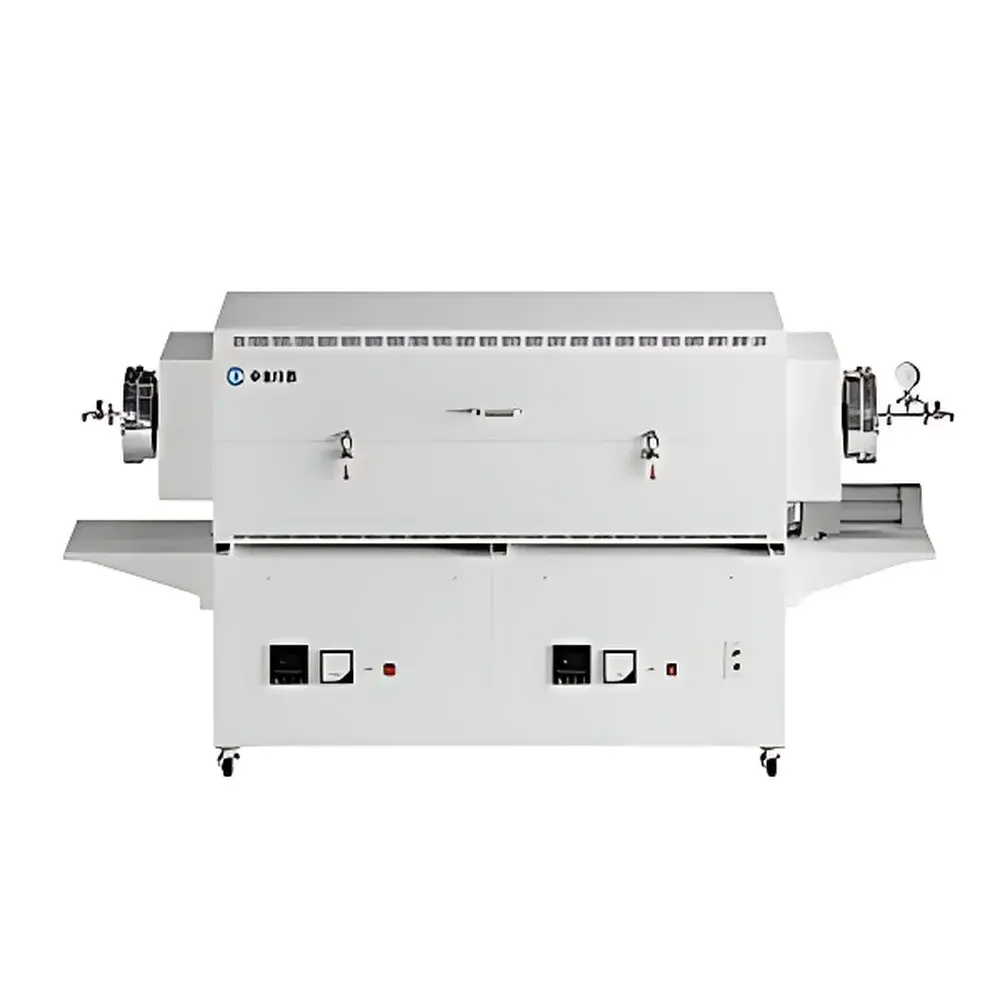
Zhuochi SG-GL1200-13 Tube Furnace for Powder Metallurgy Sintering
| Brand | Zhuochi |
|---|---|
| Origin | Zhejiang, China |
| Manufacturer Type | Authorized Distributor |
| Country of Origin | China |
| Model | SG-GL1200-13 |
| Instrument Type | Tube Furnace |
| Max Temperature | 1200 °C |
| Temperature Control Accuracy | ±1 °C |
| Max Power | 2.5 kW |
| Heating Rate (to Max Temp) | ≤30 °C/min |
| Heating Method | Resistance Wire (0Cr27Al7Mo2 Alloy) |
| Internal Chamber Dimensions | 60 mm (ID) × 400 mm (Heating Zone Length) |
| Nominal Volume | 240 L |
| Tube ID | 60 mm |
| Vacuum Capability | −0.1 MPa |
| Thermocouple Type | S-Type Platinum-Rhodium |
| Control System | LTDE Programmable PID Controller (50-Stage Ramp/Soak) |
| Tilt Angle | 15° |
| Rotation Capability | Yes |
| Cooling | Forced-air rapid cooling |
| Sealing | Stainless Steel Flange with Quartz Tube |
| Gas Flow Control | Float Flowmeter (Multi-gas compatible |
Overview
The Zhuochi SG-GL1200-13 is a high-performance programmable tube furnace engineered specifically for controlled thermal processing in powder metallurgy research and development. It operates on the principle of resistive heating using premium-grade 0Cr27Al7Mo2 alloy wire embedded within a low-thermal-mass alumina polycrystalline fiber furnace chamber. Designed for precise sintering, annealing, carburizing, and CVD precursor decomposition, the furnace delivers uniform axial temperature distribution across its 400 mm active heating zone—critical for reproducible densification of metal and ceramic powders. Its dual-shell construction, integrated forced-air cooling system, and tilting/rotating tube functionality enable process flexibility essential for laboratory-scale optimization of green compact behavior under inert, reducing, or reactive atmospheres.
Key Features
- Programmable 50-stage temperature profile control with ramp/soak capability via LTDE PID controller, supporting complex multi-step sintering cycles including dwell, cooling, and reheat sequences.
- Robust dual-layer shell structure: outer cold-rolled steel housing treated with phosphate conversion coating and electrostatic computer-gray powder coating; inner insulation composed of lightweight, high-purity alumina fiber modules with low thermal inertia.
- Quick-access design: front-opening clamshell furnace body, tiltable up to 15°, and motor-driven quartz tube rotation (optional) to ensure homogeneous particle exposure and prevent sedimentation during prolonged heating.
- High-fidelity thermal management: S-type platinum-rhodium thermocouple positioned at the furnace base for direct measurement of core temperature; ±1 °C control accuracy over full 100–1200 °C operating range.
- Gas compatibility infrastructure: stainless-steel flanged end caps, standard 60 mm OD quartz tube (with optional tapered variants: 60 mm → 100 mm → 60 mm), calibrated float flowmeters, and provision for integration with external multi-channel gas mixers and mass flow controllers.
- Safety-integrated architecture: dual independent overtemperature protection circuits, automatic power cutoff upon program completion or fault detection, and surface temperature <45 °C at ambient conditions due to optimized insulation and airflow management.
Sample Compatibility & Compliance
The SG-GL1200-13 accommodates cylindrical green compacts, pressed pellets, and loose powder charges within its 60 mm internal diameter quartz tube, with maximum sample length constrained by the 400 mm heated zone. It supports atmospheric, vacuum (−0.1 MPa), and controlled-gas environments (N₂, Ar, H₂, NH₃, CO/CO₂ mixtures), making it suitable for sintering of Fe-, Cu-, Ti-, and W-based alloys as well as oxide ceramics. The furnace meets structural and operational requirements referenced in ASTM B925-18 (Standard Guide for Sintering of Powder Metallurgy Materials) and ISO 2738-2:2019 (Sintered Metal Materials — Specifications — Part 2: Materials for General Engineering Applications). Its programmable logic and data logging interface support GLP-compliant documentation when paired with validated software platforms.
Software & Data Management
While the furnace operates natively via its embedded LTDE controller with local LCD interface, digital integration is supported through RS485 Modbus RTU communication. This enables remote monitoring, real-time temperature logging, and synchronization with laboratory information management systems (LIMS) or custom Python/Matlab scripts. All setpoints, actual temperatures, elapsed time, and alarm events are timestamped and exportable in CSV format. For regulated environments, optional validation packages—including IQ/OQ documentation templates and 21 CFR Part 11–compliant audit trail modules—are available through certified third-party service providers.
Applications
- Powder metallurgy sintering process development and optimization (solid-state, liquid-phase, and pressure-assisted variants)
- Thermal debinding of polymer-bonded metal injection molded (MIM) parts
- Controlled-atmosphere annealing of sintered components to relieve residual stress and refine microstructure
- CVD and thermal decomposition studies involving metal-organic precursors (e.g., Ni(CO)₄, TiCl₄)
- High-temperature purification of refractory metals and carbides
- Research into transient liquid phase (TLP) bonding and diffusion-controlled interfacial reactions
FAQ
What vacuum level can this furnace achieve?
The system is rated for ultimate vacuum of −0.1 MPa (100 kPa absolute) when equipped with appropriate sealing gaskets and connected to a mechanical rotary vane pump.
Is the quartz tube included standard or optional?
A straight 60 mm ID × 400 mm length fused quartz tube is supplied as standard equipment; tapered or custom-dimension tubes are available as factory options.
Can the furnace be operated under hydrogen atmosphere?
Yes—when configured with hydrogen-rated stainless-steel flanges, leak-tested seals, and appropriate ventilation and purge protocols per NFPA 55 and local safety codes.
Does the controller support data export to Excel-compatible formats?
Yes, via USB memory stick or RS485 serial connection; exported logs include date/time stamps, setpoint, PV, and status flags.
What maintenance intervals are recommended for long-term reliability?
Annual inspection of heating element continuity, thermocouple calibration verification, and fiber insulation integrity assessment are advised; no scheduled replacement of furnace lining is required under normal usage at ≤1100 °C.



