
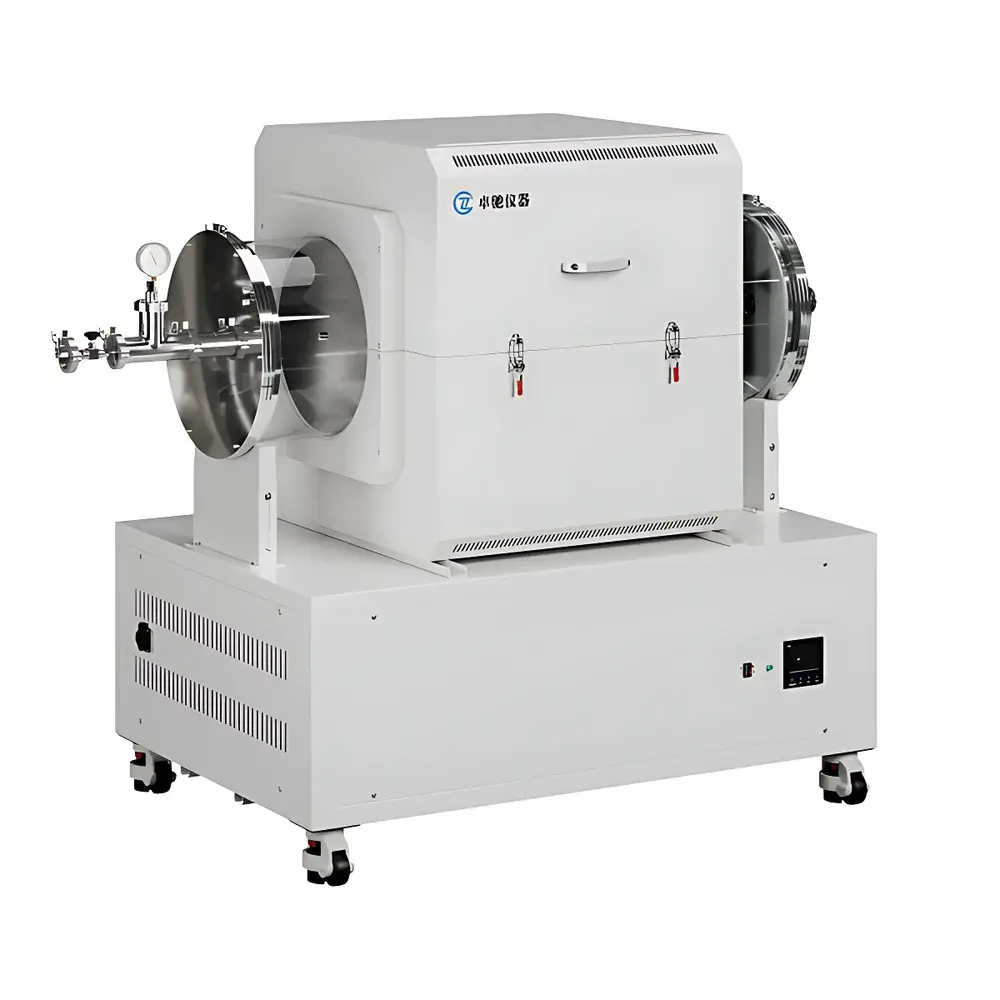
Zhuochi SG-GL1200K-400 Atmosphere-Controlled Elemental Analysis Tube Furnace for Coal and Solid Fuel Characterization
| Brand | Zhuochi |
|---|---|
| Origin | Zhejiang, China |
| Model | SG-GL1200K-400 |
| Furnace Type | Horizontal Tube Furnace |
| Max Temperature | 1200 °C |
| Temperature Uniformity | ±1 °C |
| Max Power | 18 kW |
| Heating Rate (to max temp) | ≤30 °C/min |
| Heating Method | Resistance Wire (0Cr27Al7Mo2 alloy) |
| Internal Dimensions | Ø400 mm × 700 mm |
| Effective Heating Zone | 600 mm |
| Tube ID | Ø400 mm |
| Chamber Volume | 280 L |
| Voltage/Frequency | 380 V / 50 Hz |
| Weight | 200 kg |
Overview
The Zhuochi SG-GL1200K-400 is a high-precision horizontal tube furnace engineered specifically for controlled-atmosphere thermal treatment in coal elemental analysis, proximate/ultimate analysis preparation, and solid fuel characterization workflows. Unlike standard muffle furnaces, this unit integrates a sealed quartz or high-purity alumina tube system with programmable gas inlet/outlet ports—enabling precise regulation of inert (N₂, Ar), reducing (H₂/N₂, CO), or oxidizing (air, O₂) atmospheres during thermal decomposition. Its design conforms to ASTM D3176, ISO 1171, and GB/T 212–2008 methodologies for coal ash, volatile matter, fixed carbon, and sulfur determination. The furnace operates on the principle of resistive heating via embedded 0Cr27Al7Mo2 alloy wire elements, delivering stable thermal profiles across a 600 mm uniform heating zone—critical for reproducible mass-loss measurements and quantitative residue formation under standardized ramp-hold-cool cycles.
Key Features
- High-stability temperature control: LTDE programmable PID controller with ±1 °C accuracy over full 100–1200 °C range; real-time digital display resolution of 1 °C
- Dual-stage overtemperature protection: independent mechanical and electronic cutoffs integrated into furnace architecture per IEC 61000-6-2 safety compliance
- Energy-efficient thermal design: ultra-lightweight fiberboard chamber (low heat capacity) with multi-layer ceramic fiber insulation blankets ensures rapid thermal response and minimal standby loss
- Robust mechanical construction: powder-coated cold-rolled steel outer casing (phosphate-treated + computer-gray finish); reinforced angle-steel base frame housing all electrical components and compensation wiring
- Modular gas handling interface: dual 1/4″ VCR fittings pre-installed at tube ends for seamless integration with mass flow controllers, gas purging manifolds, and exhaust scrubbers
- Programmable time-temperature profiling: up to 30 segments with independent ramp rate, dwell time, and cooling rate settings—fully compatible with GLP audit trails when paired with optional data logging modules
Sample Compatibility & Compliance
The SG-GL1200K-400 accommodates powdered coal samples (≤200 mesh), pelletized biomass, coke fines, and other granular solid fuels within its Ø400 mm × 700 mm high-purity alumina or fused quartz tube. Sample boats (ceramic or platinum) are positioned centrally in the 600 mm isothermal zone to ensure uniform thermal exposure per ASTM D5142 and ISO 29541 requirements. The furnace meets CE electromagnetic compatibility standards (EN 61326-1), complies with Class II industrial electrical safety (IEC 61010-1), and supports GMP-aligned operation through configurable password-protected parameter locking and event-log timestamping. Optional accessories include quartz wool packing, thermocouple calibration ports, and vacuum-rated flanges for sub-10⁻² mbar CVD or annealing applications.
Software & Data Management
While the base configuration utilizes an embedded LTDE controller with front-panel navigation, optional RS485/Modbus RTU or USB-to-serial interfaces enable connection to PC-based SCADA platforms (e.g., LabVIEW, MATLAB, or custom Python scripts). All temperature setpoints, actual readings, and alarm events—including overtemperature triggers and power fault codes—are timestamped and exportable as CSV. When configured with FDA 21 CFR Part 11-compliant firmware (available upon request), the system provides electronic signatures, audit trail retention ≥18 months, and role-based access control—supporting regulated coal quality assurance labs operating under ISO/IEC 17025 accreditation.
Applications
- Coal ultimate analysis sample conditioning: controlled pyrolysis under N₂ for volatile matter quantification per ASTM D3176
- Ash content determination: oxidative calcination at 750 °C in air atmosphere following ISO 1171 protocols
- Sulfur speciation pretreatment: sulfate reduction under H₂/N₂ mixtures prior to XRF or ICP-OES analysis
- Catalyst support calcination: thermal activation of Al₂O₃-, SiO₂-, or TiO₂-based carriers under inert or reducing gas flows
- Crystal structure stabilization: low-oxygen annealing of metal oxides and perovskites for XRD phase identification
- Thermal gravimetric coupling: synchronized use with TGA systems for derivative mass-loss interpretation under dynamic gas switching
FAQ
What atmosphere gases are compatible with this furnace?
Nitrogen, argon, hydrogen/nitrogen blends (5% H₂), carbon monoxide, synthetic air, and oxygen—all delivered via stainless-steel gas lines and VCR-sealed tube end caps.
Can the furnace be operated under vacuum?
Yes, when equipped with vacuum-rated flanges and a compatible mechanical pump (≤10⁻² mbar); standard configuration supports positive-pressure inert gas purging only.
Is the temperature uniformity validated across the entire heating zone?
Yes—certified uniformity of ±1 °C over the central 600 mm segment is verified using three-point thermocouple mapping per ASTM E220 calibration procedures.
Does the system meet regulatory requirements for QC laboratories?
The base unit satisfies general lab safety and EMC standards; full 21 CFR Part 11 and ISO/IEC 17025 readiness requires optional firmware upgrade and documented IQ/OQ protocols.
What maintenance is required for long-term reliability?
Annual inspection of heating element continuity, thermocouple calibration verification, and ceramic fiber integrity assessment—no routine consumables beyond periodic thermocouple replacement.



