
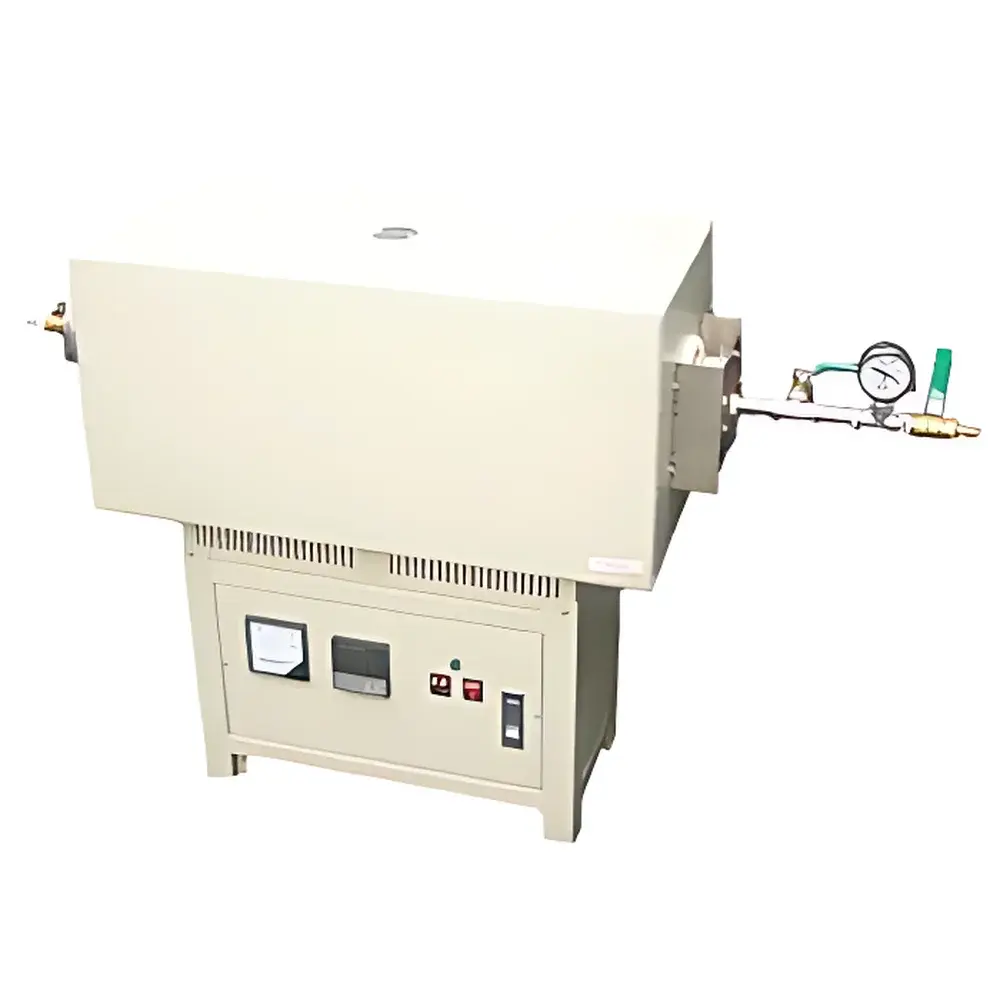
Zhuochi SK3-10-13-10 Energy-Efficient Programmable Vacuum Tube Furnace
| Brand | Zhuochi |
|---|---|
| Origin | Zhejiang, China |
| Model | SK3-10-13-10 |
| Maximum Operating Temperature | 1300 °C |
| Chamber Dimensions | Ø100 × 1000 mm |
| Rated Power | 10 kW |
| Supply Voltage | 380 V AC |
| Heating Element Material | High-Purity Kanthal A1 or Silicon Carbide (SiC) |
| Insulation | Low-Heat-Capacity Ultra-Lightweight Refractory Fiber |
| Control System | LTDE Programmable Temperature Controller (Multi-Stage Ramp/Soak/Timer) |
| Vacuum Sealing | Stainless Steel Flange with High-Temperature Viton or Ceramic-Filled Graphite Gasket |
| Optional Accessories | Digital Vacuum Gauge, Mass Flow Controller, Inert Gas Purge Kit |
Overview
The Zhuochi SK3-10-13-10 is a high-performance programmable vacuum tube furnace engineered for precise thermal processing under controlled atmospheric conditions. Designed for laboratory-scale synthesis, annealing, sintering, and heat treatment of advanced materials—including ceramics, nanomaterials, battery cathodes, and thin-film precursors—the furnace operates on resistive heating principles using high-stability alloy or silicon carbide (SiC) heating elements embedded in low-thermal-mass refractory fiber insulation. Its cylindrical quartz or alumina tube chamber (Ø100 × 1000 mm) enables uniform axial temperature distribution and rapid thermal response, while the integrated vacuum-tight sealing system supports operation from atmospheric pressure down to ≤10⁻² mbar (with optional mechanical pump). The furnace complies with standard electrical safety requirements for Class I industrial laboratory equipment (IEC 61010-1), and its thermal architecture minimizes standby energy loss—achieving typical power savings of 25–35% compared to conventional muffle furnaces of equivalent capacity.
Key Features
- Programmable LTDE temperature controller with up to 30 segment ramp-soak profiles, enabling complex thermal cycles including controlled cooling rates (down to 0.1 °C/min) and timed auto-start/shutdown functions.
- Ultra-lightweight ceramic fiber insulation reduces thermal inertia and improves temperature stability (±1 °C at 1300 °C, measured at thermocouple location) while limiting external surface temperature to <60 °C during full operation.
- Vacuum-compatible chamber assembly featuring 304 stainless steel end flanges, precision-machined O-ring grooves, and high-temperature sealing compounds rated to 1300 °C—ensuring leak rates <5 × 10⁻⁴ mbar·L/s under static vacuum conditions.
- Dual-layer tube configuration option: inner high-purity fused quartz tube (for inert/reducing atmospheres up to 1100 °C) or sintered alumina tube (Al₂O₃ ≥99.7%, usable to 1300 °C in oxidizing environments).
- Integrated safety interlocks including over-temperature cut-off (independent of main controller), door-open power disable, and real-time ground-fault monitoring per UL 61010-1.
- Modular gas inlet/outlet ports (¼” NPT) compatible with mass flow controllers and residual gas analyzers for dynamic atmosphere control and process traceability.
Sample Compatibility & Compliance
The SK3-10-13-10 accommodates cylindrical samples up to Ø90 × 950 mm and supports batch processing of powders, pellets, fibers, and coated substrates. Its chamber geometry and uniform heating profile meet ASTM C1212 (standard test method for thermal shock resistance of refractories) and ISO 8501-1 (surface preparation prior to coating) pre-conditioning requirements. When configured with optional data logging and user-accessible calibration certificates, the system supports GLP-compliant documentation workflows. While not inherently 21 CFR Part 11 compliant, the LTDE controller’s password-protected parameter editing, audit trail export (via RS485/USB), and configurable user roles enable integration into regulated QC laboratories upon validation.
Software & Data Management
The furnace operates natively via front-panel LTDE interface, but optional PC connectivity (RS485-to-USB adapter) enables remote supervision using Zhuochi’s proprietary LabFurnaceControl™ software (Windows 10/11 compatible). This application provides real-time graphing of multiple thermocouple inputs (optional K-type or S-type extension), automated CSV export of time-temperature-pressure logs, and batch ID tagging for sample traceability. All recorded datasets include timestamp, operator ID, and firmware version metadata—facilitating alignment with internal SOPs for material qualification and process repeatability reporting.
Applications
- Controlled-atmosphere synthesis of Li-ion battery cathode materials (e.g., NMC, LFP) under Ar/H₂ mixtures.
- Graphene oxide reduction and carbon nanotube annealing under vacuum or forming gas.
- Thermal gravimetric analysis (TGA) pre-conditioning and post-synthesis ash content determination.
- Pre-sintering of dental zirconia blanks and bioceramic implants under low-oxygen conditions.
- Calibration of thermocouples and reference materials per ISO/IEC 17025-accredited protocols.
- Low-temperature activation of catalyst supports (e.g., Al₂O₃, SiO₂) prior to metal loading.
FAQ
What vacuum level can the SK3-10-13-10 achieve without auxiliary pumping?
The base configuration includes a manual vacuum valve and analog vacuum gauge; ultimate pressure depends on pump selection. With a standard two-stage rotary vane pump (e.g., 4 m³/h), typical operating range is 10⁻¹–10⁻² mbar.
Is the furnace suitable for hydrogen atmosphere processing?
Yes—when equipped with alumina tube, stainless steel flanges, and H₂-rated seals (graphite-filled gaskets), it supports up to 5% H₂ in N₂ at temperatures ≤1100 °C. Full hydrogen service requires additional explosion-proof certification and purge interlocks.
Can the LTDE controller be calibrated in-house?
Yes. The controller accepts user-input offset correction for Type K thermocouples and supports verification against NIST-traceable reference thermometers per ASTM E220.
What maintenance intervals are recommended for long-term reliability?
Inspect insulation integrity and seal condition every 200 operating hours; replace quartz tubes after 50 thermal cycles above 1000 °C or upon visible devitrification; recalibrate temperature sensors annually or per usage frequency.
Does the system include CE or UL certification?
The furnace meets CE marking requirements for electromagnetic compatibility (EN 61326-1) and low-voltage directive (2014/35/EU); UL listing is available upon request for specific configurations and regional compliance packages.



