
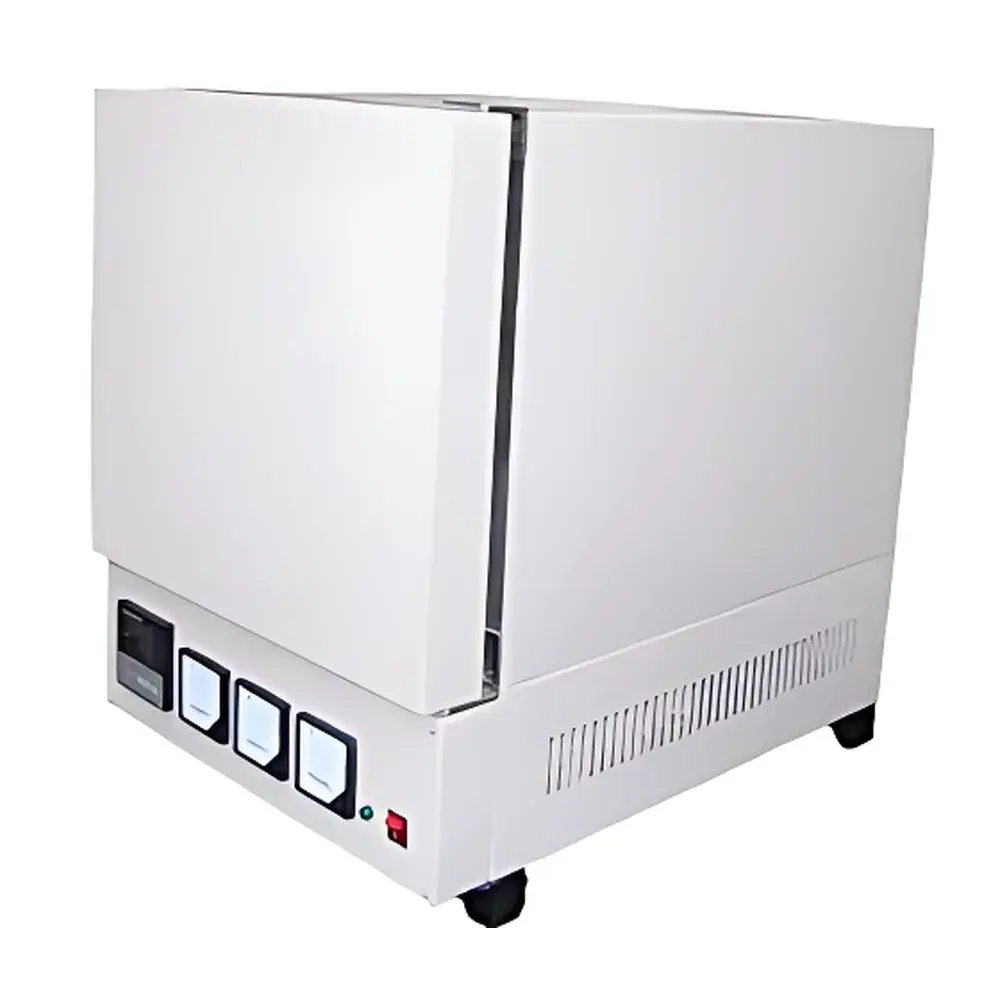
Zhuochi SXL-1016 Programmable Box-Type Muffle Furnace
| Brand | Zhuochi |
|---|---|
| Origin | Zhejiang, China |
| Model | SXL-1016 |
| Chamber Dimensions | 400 × 250 × 160 mm |
| Maximum Operating Temperature | 1000 °C |
| Temperature Uniformity | ±1 °C |
| Power Rating | 8 kW |
| Voltage | 380 V AC, 50 Hz |
| Control System | 30-Stage Programmable Microprocessor Controller |
| Heating Element | High-Durability Resistance Wire |
| Safety Features | Dual Over-Temperature Protection, Earth Leakage & Electric Shock Protection |
| Surface Finish | Matte Epoxy Powder Coating (European Standard) |
| Interior Lining | Stainless Steel (Front Door & Chamber Rim) |
| Optional Data Logging | RS485/USB Interface for PC Connectivity |
Overview
The Zhuochi SXL-1016 Programmable Box-Type Muffle Furnace is a precision-engineered high-temperature thermal processing instrument designed for rigorous laboratory and small-scale industrial applications. It operates on resistive heating principles, utilizing high-stability resistance wire elements housed within a thermally insulated chamber to achieve uniform, controllable heating up to 1000 °C. The furnace employs a muffle configuration—where the heating elements are physically isolated from the chamber interior—to ensure contamination-free, oxidation-controlled environments essential for metallurgical heat treatments, ceramic sintering, ashing, and elemental analysis. Its robust construction, combined with European-standard matte powder coating and stainless-steel chamber sealing surfaces, ensures long-term dimensional stability, corrosion resistance, and operator safety in demanding QC, R&D, and academic settings.
Key Features
- 30-stage programmable temperature controller enabling precise ramp-hold-cool profiles—including variable heating rates, multi-segment isothermal holds, and customizable cooling sequences.
- Chamber dimensions of 400 × 250 × 160 mm (L×W×H) provide ample working volume for sample batches or larger crucibles while maintaining thermal homogeneity across the entire zone.
- Temperature accuracy of ±1 °C at setpoint, verified per internal calibration protocols aligned with ISO/IEC 17025 traceability practices for laboratory-grade thermal instrumentation.
- Dual independent over-temperature protection circuits: primary controller-based cutoff and secondary hardware-limit switch, both compliant with IEC 61000-6-2 electromagnetic compatibility and IEC 61010-1 safety standards.
- Matte-finish epoxy powder coating meets EN 13423 surface durability requirements; front door and chamber rim lined with AISI 304 stainless steel to prevent thermal warping and oxidation-induced gasket degradation.
- Integrated earth leakage circuit breaker (ELCB) and reinforced insulation barrier minimize electrical hazard risks during extended high-power operation (8 kW at 380 V).
Sample Compatibility & Compliance
The SXL-1016 accommodates standard porcelain, alumina, and quartz crucibles (up to Ø120 mm × H100 mm), graphite boats, and metal samples requiring annealing, hardening, or stress-relief treatments. It supports ASTM E1112 (standard practice for calibration of muffle furnaces), ISO 5667-16 (water quality sampling—sample preservation via dry ashing), and USP & EP methods for loss-on-ignition (LOI) and residue determination. All electrical components conform to CE marking directives (2014/35/EU Low Voltage Directive and 2014/30/EU EMC Directive). The furnace design facilitates GLP-compliant operation when paired with validated data logging software, supporting audit-ready records including timestamped temperature profiles, alarm events, and user access logs.
Software & Data Management
An optional RS485 or USB interface enables real-time bidirectional communication with Windows-based monitoring software. This software provides graphical temperature trajectory visualization, automated CSV export, configurable alarm thresholds, and password-protected user roles. When deployed under validated conditions, the system supports 21 CFR Part 11 compliance through electronic signature capture, audit trail generation (including parameter changes and manual overrides), and data integrity safeguards such as write-protection and cryptographic hash verification. Raw data files include metadata headers specifying furnace ID, operator, date/time, and calibration status—critical for regulatory submissions in pharmaceutical, environmental, and materials testing laboratories.
Applications
- Heat treatment of small steel components: austenitizing, quenching, tempering, and annealing per ASTM A255 and ISO 9001 process validation requirements.
- Ceramic and refractory material processing: sintering of oxide-based compacts (Al2O3, ZrO2) and low-temperature co-fired ceramics (LTCC) up to 1000 °C.
- Proximate analysis in coal and biomass labs: moisture, volatile matter, fixed carbon, and ash content determination per ASTM D3172 and ISO 1171.
- Inorganic residue quantification: gravimetric analysis of metals, soils, and sludges following EPA Method 3010A and ISO 11885.
- Pre-treatment of catalyst supports and battery electrode precursors prior to XRD or SEM characterization.
FAQ
What is the maximum recommended continuous operating temperature for the SXL-1016?
The furnace is rated for continuous operation at 1000 °C; exceeding this temperature may accelerate element degradation and compromise calibration stability.
Is the temperature uniformity verified across the full chamber volume?
Yes—uniformity is characterized per ASTM E2203 using nine-point mapping at 800 °C and 1000 °C, confirming ≤±3 °C deviation across the working zone.
Can the controller be calibrated in-house?
The microprocessor controller accepts two-point calibration inputs (offset and gain) using NIST-traceable reference thermocouples; full recalibration requires factory service.
Does the unit comply with UL or CSA safety standards?
While not UL/CSA certified, its electrical architecture and protective systems meet equivalent performance criteria defined in IEC 61010-1 Ed. 3.0, widely accepted for CE-marked lab equipment in North America and EU markets.
What maintenance intervals are recommended for optimal longevity?
Inspect heating elements and insulation integrity every 200 operational hours; clean chamber interior after each ashing cycle; verify thermocouple drift annually or after 500 thermal cycles.



