
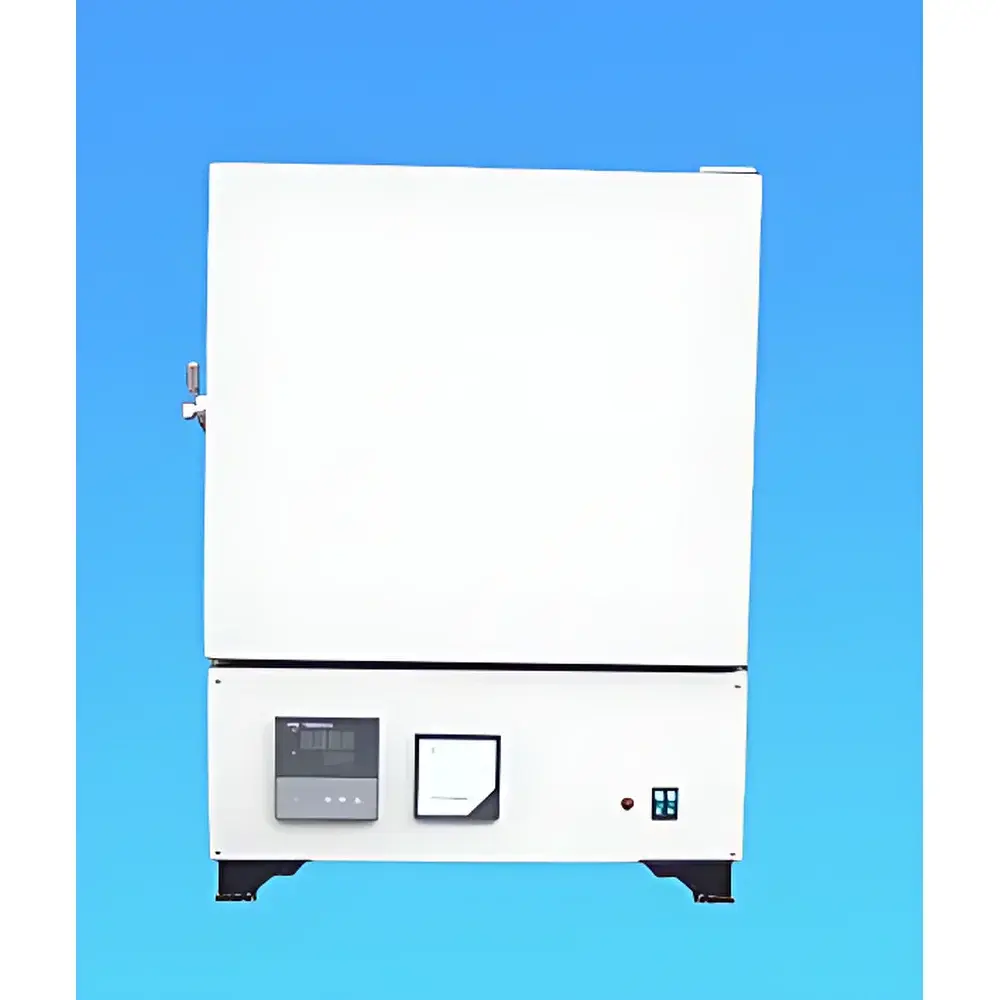
Zhuochi SXL-1202 Programmable Box-Type Muffle Furnace
| Brand | Zhuochi |
|---|---|
| Origin | Zhejiang, China |
| Model | SXL-1202 |
| Chamber Dimensions | 200 × 120 × 80 mm |
| Maximum Temperature | 1200 °C |
| Temperature Uniformity | ±1 °C |
| Power Rating | 2.5 kW |
| Voltage | 220 V AC, 50 Hz |
| Control System | 30-Stage Programmable Microcomputer Controller |
| Heating Element | High-Purity Resistance Wire |
| Chamber Lining | Stainless Steel (Interior Door & Front Panel) |
| Safety Features | Dual Over-Temperature Protection, Earth Leakage & Electric Shock Protection |
| Surface Finish | Matte Electrostatic Powder Coating (EU Standard) |
Overview
The Zhuochi SXL-1202 Programmable Box-Type Muffle Furnace is a precision-engineered laboratory thermal processing instrument designed for repeatable, high-stability heating applications up to 1200 °C. Based on resistive heating principles with embedded thermocouple feedback and PID-controlled power modulation, the furnace delivers consistent thermal profiles across its compact 200 × 120 × 80 mm working chamber. Its muffle architecture isolates the sample from direct contact with heating elements and combustion byproducts—ensuring contamination-free environments essential for elemental analysis, heat treatment of small metallic components (e.g., quenching, annealing, tempering), and high-purity sintering or fusion of ceramics and refractory materials. The unit complies with fundamental electrical safety standards applicable to Class I laboratory equipment under IEC 61010-1, and its structural design—including stainless steel interior surfaces and EU-standard matte powder coating—supports long-term corrosion resistance and cleanroom-compatible operation.
Key Features
- 30-segment programmable temperature controller enabling precise ramp-hold-cool profiles, with adjustable heating rates, multi-step isothermal holds, and user-defined cooling curves
- High-reproducibility thermal performance: ±1 °C temperature accuracy across the full 20–1200 °C operating range, verified via calibrated Type K thermocouple input and digital compensation
- Robust mechanical construction: cold-rolled steel outer casing with EU-compliant matte electrostatic powder coating; interior door lining and front chamber panel fabricated from 304 stainless steel for oxidation resistance and ease of cleaning
- Dual independent over-temperature protection: primary limit set at 1250 °C and secondary hardware cutoff at 1300 °C, both electrically isolated from the main control circuit
- Integrated safety system including earth leakage circuit breaker (ELCB) and insulated grounding path compliant with GB 4793.1 and IEC 61010-1 requirements for laboratory electrical equipment
- Optional RS485 interface (Modbus RTU protocol) for integration with SCADA systems or third-party data acquisition platforms; compatible with optional PC-based monitoring software for real-time logging and audit-trail generation
Sample Compatibility & Compliance
The SXL-1202 accommodates crucibles, boats, and sample holders made from alumina, quartz, silicon carbide, or high-purity graphite—compatible with ASTM E1111 (standard test method for determining thermal stability of refractories) and ISO 5659-2 (fire testing—smoke production). Its sealed muffle configuration prevents cross-contamination during ashing, calcination, or metallographic specimen preparation. For regulated environments, the furnace supports GLP-compliant workflows when used with validated software packages that provide electronic signatures, time-stamped event logs, and 21 CFR Part 11–ready audit trails (when paired with optional certified software modules). It is not intended for explosive, volatile, or highly reactive samples without supplemental inert gas purging accessories.
Software & Data Management
The standard microcontroller includes non-volatile memory for storing up to 10 independent programs, each with 30 configurable steps. Optional PC connectivity enables remote parameter setting, live temperature visualization, and CSV-formatted data export. When deployed in quality-critical settings—such as university metallurgy labs, QC departments in ceramic manufacturing, or R&D facilities performing ASTM E831 thermal expansion studies—the system supports traceable calibration records and deviation reporting. All firmware updates are delivered via secure USB flash drive; no cloud dependency or internet exposure is required, preserving network integrity in air-gapped laboratory infrastructures.
Applications
- Heat treatment of small-scale ferrous and non-ferrous alloys (annealing, stress relieving, hardening)
- Gravimetric analysis and loss-on-ignition (LOI) testing per EPA Method 9081 and ISO 1171
- Sintering of oxide ceramics (e.g., Al₂O₃, ZrO₂) and ferrite powders under controlled ambient conditions
- Preparation of metallurgical specimens for optical microscopy and SEM analysis
- Calibration of thermocouples and reference materials in metrology laboratories
- Thermal cycling tests for electronic component substrates and packaging materials (IEC 60068-2-14)
FAQ
What is the maximum continuous operating temperature of the SXL-1202?
The furnace is rated for continuous operation at 1200 °C, with short-term excursions up to 1250 °C permitted under manufacturer-specified duty cycles.
Does the unit include a built-in data logger?
No internal storage for extended logging is provided; however, real-time temperature output is available via analog 4–20 mA or digital RS485 Modbus signals for connection to external recorders or PLCs.
Can the SXL-1202 be operated under inert or reducing atmospheres?
The base model is configured for ambient air operation only; optional quartz tube inserts with flanged gas inlet/outlet ports and vacuum-rated seals are available for controlled-atmosphere applications.
Is calibration documentation included with shipment?
A factory-assembled temperature verification report (covering three-point validation at 200 °C, 600 °C, and 1000 °C) is supplied; NIST-traceable calibration certificates require separate purchase and on-site verification.
What maintenance intervals are recommended for optimal thermal uniformity?
Biannual inspection of heating element continuity, thermocouple junction integrity, and door gasket compression is advised; replacement of resistance wire elements is typically required after ~5000 hours of cumulative operation at ≥1000 °C.



