
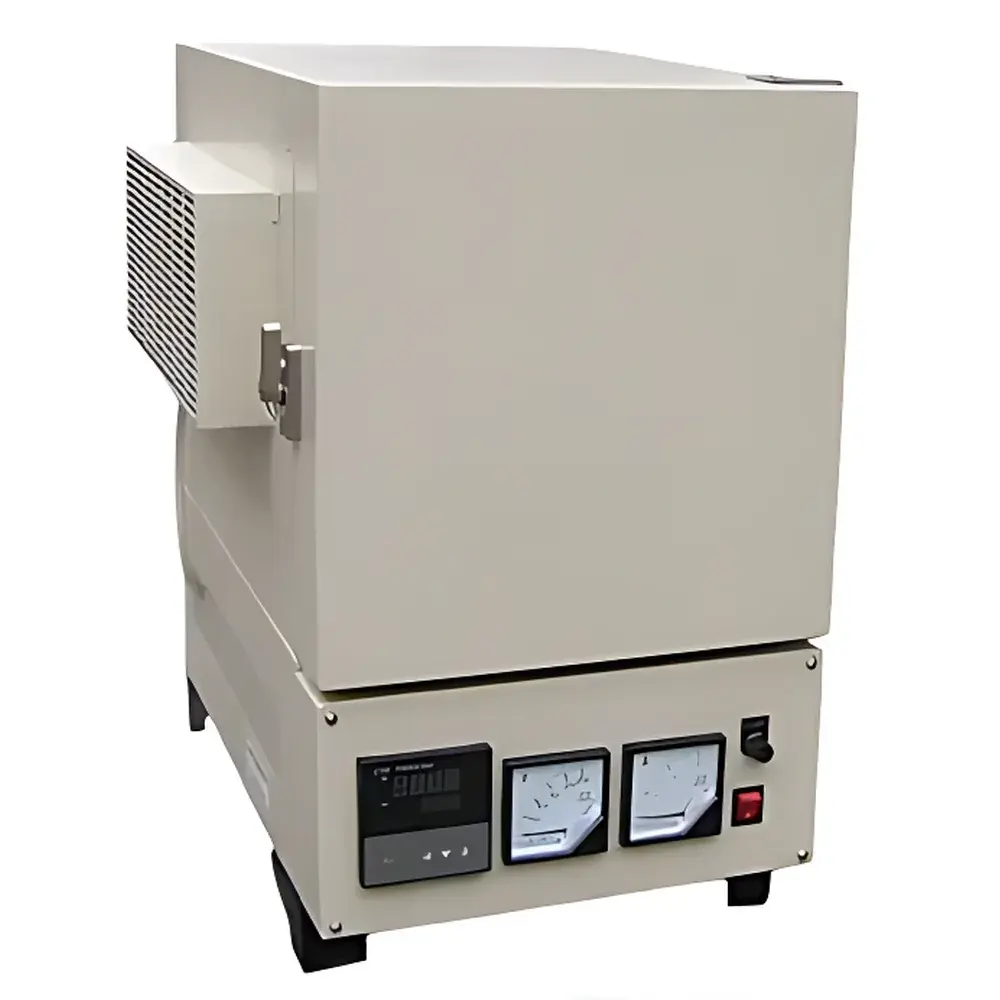
Zhuochi SXL-1304 Programmable Box-Type Muffle Furnace
| Brand | Zhuochi |
|---|---|
| Origin | Zhejiang, China |
| Model | SXL-1304 |
| Chamber Dimensions | 250 × 150 × 100 mm |
| Maximum Operating Temperature | 1300 °C |
| Temperature Uniformity | ±1 °C |
| Power Supply | 220 V, 50 Hz |
| Rated Power | 4 kW |
| Heating Element | Silicon Carbide Rods |
| Control System | 30-Stage Programmable Microcomputer Controller |
| Safety Features | Dual Over-Temperature Protection, Earth Leakage & Electric Shock Protection |
| Compliance | Designed to meet general laboratory safety and thermal stability requirements per IEC 61000-6-3 (EMC) and GB/T 10066.1–2004 (Industrial Furnaces) |
Overview
The Zhuochi SXL-1304 Programmable Box-Type Muffle Furnace is a precision-engineered high-temperature thermal processing instrument designed for controlled atmosphere-free heating in research laboratories, materials science departments, metallurgical testing facilities, and quality control environments. Operating on resistive heating principles via silicon carbide (SiC) rods, the furnace achieves stable, uniform thermal distribution within its insulated chamber—enabling reproducible heat treatment processes including annealing, tempering, quenching, sintering, ashing, and high-temperature calcination. Its muffle configuration isolates the sample from direct contact with heating elements and combustion byproducts, ensuring chemical purity and dimensional stability during thermal cycles. With a maximum rated temperature of 1300 °C and temperature accuracy maintained at ±1 °C across the full operating range, the SXL-1304 supports applications demanding strict thermal protocol adherence—particularly where trace contamination or thermal gradient-induced microstructural variation must be minimized.
Key Features
- 30-segment programmable temperature controller enabling precise ramp-hold-cool profiles; user-defined heating rates, dwell times, and multi-step sequences are stored and recalled without manual intervention.
- Robust chamber construction featuring a matte-finish electrostatically sprayed steel enclosure and stainless-steel interior lining (front door and cavity aperture), enhancing corrosion resistance and long-term dimensional integrity.
- Lightweight, low-thermal-mass insulation using high-purity ceramic fiber modules—optimized for rapid heat-up, energy efficiency, and minimal external surface temperature rise during operation.
- Dual independent over-temperature protection circuits: primary PID-based limit control and secondary mechanical cut-off switch, both independently wired and certified for fail-safe shutdown.
- Integrated earth leakage circuit breaker and reinforced grounding system compliant with IEC 61000-6-3 electromagnetic compatibility standards and local electrical safety codes.
- Optional RS485 serial interface supporting Modbus RTU protocol for integration into centralized lab monitoring systems or SCADA platforms.
Sample Compatibility & Compliance
The SXL-1304 accommodates crucibles, boats, and trays made from alumina, quartz, silicon nitride, or molybdenum—compatible with inert, oxidizing, and mildly reducing atmospheres (when used with optional gas inlet ports). It is routinely deployed in ASTM E1111 (ash content determination), ISO 562 (volatile matter analysis), and USP heavy metals testing workflows. While not intrinsically rated for hazardous area use, its design conforms to general-purpose laboratory equipment safety benchmarks under GB/T 10066.1–2004 and aligns with GLP documentation requirements when paired with validated data logging software. No internal oxygen sensors or pressure regulation are included; ambient air operation is standard unless modified externally.
Software & Data Management
A Windows-compatible PC communication module (optional) enables real-time temperature graphing, profile downloading/uploading, and timestamped data export in CSV format. The software supports audit trail generation—including operator ID, parameter changes, start/stop events, and alarm logs—meeting foundational FDA 21 CFR Part 11 expectations for electronic records when deployed with appropriate institutional access controls and backup protocols. All firmware updates are delivered via secure USB flash drive; no cloud connectivity or remote firmware update capability is embedded.
Applications
- Thermal treatment of small-scale steel and alloy specimens (e.g., hardness optimization via annealing or tempering per ASTM A370).
- Ceramic green body sintering and glaze firing in materials development labs.
- Residue quantification in pharmaceutical excipients and food matrices (AOAC 923.03 ashing method).
- Pre-concentration of environmental samples prior to ICP-OES or AAS analysis.
- Calibration verification of thermocouples and RTDs using fixed-point reference materials (e.g., Al, Zn, Sn melting points).
- High-temperature synthesis of metal oxides, phosphors, and battery cathode precursors under controlled airflow.
FAQ
What is the recommended maintenance interval for the silicon carbide heating elements?
Silicon carbide rods typically require visual inspection every 200 operational hours; replacement is advised upon visible cracking, significant resistance drift (>15% increase), or inability to reach setpoint within specified ramp time.
Can the furnace operate continuously at 1300 °C?
Yes—continuous operation at maximum rated temperature is supported, though sustained use above 1200 °C may reduce element service life; periodic cooling cycles are recommended for extended longevity.
Is NIST-traceable calibration documentation available?
Factory calibration certificates (including as-found/as-left data at three points: 600 °C, 900 °C, and 1200 °C) can be provided upon request; third-party NIST-traceable calibration services are supported via qualified regional metrology labs.
Does the unit comply with CE marking requirements?
The SXL-1304 meets essential safety and EMC requirements under the EU Low Voltage Directive (2014/35/EU) and Electromagnetic Compatibility Directive (2014/30/EU); however, formal CE marking is not affixed as the device is supplied for non-EU markets and lacks notified body certification.
What type of thermocouple is used for internal temperature sensing?
A Type S (Platinum-10% Rhodium / Platinum) thermocouple is factory-installed and sealed within the chamber wall, providing stability and repeatability up to 1300 °C with an inherent uncertainty of ±0.5 °C at 1000 °C.



