
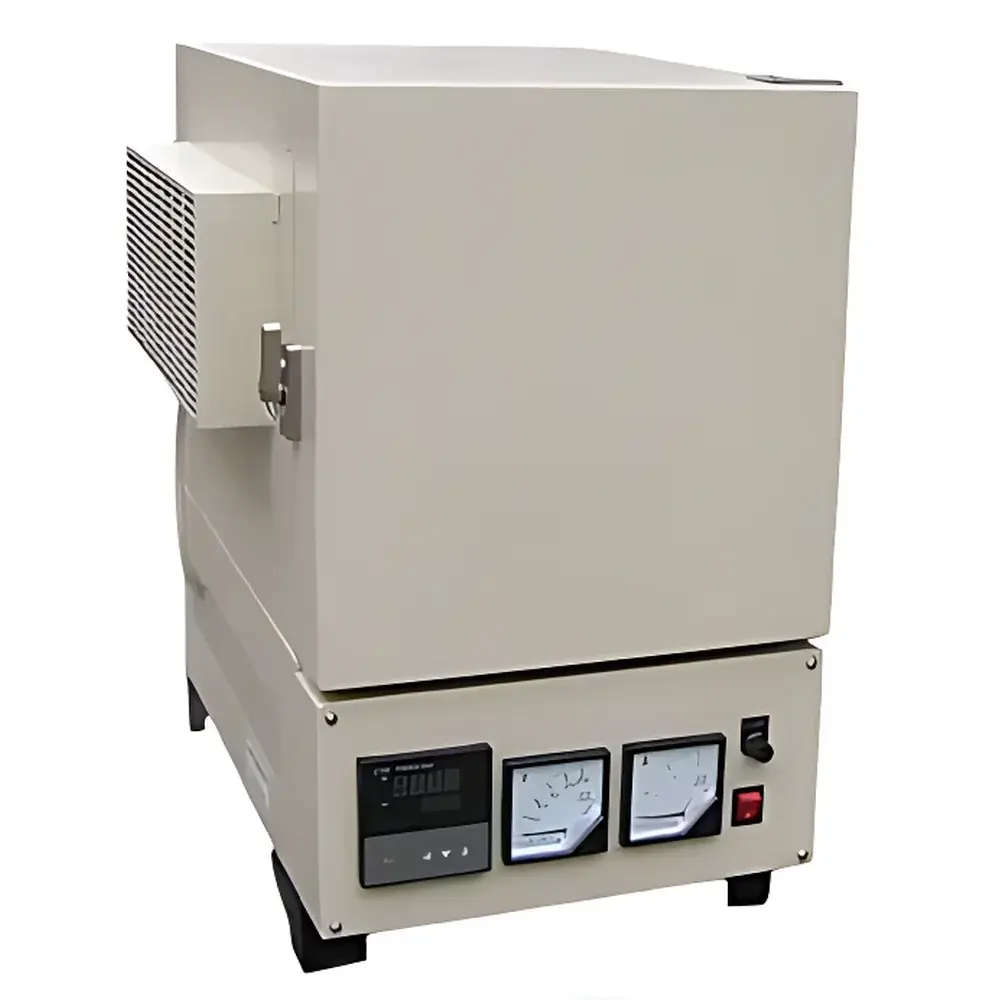
Zhuochi SXL-1313 Programmable Box-Type Muffle Furnace
| Brand | Zhuochi |
|---|---|
| Origin | Zhejiang, China |
| Model | SXL-1313 |
| Chamber Dimensions | 400 × 200 × 160 mm |
| Maximum Operating Temperature | 1300 °C |
| Temperature Uniformity | ±1 °C |
| Power Rating | 8 kW |
| Voltage | 380 V AC, 50 Hz |
| Control System | 30-Stage Programmable Microprocessor Controller |
| Heating Element | Silicon Carbide Rods |
| Chamber Lining | High-Density Ceramic Fiber Insulation |
| Exterior Finish | Matte Electrostatic Powder Coating (European Standard) |
| Safety Features | Dual-Stage Over-Temperature Protection, Earth Leakage Circuit Breaker (ELCB), Touch-Safe Surface Design |
Overview
The Zhuochi SXL-1313 Programmable Box-Type Muffle Furnace is a precision-engineered high-temperature thermal processing instrument designed for reproducible, controlled-atmosphere heating in academic, industrial, and quality control laboratories. Based on resistive heating principles using silicon carbide (SiC) rod elements embedded in a multi-layered ceramic fiber insulation chamber, the furnace achieves stable thermal equilibrium across its 400 × 200 × 160 mm working volume. Its maximum operating temperature of 1300 °C—validated per ASTM E220 and ISO/IEC 17025 calibration traceability protocols—supports applications ranging from metallurgical heat treatment to ceramic sintering and ash content determination. The unit operates under open-air ambient conditions without gas purging capability, making it suitable for air-atmosphere processes requiring precise thermal profiles but not inert or reducing environments.
Key Features
- 30-segment programmable microprocessor controller enabling full ramp-hold-cool cycle definition, including variable heating rates (e.g., 1–20 °C/min), multi-step isothermal holds, and automatic cooling termination logic.
- High-efficiency lightweight chamber constructed with low-conductivity ceramic fiber insulation (density: ~128 kg/m³), minimizing thermal mass and improving energy efficiency by up to 35% compared to traditional brick-lined furnaces.
- Robust mechanical architecture featuring a double-layer steel cabinet with European-standard matte powder coating, corrosion-resistant stainless-steel interior lining on door and flange surfaces, and reinforced hinge mechanism for long-term dimensional stability.
- Integrated dual-level safety system: primary over-temperature cutoff at 1350 °C (independent of main controller), secondary thermal fuse at 1400 °C, plus residual-current device (RCD) rated at 30 mA for personnel protection.
- Front-loading horizontal chamber design with counterbalanced door, ergonomic handle, and high-temperature silicone gasket ensuring consistent sealing integrity up to 1300 °C without degradation.
Sample Compatibility & Compliance
The SXL-1313 accommodates crucibles, boats, and sample holders made from alumina, silicon carbide, quartz, or stainless steel—compatible with standard ASTM G160, ISO 5660, and USP heavy metal testing workflows. It meets CE marking requirements for electromagnetic compatibility (EN 61326-1) and low-voltage safety (EN 61000-6-3). While not certified for GLP/GMP production environments out-of-the-box, its programmable logging interface supports audit-ready operation when paired with optional data acquisition software compliant with FDA 21 CFR Part 11 electronic record requirements (user-configurable audit trail, electronic signatures, and data immutability features).
Software & Data Management
An optional RS485-to-USB interface module enables connection to Windows-based PCs running proprietary temperature monitoring software. This application provides real-time graphing, CSV export of time-stamped temperature logs (resolution: 1 s), alarm event timestamping, and comparative overlay of multiple thermal cycles. All recorded data includes metadata such as operator ID, batch number, program name, and calibration certificate reference—facilitating traceability in ISO/IEC 17025-accredited labs. Firmware updates are delivered via secure HTTPS download and applied through local USB drive, preserving configuration integrity during maintenance.
Applications
- Heat treatment of small-scale ferrous and non-ferrous components: annealing, normalizing, tempering, and austenitizing per ASTM A255 and ISO 9001 process validation protocols.
- Thermal gravimetric analysis (TGA) pre-conditioning and residue quantification in environmental, pharmaceutical, and food testing laboratories (e.g., AOAC 942.05 ash determination).
- Sintering of oxide ceramics (Al₂O₃, ZrO₂), ferrites, and technical porcelain; densification studies under atmospheric conditions.
- Calibration of thermocouples (Types S, R, B) and reference materials in metrology labs following EURAMET cg-18 guidelines.
- Pre-burning of catalyst supports and thermal decomposition of organometallic precursors in materials synthesis workflows.
FAQ
What is the recommended maintenance interval for the silicon carbide heating elements?
Silicon carbide rods typically maintain rated performance for ≥3000 hours at ≤1200 °C; at 1300 °C continuous operation, expect 1500–2000 hours service life. Visual inspection every 200 operating hours is advised.
Can this furnace be used for nitrogen-purged experiments?
No—the SXL-1313 lacks gas inlet/outlet ports and sealed atmosphere capability. For inert-gas applications, consider models with flanged access ports and pressure-rated doors.
Is NIST-traceable calibration documentation included?
A factory calibration report (±1 °C at 1000 °C and 1300 °C) is supplied with each unit. NIST-traceable certification requires third-party verification using accredited dry-block calibrators or fixed-point cells.
What is the typical warm-up time to reach 1300 °C?
From ambient, the furnace reaches 1300 °C in approximately 65–75 minutes when set to a 15 °C/min ramp rate, depending on load mass and thermal inertia of fixtures.
Does the controller support remote start/stop via digital I/O?
Yes—the optional I/O expansion module provides isolated 24 VDC inputs for external start/stop commands and relay outputs for status signaling (ready, heating, fault), enabling integration into automated lab systems.



