
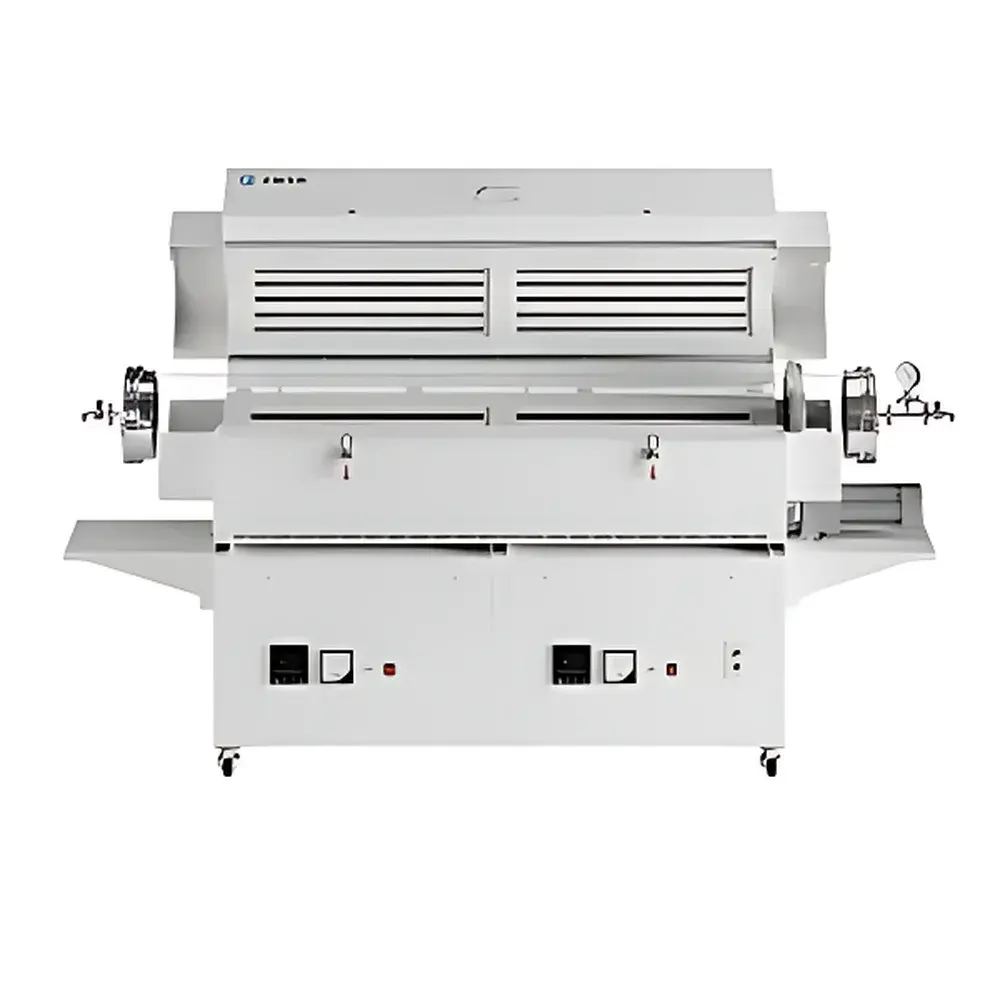
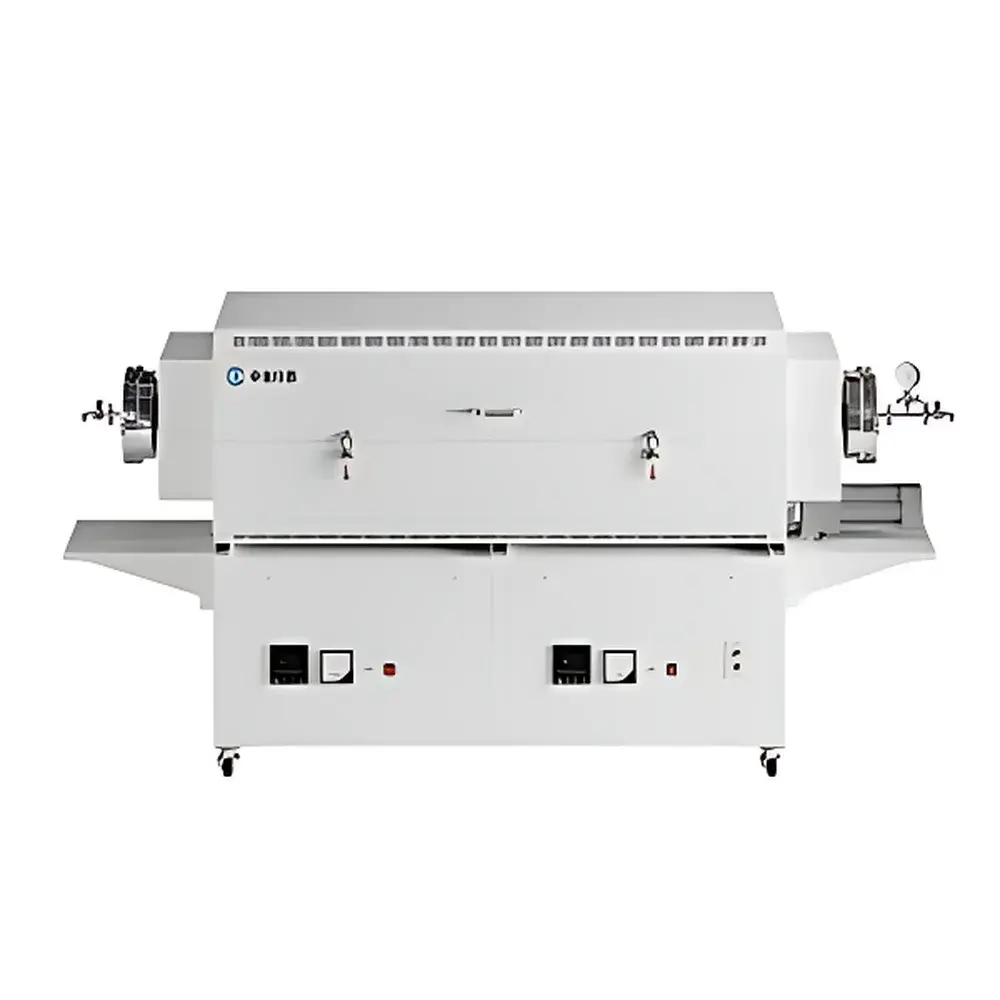
Zhuochi ZSG-GL1200K Rotary Vacuum Tube Furnace
| Brand | Zhuochi |
|---|---|
| Origin | Zhejiang, China |
| Manufacturer Type | Authorized Distributor |
| Country of Origin | China |
| Model | ZSG-GL1200K |
| Instrument Type | Rotary Tube Furnace |
| Max Temperature | 1200 °C |
| Temperature Uniformity | ±1 °C |
| Max Power | 2.5 kW |
| Max Heating Rate | 30 °C/min |
| Heating Method | Resistance Wire (0Cr27Al7Mo2 Alloy) |
| Internal Chamber Dimensions | 60 mm (ID) × 400 mm (Heating Zone Length) |
| Effective Tube Volume | ~1.13 L (based on Φ60 mm × 400 mm) |
| Vacuum Capability | –0.1 MPa (absolute) |
| Tilt Angle | 15° |
| Rotation Function | Yes |
| Sealing | Stainless Steel Flange with Quartz Tube |
| Gas Inlet | Equipped with Float Flowmeter |
| Thermal Insulation | Dual-layer Al₂O₃ Polycrystalline Fiber + Ceramic Fiber Blanket |
| Temperature Sensor | S-Type Platinum-Rhodium Thermocouple |
| Controller | LTDE Programmable PID Controller (50-Stage Ramp/Soak) |
| Safety | Dual-Stage Over-Temperature Protection |
| Power Supply | 220 V, 50 Hz |
Overview
The Zhuochi ZSG-GL1200K Rotary Vacuum Tube Furnace is an engineered thermal processing system designed for controlled high-temperature synthesis, annealing, calcination, and chemical vapor deposition (CVD) under inert, reducing, or vacuum atmospheres. Its core architecture integrates rotational motion of the quartz tube with precise vacuum sealing, programmable thermal profiling, and rapid thermal response—enabling uniform heat transfer to powdered, granular, or pelletized samples during dynamic thermal treatment. Unlike static tube furnaces, the rotation function ensures consistent exposure of particulate materials to the uniform temperature zone (±1 °C), minimizing thermal gradients and particle agglomeration. The furnace operates within a validated temperature range of 100–1200 °C, with heating rates adjustable from 1 to 30 °C/min and stable vacuum maintenance down to –0.1 MPa (absolute). Constructed with a dual-shell cold-rolled steel enclosure (phosphate-treated and electrostatically coated in computer gray), it features a low-thermal-mass polycrystalline alumina fiber furnace chamber and high-stability 0Cr27Al7Mo2 resistance wire heating elements embedded in fiber insulation.
Key Features
- Rotational capability: Motor-driven quartz tube rotation (0–15 rpm, variable speed) ensures homogeneous thermal treatment of bulk powders and catalysts.
- Vacuum & gas compatibility: Integrated stainless-steel flanged sealing system supports operation under high vacuum (–0.1 MPa) or controlled gas flow via calibrated float flowmeters; optional multi-channel gas mixing manifold available for reactive atmosphere synthesis.
- Precision thermal control: LTDE 50-segment programmable PID controller enables complex ramp-hold-cool profiles with ±1 °C accuracy and real-time deviation compensation.
- Modular thermal design: Removable dual-layer fiber insulation (alumina polycrystal + ceramic blanket), quick-access hinged front door, and tiltable furnace body (up to 15°) facilitate sample loading, quenching, and process observation.
- Robust safety architecture: Dual independent over-temperature cutoffs, grounded heating circuitry, forced-air cooling fan, and thermocouple fault detection comply with IEC 61000-6-2 EMC and general laboratory electrical safety standards.
- Energy-efficient operation: Low thermal inertia chamber and optimized power distribution (2.5 kW @ 220 V/50 Hz) reduce standby losses and accelerate thermal cycling without compromising stability.
Sample Compatibility & Compliance
The ZSG-GL1200K accommodates standard Φ60 mm quartz tubes (400 mm heated length), with optional tapered configurations (e.g., Φ60/Φ100 mm transition) for specialized gas dispersion or powder fluidization applications. It is routinely employed for processing metal oxides, battery cathode precursors, semiconductor precursors, and heterogeneous catalysts. While not certified to ISO/IEC 17025 or ASTM E1112 as a metrological instrument, its thermal performance meets common requirements for materials research per ASTM C177 (steady-state heat flux), ASTM E220 (thermocouple calibration), and USP (thermal validation of dry heat sterilization processes). The furnace’s programmable logic and digital logging support GLP-compliant documentation when integrated with external data acquisition systems.
Software & Data Management
The LTDE controller provides local interface-only operation with no proprietary software dependency. All thermal programs—including ramp rates, soak durations, cooling profiles, and alarm thresholds—are stored in non-volatile memory and exportable via RS485 (Modbus RTU) to third-party SCADA or LIMS platforms. Timestamped temperature logs (1-second resolution) can be captured externally using compliant DAQ hardware. For audit-trail compliance in regulated environments (e.g., GMP pilot-scale synthesis), users may integrate the furnace into a validated data acquisition system meeting FDA 21 CFR Part 11 requirements through qualified middleware and electronic signature protocols.
Applications
- Controlled-atmosphere annealing of thin-film substrates and nanowire arrays.
- CVD precursor decomposition for graphene, MoS₂, and perovskite thin-film growth.
- High-purity calcination of Li-ion battery cathode materials (e.g., NMC, LFP) under Ar/H₂ mixtures.
- Thermal reduction of metal oxide powders (e.g., NiO → Ni, CuO → Cu) with in-situ rotation to prevent sintering.
- Low-oxygen pyrolysis of biomass-derived carbons and MOF-derived porous carbons.
- Multi-step thermal processing sequences requiring sequential gas switching, vacuum purging, and precise dwell times.
FAQ
What vacuum level can the furnace achieve, and is a vacuum pump included?
The system is rated for –0.1 MPa (absolute) vacuum; however, a vacuum pump is not supplied and must be selected based on required ultimate pressure and pumping speed (e.g., two-stage rotary vane pump for general use, turbomolecular for ultra-high vacuum).
Can the furnace operate continuously at 1200 °C?
Yes—continuous operation at maximum temperature is supported with proper ventilation and periodic maintenance of heating elements and insulation integrity per manufacturer guidelines.
Is the quartz tube included, and what are its thermal limits?
A standard Φ60 mm × 400 mm fused quartz tube is supplied; continuous use above 1100 °C requires careful thermal cycling to avoid devitrification and mechanical stress fracture.
Does the rotation mechanism support load balancing for asymmetric samples?
Rotation is optimized for uniformly distributed particulate loads; significant mass imbalance (>10 g asymmetry) may induce vibration and should be avoided.
How is temperature uniformity verified across the heating zone?
Uniformity is characterized using three-point thermocouple mapping (center + ±100 mm) per internal QA protocol; typical axial variation within the 400 mm zone is ≤±1 °C at 1000 °C steady state.



