
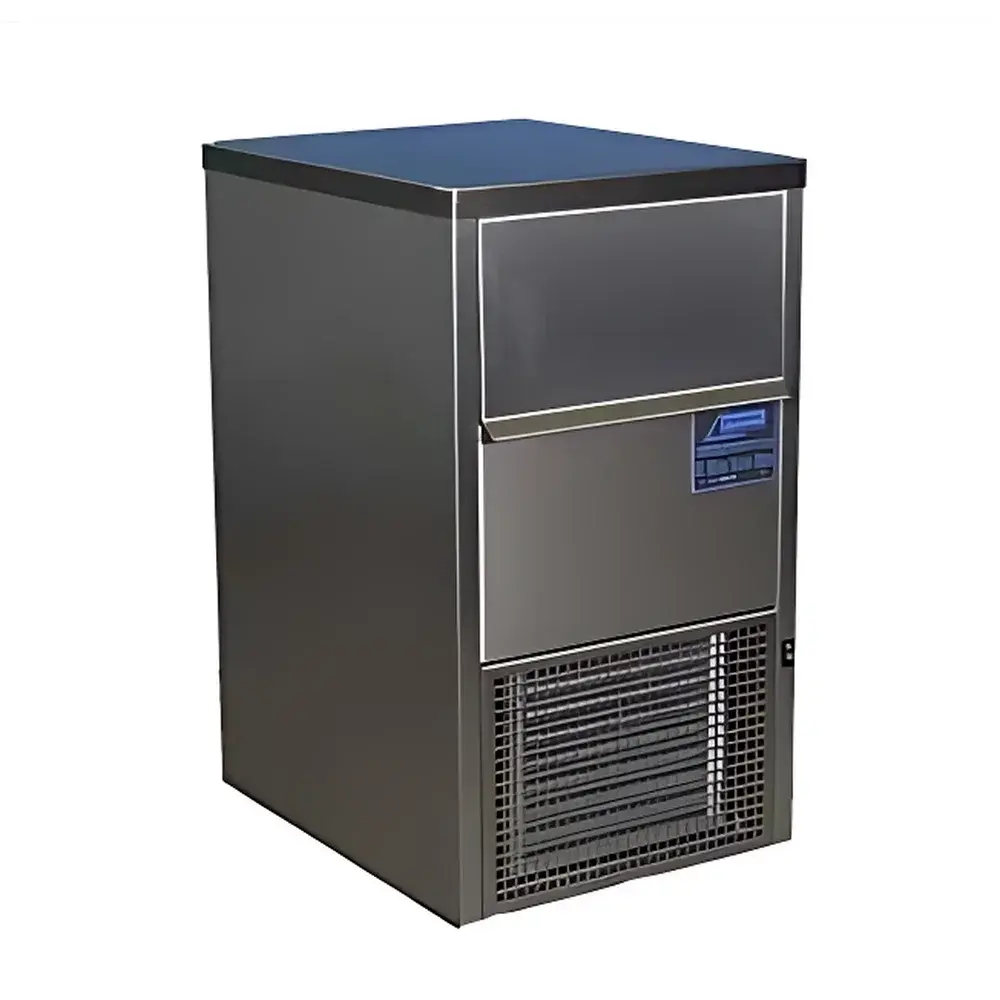
ZIEGRA ZBE 30-10 Flake Ice Machine
| Brand | ZIEGRA |
|---|---|
| Origin | Germany |
| Model | ZBE 30-10 |
| Ice Production Capacity | 30 kg/24 h |
| Storage Capacity | 10 kg |
| Ice Type | Flake Ice |
| Ice Making Principle | Dual-Screw Extrusion |
| Cooling System | Hermetic Compressor |
| Water Consumption | 1 L/kg |
| Insulation | 40 mm Polyurethane Foam |
| Power Supply | 230 V, 50 Hz, 0.4 kW |
| Ambient Operating Temperature | 7–42 °C |
| Refrigerant | R404A (optional R290) |
| Sound Pressure Level | 45 dBA |
| Dimensions (W×D×H) | 400 × 500 × 710 mm |
| Net Weight | 60 kg |
| Construction | Full Stainless Steel (AISI 304) Interior and Exterior |
| Water Inlet | 3/4" BSP Male Thread |
| Drain Outlet | 19 × 13 mm Flexible Hose |
| Water Requirements | Potable water, pH 7.2–9.5, hardness 6–14 °dH (100–250 mg/L CaCO₃), temperature 5–30 °C, pressure 1–5 bar |
Overview
The ZIEGRA ZBE 30-10 is a compact, high-reliability flake ice machine engineered for continuous, low-maintenance operation in demanding laboratory, pharmaceutical, clinical, and food safety environments. Unlike conventional cube or nugget ice systems, this unit employs a dual-screw extrusion principle to produce thin, dry, irregularly shaped flake ice with a controlled surface temperature of –0.5 °C. This precise thermal profile ensures optimal cooling performance without excessive moisture retention or spontaneous agglomeration—critical for preserving sample integrity during cold chain handling, histology specimen preparation, enzymatic assays, and temperature-sensitive reagent storage. Designed and assembled entirely in Germany, the ZBE 30-10 meets stringent European manufacturing standards for materials, electrical safety (EN 60335-1), refrigeration system integrity (EN 378), and potable water contact compliance (EN 13242, EN 1564). Its hermetically sealed refrigeration circuit, using either R404A or the lower-GWP alternative R290, delivers stable output across ambient temperatures ranging from 7 °C to 42 °C—making it suitable for both climate-controlled labs and non-air-conditioned utility rooms.
Key Features
- Full AISI 304 stainless steel construction—interior drum, evaporator surface, storage bin, and external casing—for corrosion resistance, cleanability, and long-term structural integrity under repeated thermal cycling.
- Dual-screw extrusion technology generating uniform, low-density flake ice (thickness ≈ 1.0–1.5 mm) with minimal surface moisture and high surface-area-to-volume ratio—ideal for rapid, non-destructive sample cooling.
- Microprocessor-based control system with adaptive cycle management: automatic start/stop based on bin fill level, real-time monitoring of compressor load and condensation temperature, and self-diagnostic fault logging.
- 40 mm polyurethane foam insulation in the storage bin minimizes thermal bridging and reduces standby energy consumption by up to 35% compared to standard insulated designs.
- Compliant with EU Drinking Water Directive (98/83/EC) requirements: all wetted components—including water distribution nozzles, evaporator surface, and ice discharge chute—meet material migration limits for potable water contact.
- Rated for uninterrupted 7-day, 24-hour operation at full capacity (30 kg/24 h) under nominal conditions (20 °C ambient, 15 °C inlet water), with validated stability even at upper ambient limit (42 °C).
Sample Compatibility & Compliance
The ZBE 30-10 is routinely deployed in GLP- and GMP-regulated laboratories where traceability, hygiene, and process consistency are mandatory. Its stainless steel architecture supports routine cleaning validation per ISO 14644-1 (cleanroom-compatible surfaces) and facilitates compatibility with common laboratory disinfectants (e.g., 70% ethanol, quaternary ammonium compounds). All internal water pathways conform to EN 13242 for materials in contact with drinking water, eliminating leaching risks associated with plasticized polymers. The unit does not require external water softening when operated within specified hardness limits (6–14 °dH), reducing infrastructure dependencies. While not a medical device per EU MDR 2017/745, its design aligns with ICH Q5C stability testing environmental controls and supports cold-chain documentation requirements per WHO TRS 961 Annex 9.
Software & Data Management
The ZBE 30-10 operates via an embedded microcontroller with non-volatile memory storing operational logs—including daily ice output, cumulative runtime, compressor activation cycles, and thermal deviation alerts—for up to 12 months. Though it lacks Ethernet or cloud connectivity, its event log export capability (via USB-C port on service panel) enables integration into lab-wide preventive maintenance schedules. Audit trails comply with FDA 21 CFR Part 11 principles for electronic records: each logged entry includes timestamp, operator ID (if assigned via external access control), and immutable status flags (e.g., “Bin Full,” “Low Water Pressure”). No firmware updates are required during typical service intervals; all calibration parameters are factory-set and mechanically stabilized.
Applications
- Clinical pathology labs: maintaining tissue specimens at 0–4 °C during grossing and embedding without cellular distortion.
- Pharmaceutical QC: cooling HPLC autosampler trays, dissolution apparatus baths, and stability chamber reference samples.
- Molecular biology: pre-chilling centrifuge rotors, electrophoresis tanks, and PCR workstations prior to nucleic acid extraction.
- Food microbiology: rapid chilling of enrichment broths post-incubation to halt microbial growth before plating.
- Veterinary diagnostics: preserving serum and plasma aliquots during field collection and transport.
- Biobanking: temporary stabilization of cryovials during rack transfer between liquid nitrogen dewars and ultra-low freezers.
FAQ
What is the expected service life of the ZBE 30-10 under routine laboratory use?
With scheduled biannual maintenance (condenser coil cleaning, refrigerant pressure verification, and drain line inspection), the unit demonstrates ≥15 years of functional service life—validated by ZIEGRA’s field reliability database across >1,200 installed units in European academic and industrial labs.
Can the ZBE 30-10 be integrated into a building’s central water supply system?
Yes—provided incoming water meets specified quality parameters (pH, hardness, particulate load) and pressure remains within 1–5 bar. A dedicated shut-off valve and sediment filter (5 µm rating) are recommended upstream of the 3/4″ BSP inlet.
Is R290 refrigerant retrofit available for existing units?
R290 conversion is only supported on units manufactured after Q3 2022 and requires factory-authorized service due to pressure rating modifications, charge optimization, and updated safety labeling per EN 378-1:2016/A11:2021.
Does the machine generate audible alarms for operational faults?
Yes—the control panel emits distinct audible tones for low water flow, high head pressure, and bin overfill, each accompanied by corresponding LED indicators and logged event codes accessible via service menu.
How does flake ice from the ZBE 30-10 compare to crushed ice in terms of thermal efficiency?
Flake ice achieves ~2.3× faster heat transfer than equivalently massed crushed ice due to higher surface area, absence of air pockets, and consistent –0.5 °C surface temperature—reducing equilibration time in sample cooling applications by 40–60% (per ASTM E2234-21 thermal mapping studies).



