
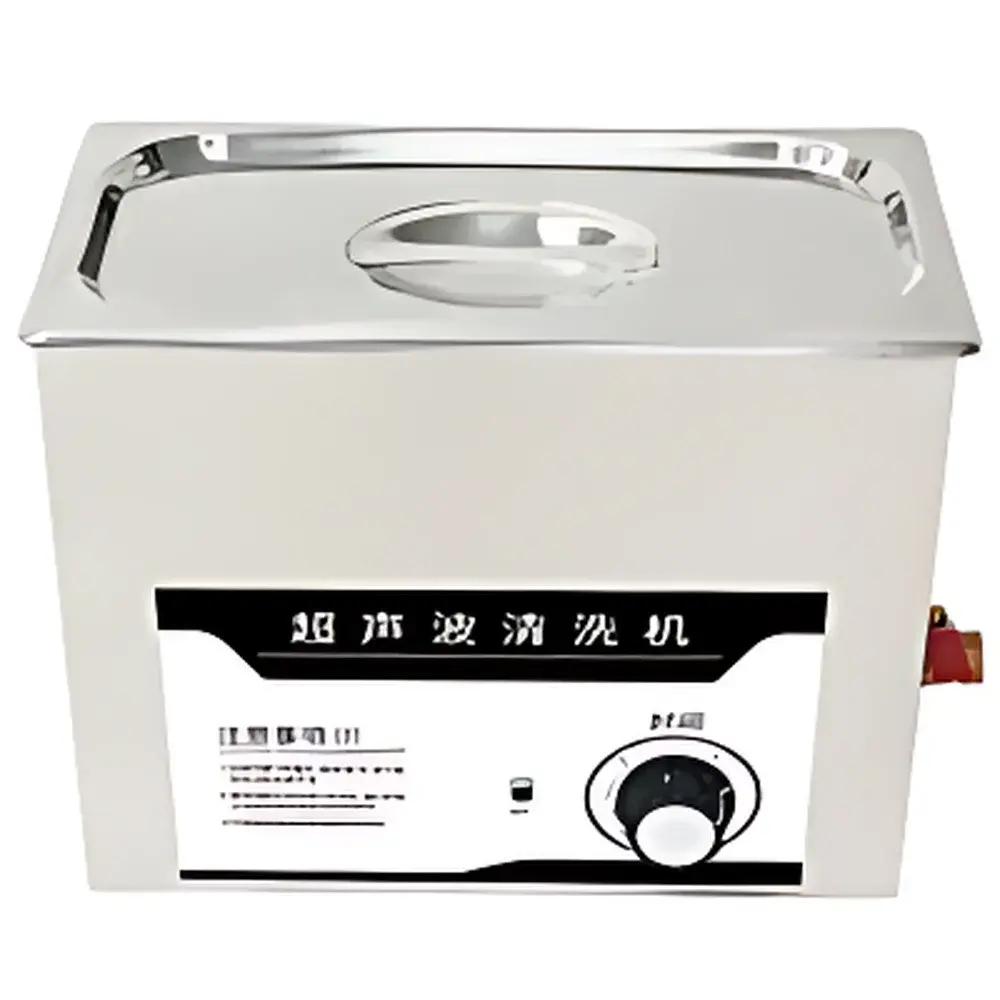
ZiQi ZQ-30 6L Benchtop Mechanical Knob Ultrasonic Cleaner
| Brand | ZiQi |
|---|---|
| Origin | Shanghai, China |
| Manufacturer Type | Direct Manufacturer |
| Product Category | Domestic |
| Model | ZQ-30 (6 L) |
| Instrument Type | General-Purpose |
| Capacity | 6 L |
| Ultrasonic Frequency | 40 kHz |
| Ultrasonic Power | 180 W |
| Power Adjustment | Not Adjustable |
| Temperature Control | Not Available |
| Timer Range | 1–30 min (mechanical dial) |
| Sound-Dampening Lid | Included |
| Drainage | Manual valve |
Overview
The ZiQi ZQ-30 is a benchtop ultrasonic cleaner engineered for reliable, repeatable cleaning performance in academic laboratories, R&D facilities, and industrial quality control environments. It operates on the principle of cavitation—high-frequency sound waves (40 kHz) generate microscopic vacuum bubbles in the cleaning solution; their implosive collapse delivers localized energy sufficient to dislodge particulate contaminants, oils, oxides, and biological residues from surfaces without mechanical abrasion. Designed for general-purpose use, the ZQ-30 supports critical pre-analytical workflows including sample preparation, component degreasing, solvent degassing, emulsification, homogenization, extraction, and cell lysis. Its fixed-frequency, fixed-power architecture ensures consistent acoustic output across operational cycles—ideal for standardized protocols where process reproducibility is prioritized over variable parameter tuning.
Key Features
- Robust stainless steel construction: Both inner tank and outer housing are fabricated from high-grade 304 stainless steel, offering superior corrosion resistance and long-term structural integrity.
- Seamless tank design: The 6 L cleaning chamber is formed via deep-drawn stamping—eliminating weld seams that could harbor residue or compromise leak integrity.
- Precision mechanical timer: A calibrated rotary knob enables accurate manual setting of cleaning duration from 1 to 30 minutes; no electronic interface required, reducing failure points and enhancing operational simplicity.
- Integrated sound-dampening lid: Reduces airborne noise by up to 15 dB(A) during operation and minimizes solvent evaporation—supporting safer, quieter laboratory environments.
- Optimized transducer assembly: Ultrasonic transducers are sourced from internationally certified suppliers and bonded to the tank base using aerospace-grade epoxy, ensuring efficient energy transfer and thermal stability under continuous duty.
- Manual drain valve: Located at the tank base for controlled, spill-free solution disposal—compatible with standard lab waste handling procedures.
Sample Compatibility & Compliance
The ZQ-30 accommodates a wide range of sample geometries and materials, including metal parts, glassware (vials, cuvettes, pipette tips), ceramic substrates, printed circuit boards, and delicate optical components. Its 300 × 150 × 150 mm tank interior provides adequate immersion depth for medium-sized assemblies. While the unit does not incorporate temperature regulation or programmable power modulation, its stable 40 kHz / 180 W output conforms to common laboratory cleaning validation practices referenced in ISO 13485 (for medical device manufacturing support) and ASTM D2603 (Standard Test Method for Sonic Shear Stability of Polymer Solutions). As a Class I electrical appliance, it complies with IEC 61010-1 for laboratory equipment safety. No integrated data logging or audit trail functionality is provided; users implementing GxP workflows must supplement with external documentation per GLP/GMP requirements.
Software & Data Management
The ZQ-30 is a hardware-only system with no embedded microprocessor, firmware, or digital connectivity. All controls are electromechanical: the timer dial directly actuates a synchronous motor-driven cam switch, and power delivery is governed by a passive relay circuit. Consequently, no software installation, calibration certificates, or electronic records are generated. This architecture eliminates cybersecurity concerns, firmware update dependencies, or software validation burdens—making it suitable for regulated environments where instrument qualification focuses solely on physical performance verification (e.g., cleaning efficacy testing per USP or visual residue inspection per ISO 15883-1). Users requiring traceable operation logs must implement manual entry into laboratory notebooks or integrate external timers with timestamped recording.
Applications
- Pre-analytical sample preparation: Removal of machining oils, polishing compounds, and fingerprints from analytical standards and reference materials.
- Electronics manufacturing: Cleaning solder paste residues, flux remnants, and particulate debris from PCBs and SMT components prior to AOI or functional testing.
- Materials science: Degassing of polymer solutions and nanoparticle suspensions to prevent bubble-induced defects in casting or coating processes.
- Life sciences: Disaggregation of tissue fragments, disruption of microbial biofilms, and gentle cell lysis for protein extraction (when paired with appropriate buffers).
- Quality assurance labs: Routine cleaning of volumetric glassware, titration burettes, and HPLC injection syringes to eliminate carryover between analyses.
FAQ
Is the ultrasonic frequency adjustable?
No—the ZQ-30 operates exclusively at a fixed frequency of 40 kHz, optimized for broad-spectrum contaminant removal in aqueous and mild solvent-based solutions.
Can the cleaning temperature be controlled or monitored?
No—this model lacks heating elements, thermostats, or temperature sensors. Users must pre-condition solutions externally if elevated temperatures are required.
Does the unit support automated cycle programming or remote operation?
No—it features only a single mechanical timer and manual power switch. No RS-232, USB, or Ethernet interfaces are included.
What accessories are available for enhanced usability?
A stainless steel mesh basket (part #ZQ-BASKET-6L) is offered as an optional accessory to protect fragile items and facilitate batch handling.
How is cleaning performance validated?
Users typically perform periodic verification using aluminum foil erosion tests (per ASTM E1755) or particle counting of rinse water to confirm consistent cavitation intensity across the tank volume.



