
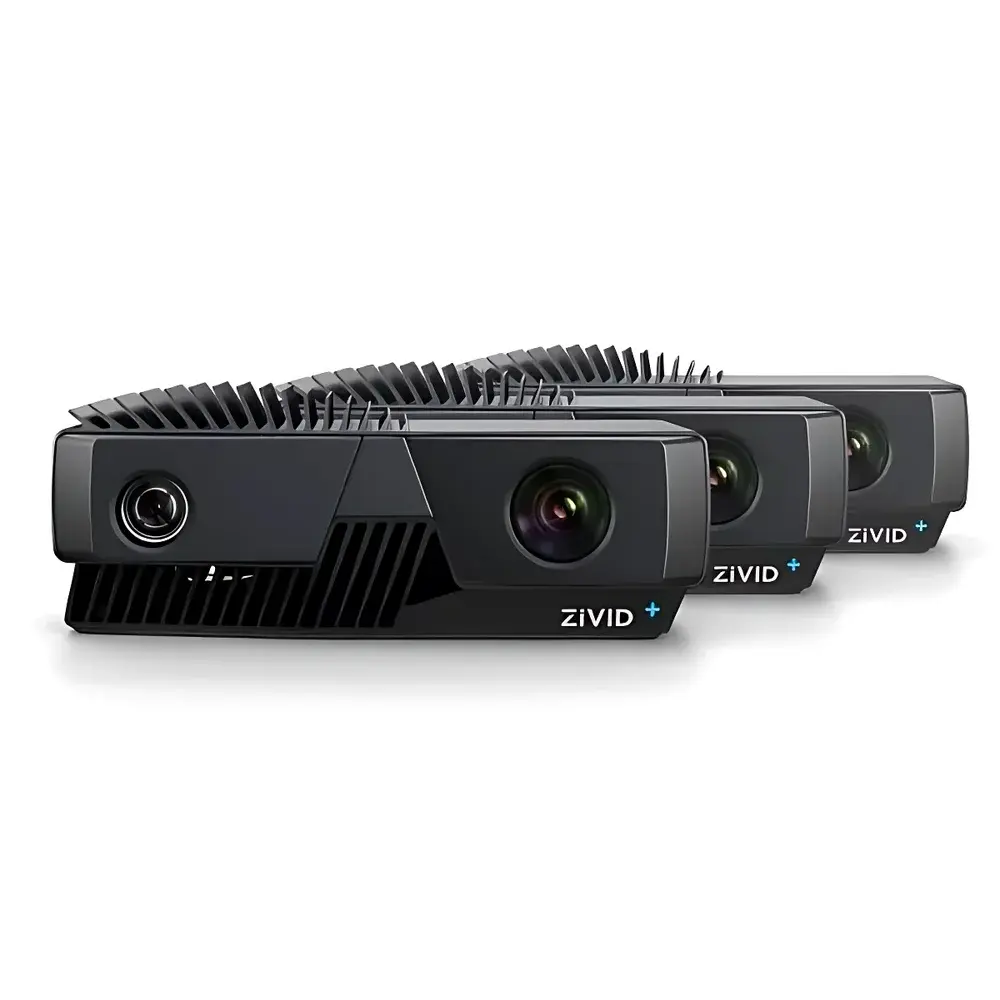
Zivid Smart 3D Camera
| Brand | Zivid |
|---|---|
| Model | Zivid One+ / Zivid Two |
| Origin | Norway |
| Type | Industrial 3D Color Vision Camera |
| Sensor Resolution | 1920 × 1200 (native RGB + depth) |
| Point Accuracy | ≤30 µm (Zivid One+), ≤55 µm (Zivid Two) |
| Planarity Accuracy | ≤45 µm |
| Dimensional Accuracy | >99% |
| Capture Time | ≥80 ms |
| Frame Rate | Up to 12 FPS |
| HDR Support | Yes |
| Enclosure Rating | IP65 |
| Eye Safety Class | Class 1 (IEC 62471) |
| Measurement Ranges | Near (0.3–0.8 m), Medium (0.6–1.6 m), Far (1.2–2.6 m), MAX (up to 2.1 m) |
| FOV Options | Multiple calibrated field-of-view configurations |
| Integration Interface | GigE Vision, GenICam compliant |
| SDK | Zivid SDK (C++, Python, .NET, ROS2 support) |
| Compliance | CE, FCC, UKCA, RoHS, ISO 13849-1 PL e, EN 61000-6-2/6-4 |
Overview
The Zivid Smart 3D Camera is a high-precision, industrial-grade color 3D vision system engineered for robust deployment in automated manufacturing, logistics, and robotics applications. Unlike conventional stereo or time-of-flight cameras, Zivid leverages proprietary time-encoded structured light technology—projecting dynamically modulated light patterns across the scene and analyzing pixel-level phase shifts over multiple exposures. This spatiotemporal encoding eliminates reliance on surface texture, enables sub-pixel depth resolution, and delivers true 3D point clouds with synchronized, native 1920 × 1200 RGB color data. The system operates under controlled white-light illumination (Class 1 eye-safe), ensuring compatibility with collaborative robot (cobot) workcells and human-in-the-loop environments. With an IP65-rated aluminum housing and thermal-stable optical architecture, Zivid cameras maintain metrological repeatability across ambient temperature fluctuations (10–40 °C) and mechanical vibration—critical for long-term integration into production lines governed by ISO 9001 or IATF 16949 quality systems.
Key Features
- Sub-50 µm point accuracy — Achieved via multi-frequency temporal coding and geometric calibration traceable to NIST-traceable artifacts; supports dimensional verification per ISO 10360 and ASME B89.4.19.
- True-color 3D point clouds — Simultaneous acquisition of spatial coordinates and photorealistic RGB values at full sensor resolution, enabling appearance-based classification alongside geometry-driven pose estimation.
- Adaptive HDR imaging — Multi-exposure fusion algorithm mitigates saturation on reflective surfaces (e.g., bare metal, polished plastic), preserving depth integrity where conventional 3D sensors fail.
- Configurable measurement volumes — Three standardized working ranges (Near, Medium, Far) with factory-calibrated lenses; optional MAX variant extends usable depth up to 2.1 m while maintaining <0.2% volumetric error.
- Robot-integrated design — Compact form factor (Zivid Two: 112 × 78 × 75 mm) and low mass (<550 g) optimized for “eye-in-hand” mounting; integrated hand-eye calibration routines reduce setup time and improve TCP repeatability by 10× vs. external calibration methods.
- GigE Vision & GenICam compliance — Seamless integration with standard machine vision frameworks (HALCON, OpenCV, Common Vision Blox); supports hardware-triggered synchronization and precise timestamping for deterministic motion control.
Sample Compatibility & Compliance
Zivid cameras acquire stable 3D data from challenging materials—including glossy metals, translucent polymers, matte black rubber, and textured composites—without requiring spray coating or retro-reflective targets. The absence of moving parts and solid-state illumination ensures consistent performance across varying lighting conditions typical of warehouse and assembly floor environments. All models comply with electromagnetic compatibility (EN 61000-6-2/6-4), functional safety (ISO 13849-1 PL e), and regional regulatory requirements (CE, UKCA, FCC, RoHS). For regulated industries, the Zivid SDK supports audit-ready logging, user access controls, and configurable data retention policies aligned with FDA 21 CFR Part 11 and EU Annex 11 principles.
Software & Data Management
The Zivid SDK provides comprehensive APIs for C++, Python, .NET, and ROS 2, including built-in tools for point cloud filtering, segmentation, pose estimation, and custom feature extraction. Calibration files are digitally signed and version-controlled; all captured point clouds embed EXIF-style metadata (exposure settings, lens distortion coefficients, temperature logs). Batch processing workflows can be exported as reproducible pipelines using Zivid’s CLI interface, supporting integration into CI/CD environments for validation of vision system updates. Raw data export formats include PLY, OBJ, and CSV with millimeter-accurate XYZRGB coordinates; optional encrypted storage mode satisfies internal IT security policies without compromising real-time throughput.
Applications
- Bin picking & depalletizing — Real-time segmentation of randomly oriented parts within cluttered containers using combined geometric and chromatic cues.
- Assembly guidance & verification — Precise localization of connectors, fasteners, and PCB components prior to insertion; post-assembly inspection against CAD-defined GD&T tolerances.
- Package dimensioning & volume calculation — Automated measurement of irregular parcels for logistics billing and pallet optimization.
- Quality control & defect detection — Detection of dents, warpage, or misaligned features on stamped sheet metal or injection-molded housings using deviation mapping against nominal surfaces.
- Robotic welding seam tracking — High-frame-rate depth streaming enables dynamic torch path correction based on joint geometry in real time.
FAQ
What distinguishes Zivid’s structured light approach from laser triangulation or stereo vision?
Zivid uses time-encoded pattern projection rather than static fringe patterns or disparity matching—enabling single-shot depth reconstruction with immunity to ambient light interference and no dependency on surface texture.
Can Zivid cameras operate in direct sunlight or under strong fluorescent lighting?
Yes—the active illumination system and narrowband optical filtering suppress ambient spectral noise; however, optimal performance is achieved under controlled ambient conditions (≤10,000 lux diffuse illumination).
Is hand-eye calibration supported out-of-the-box?
Yes—Zivid SDK includes a validated Tsai-Lenz method implementation with interactive visualization, supporting both fixed-mount and robot-mounted configurations.
Does the system support real-time point cloud streaming to PLCs or motion controllers?
Via GigE Vision, Zivid delivers timestamped point clouds with sub-millisecond jitter; third-party drivers (e.g., Beckhoff TwinCAT, Siemens SIMATIC IT) enable direct ingestion into industrial control networks.
How frequently are firmware and SDK updates released?
Zivid follows a quarterly release cadence with documented change logs, backward-compatible API versions, and extended support windows aligned with industrial product lifecycle expectations (≥5 years).



