
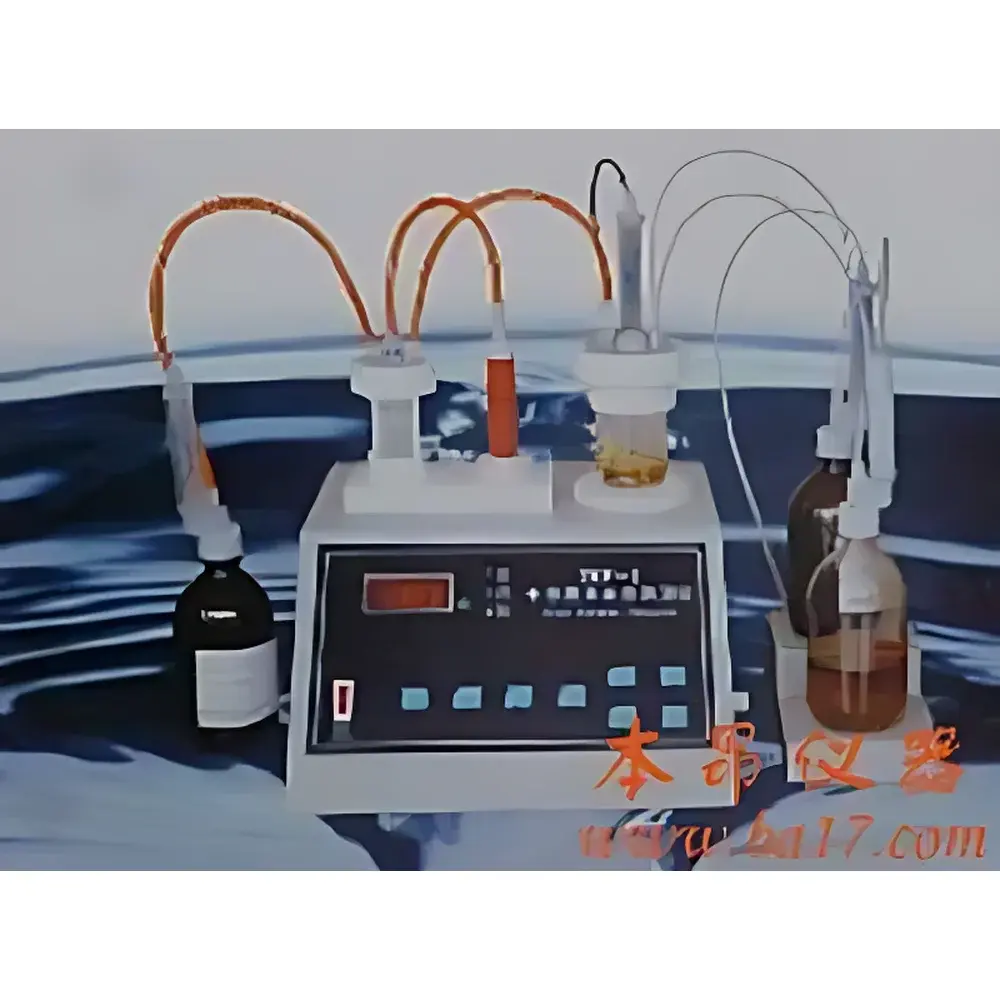
ZKF-1 Automatic Karl Fischer Moisture Analyzer
| Origin | Shanghai, China |
|---|---|
| Manufacturer Type | Authorized Distributor |
| Origin Category | Domestic (PRC) |
| Model | ZKF-1 |
| Price | USD 2,850 (FOB Shanghai) |
| Measurement Principle | Volumetric Karl Fischer Titration |
| Water Content Range | 0.001–100 wt% |
| Resolution | 0.01 mL |
| Repeatability (RSD) | ≤0.01 |
| Linearity Correlation Coefficient | ≥0.998 |
| Burette Accuracy | ±0.004 mL |
| Electrode System | Dual Platinum Electrodes with Polarization Voltage Endpoint Detection |
| Reagent Compatibility | Pyridine-based or Pyridine-Free KF Reagents |
| Display | High-Brightness LED Numeric Display |
| System Architecture | Fully Enclosed Fluidic Pathway |
| Safety Features | Toxic Vapor Containment, Real-Time Error Interruption, Air Purge Functionality |
Overview
The ZKF-1 Automatic Karl Fischer Moisture Analyzer is a benchtop volumetric titration system engineered for precise, reproducible quantification of trace to bulk water content in solid, liquid, and gaseous samples across pharmaceutical, chemical, petrochemical, food, and cosmetic industries. It operates on the classical Karl Fischer (KF) reaction—where iodine, sulfur dioxide, methanol, and a base react stoichiometrically with water—and implements endpoint detection via dual platinum electrodes measuring polarization voltage shift. Unlike coulometric systems suited for sub-ppm analysis, the ZKF-1’s volumetric architecture delivers high accuracy across a broad dynamic range (0.001–100 wt% H₂O), making it ideal for QC laboratories performing routine release testing, stability studies, and raw material qualification under GLP/GMP-aligned workflows.
Key Features
- Fully automated fluid handling: reagent aspiration, solvent delivery, waste evacuation, and system air purging—all programmable via front-panel controls.
- Dual platinum electrode system with real-time polarization voltage monitoring ensures unambiguous endpoint detection and eliminates subjective visual interpretation.
- Patented reagent bottle coupling interface (Patent No. ZL200820052892.1) minimizes reagent exposure and prevents moisture ingress during bottle changes.
- Hermetically sealed tubing network and vapor-trapped reaction cell suppress ambient humidity interference and contain toxic KF reagent vapors (e.g., SO₂, CH₃OH).
- High-brightness LED numeric display provides clear readout of titrant volume consumed, calculated water content (% w/w), and system status indicators.
- Non-linear speed-adjustable magnetic stirrer enables optimal mixing for heterogeneous or viscous samples without splashing or vortex formation.
- Immediate operational interruption capability allows safe recovery from procedural errors—preserving sample integrity, reagent economy, and operator safety.
Sample Compatibility & Compliance
The ZKF-1 accommodates diverse matrices including hygroscopic powders (e.g., antibiotics, urea), volatile solvents (gasoline, acetone), viscous liquids (lubricating oils, surfactant pastes), and semi-solids (creams, toothpaste). Its closed-system design meets fundamental requirements of ISO 760:2023 (Determination of water — Karl Fischer method) and supports method validation per ICH Q2(R2). While not pre-certified for 21 CFR Part 11, its deterministic endpoint logic, auditable manual operation log, and non-volatile parameter storage facilitate integration into regulated environments where electronic records are manually reviewed and signed. The instrument complies with CE electromagnetic compatibility (EMC) directives and GB/T 14710–2009 (Environmental Adaptability of Analytical Instruments).
Software & Data Management
The ZKF-1 operates without proprietary PC software; all functions—including method recall, titrant standardization, blank correction, and result calculation—are executed locally via embedded firmware. Final results (water %, titrant volume, date/time stamp) are displayed and retained in non-volatile memory for up to 100 test records. Data export requires manual transcription or optional RS-232 interface (available upon request) for connection to LIMS or Excel-based reporting templates. Audit trails are maintained through sequential record numbering and timestamped operation logs—sufficient for internal QA review and basic regulatory documentation per ALCOA+ principles (Attributable, Legible, Contemporaneous, Original, Accurate).
Applications
- Pharmaceuticals: Quantification of residual moisture in active pharmaceutical ingredients (APIs), excipients, and lyophilized formulations per USP <921>.
- Petrochemicals: Water determination in crude oil fractions, lubricants, and jet fuels per ASTM D6304 and IP 74.
- Food & Beverage: Validation of dehydration efficiency in milk powder, cereal flours, and malt beverages per AOAC 992.18.
- Agrochemicals: Moisture control in pesticide emulsifiable concentrates and granular fertilizers per ISO 8587.
- Electrolytes & Battery Materials: Critical water specification verification in Li-ion battery cathode precursors and electrolyte solvents.
- Polymers & Coatings: Monitoring hydrolytic degradation susceptibility in polyesters, polyamides, and epoxy resins.
FAQ
What types of Karl Fischer reagents are compatible with the ZKF-1?
Both pyridine-containing and modern pyridine-free reagents (e.g., imidazole-based) may be used, provided they conform to ASTM D1364 specifications for volumetric KF titrants.
Does the ZKF-1 support automatic calibration or standardization?
No—standardization must be performed manually using certified water standards (e.g., sodium tartrate dihydrate or pure water standards); the instrument records and applies the calculated titer factor to subsequent analyses.
Can the ZKF-1 analyze samples that release water only upon heating?
Not natively—the ZKF-1 lacks integrated oven or headspace sampling. For thermally labile or bound-water samples, coupling with an external KF oven (e.g., MKC-710 series) is required.
Is the burette certified to ISO/IEC 17025 standards?
The burette is factory-calibrated to ±0.004 mL accuracy per ISO 8655-3, but formal accreditation requires third-party verification under a recognized calibration laboratory’s scope.
How often should the dual platinum electrodes be cleaned?
Electrodes should be rinsed with dry methanol after each batch of 10–15 analyses and polished with alumina slurry quarterly—or whenever endpoint response time exceeds 30 seconds or baseline drift exceeds 10 mV.
Related Products





