
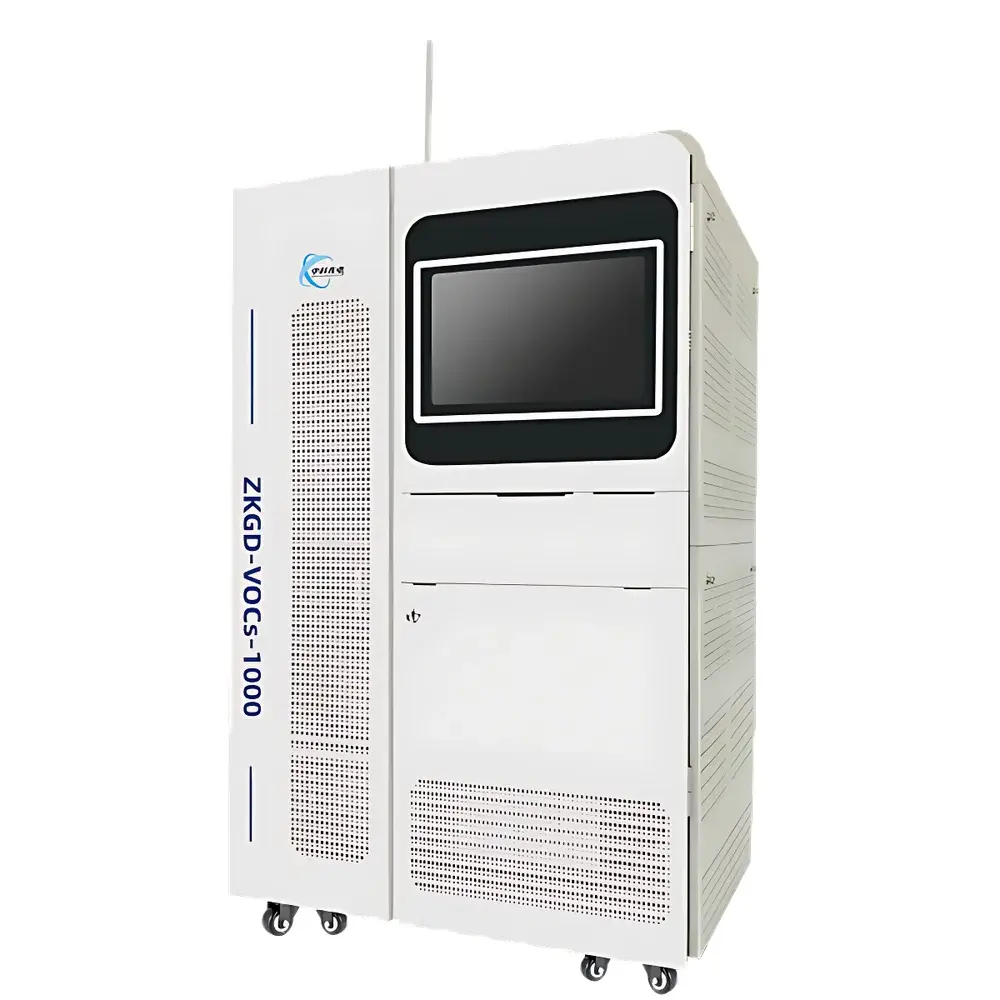
ZKGD-VOCs-1000 Online Volatile Organic Compounds (VOCs) Monitoring System by CASP
| Brand | CASP |
|---|---|
| Origin | Jiangsu, China |
| Manufacturer Type | Original Equipment Manufacturer (OEM) |
| Product Category | Domestic |
| Model | ZKGD-VOCs-1000 |
| Instrument Type | Online Gas Chromatographic Analyzer |
| Detection Range | C2–C12 Alkanes, Alkenes, Alkynes, Aromatics, Chlorinated Hydrocarbons, Oxygenated & Nitrogenous VOCs, Organosulfur Compounds |
| Target Analytes | Up to 116 Speciated VOCs |
| Compliance | Meets and exceeds HJ 1010–2018 Technical Requirements for Online GC-Based VOC Monitoring Systems in Ambient Air |
Overview
The ZKGD-VOCs-1000 Online Volatile Organic Compounds (VOCs) Monitoring System is a fully automated, laboratory-grade gas chromatography–flame ionization detection (GC-FID) and optional GC–mass spectrometry (GC-MS) compatible platform engineered for continuous, unattended measurement of speciated VOCs in ambient air and industrial fence-line environments. Designed specifically to address the analytical challenges posed by low-concentration, adsorption-prone, and chemically diverse VOC mixtures, the system integrates cryogenic preconcentration, thermal desorption, high-resolution capillary GC separation, and dual-channel detection to deliver robust speciation capability across 116 target compounds—including alkanes (C₂–C₁₂), alkenes, alkynes, mono- and polyaromatic hydrocarbons, chlorinated solvents (e.g., trichloroethylene, chloroform), oxygenates (e.g., acetone, MEK, aldehydes), nitrogen-containing species (e.g., acetonitrile, pyridine), and organosulfur compounds (e.g., dimethyl sulfide, carbonyl sulfide). Its architecture follows the fundamental principles of EPA TO-15/TO-17 and ISO 16017-1 for ambient VOC analysis, with hardware and method parameters optimized to satisfy—and exceed—the performance criteria defined in China’s HJ 1010–2018 standard for online VOC monitoring systems.
Key Features
- Automated, unattended operation with 24/7 data acquisition, supporting configurable sampling intervals (15 min to 2 h) and scheduled calibration cycles.
- Cryogenic trapping at –40 °C coupled with rapid thermal desorption (≥30 °C/s ramp rate) ensures quantitative recovery of highly volatile and polar VOCs prone to wall loss or degradation.
- Dual-column GC configuration (e.g., DB-VRX + DB-5ms or equivalent) enables simultaneous separation of light hydrocarbons (C₂–C₆) and heavier aromatics/chlorinated compounds (C₆–C₁₂) within a single run.
- FID detection with linear dynamic range >10⁷ and sub-pptv (parts-per-trillion-by-volume) detection limits for key compounds such as benzene, toluene, and ethylbenzene under standard operating conditions.
- Modular design supports optional integration of quadrupole mass spectrometry (GC-MS) for enhanced compound identification, library matching (NIST/EPA), and non-target screening capability.
- Onboard calibration gas management with certified multi-component standard cylinders (EPA TO-14A or custom blends), automatic valve sequencing, and pressure-controlled delivery.
- Ruggedized environmental enclosure rated IP55, suitable for outdoor deployment in industrial zones with temperature compensation (–20 °C to +50 °C operational range).
Sample Compatibility & Compliance
The ZKGD-VOCs-1000 is validated for ambient air, stack emissions (with dilution module), and perimeter/fence-line monitoring applications. It accepts standard 0.5–2.0 L/min sample flow rates through inert (SilcoNert®-treated) stainless-steel or fused-silica sampling lines. All wetted materials comply with ASTM D5502 and ISO 16017-1 requirements for VOC inertness. The system meets full traceability and audit readiness requirements under GLP and GMP frameworks, including electronic logbooks, user-access controls, and calibration verification records. Data output conforms to HJ 1010–2018 reporting formats and supports export in CSV, XML, and MODBUS TCP protocols for integration into national environmental information platforms (e.g., CNEMC data centers) and third-party SCADA systems.
Software & Data Management
The embedded Linux-based control software provides real-time chromatogram visualization, peak integration with retention time locking (RTL), automated compound identification via retention index matching, and customizable reporting templates aligned with HJ 1010–2018 Annex B. All raw chromatographic data, method parameters, calibration logs, and maintenance events are stored locally with SHA-256 hashing for integrity verification. Remote access is enabled via TLS 1.2–secured web interface or OPC UA server. Audit trail functionality satisfies FDA 21 CFR Part 11 requirements for electronic records and signatures, including immutable timestamps, operator authentication, and change history for all critical parameters.
Applications
- Ambient air quality monitoring networks (urban, suburban, background sites)
- Industrial park boundary monitoring and emission source attribution
- Chemical manufacturing, petrochemical refining, and coating application facilities
- Landfill and wastewater treatment plant fugitive emission assessment
- Validation of abatement system performance (e.g., RTO, activated carbon adsorption)
- Supporting health risk assessments and photochemical modeling (e.g., ozone formation potential)
FAQ
What regulatory standards does the ZKGD-VOCs-1000 comply with?
It meets and exceeds the technical specifications outlined in HJ 1010–2018, and its methodology aligns with ISO 16017-1, EPA TO-15, and EN 14662 for ambient VOC monitoring.
Can the system quantify individual isomers (e.g., xylenes, butanes)?
Yes—its high-resolution GC column set and optimized temperature programming enable baseline separation of structural isomers, supported by retention index libraries and FID response factor correction.
Is remote diagnostics and firmware update supported?
Yes, via secure HTTPS-based web interface with role-based access control; firmware updates are digitally signed and validated prior to installation.
What maintenance intervals are recommended for routine operation?
Preconcentrator traps require replacement every 6 months under typical ambient conditions; GC columns every 12–18 months; FID jet cleaning and detector tuning every 3 months.
Does the system support real-time data transmission to provincial environmental monitoring centers?
Yes—it includes native HJ 212–2017 protocol compliance for seamless data upload to China’s national environmental monitoring information system (CNEMC).
Related Products







