
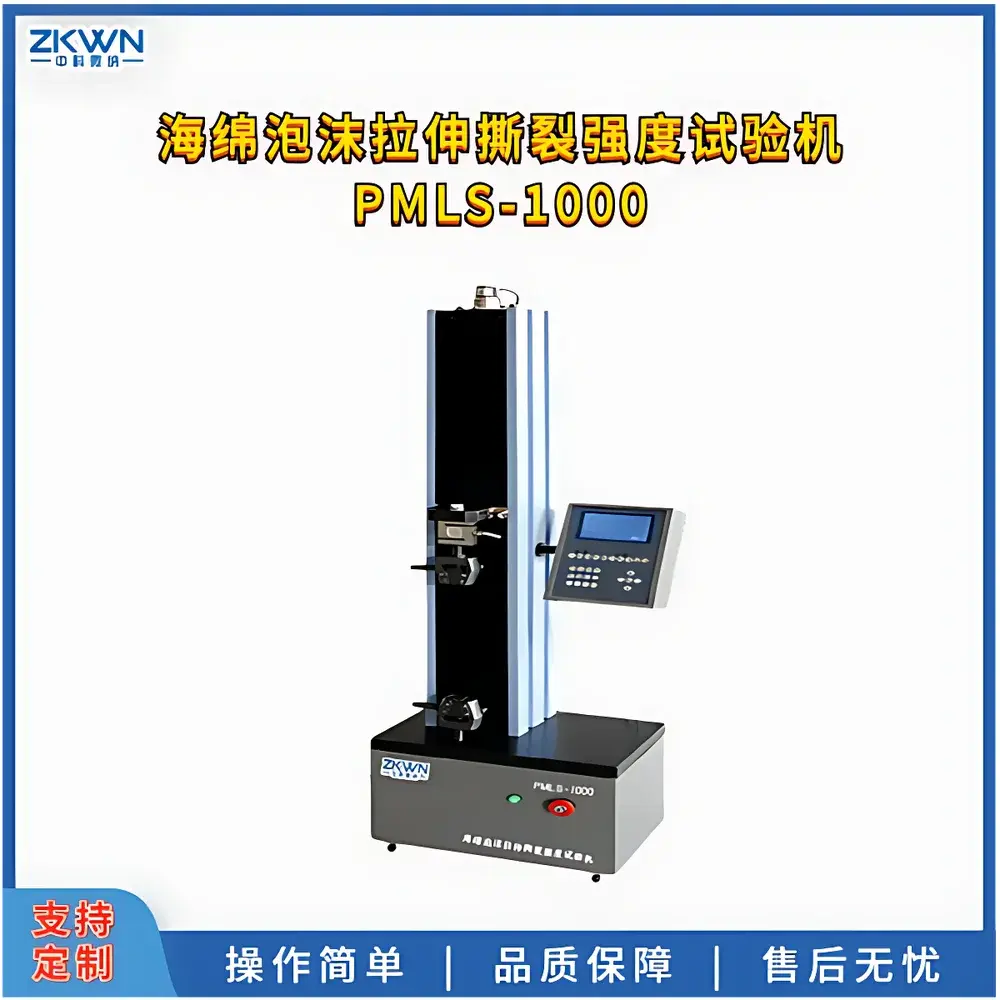
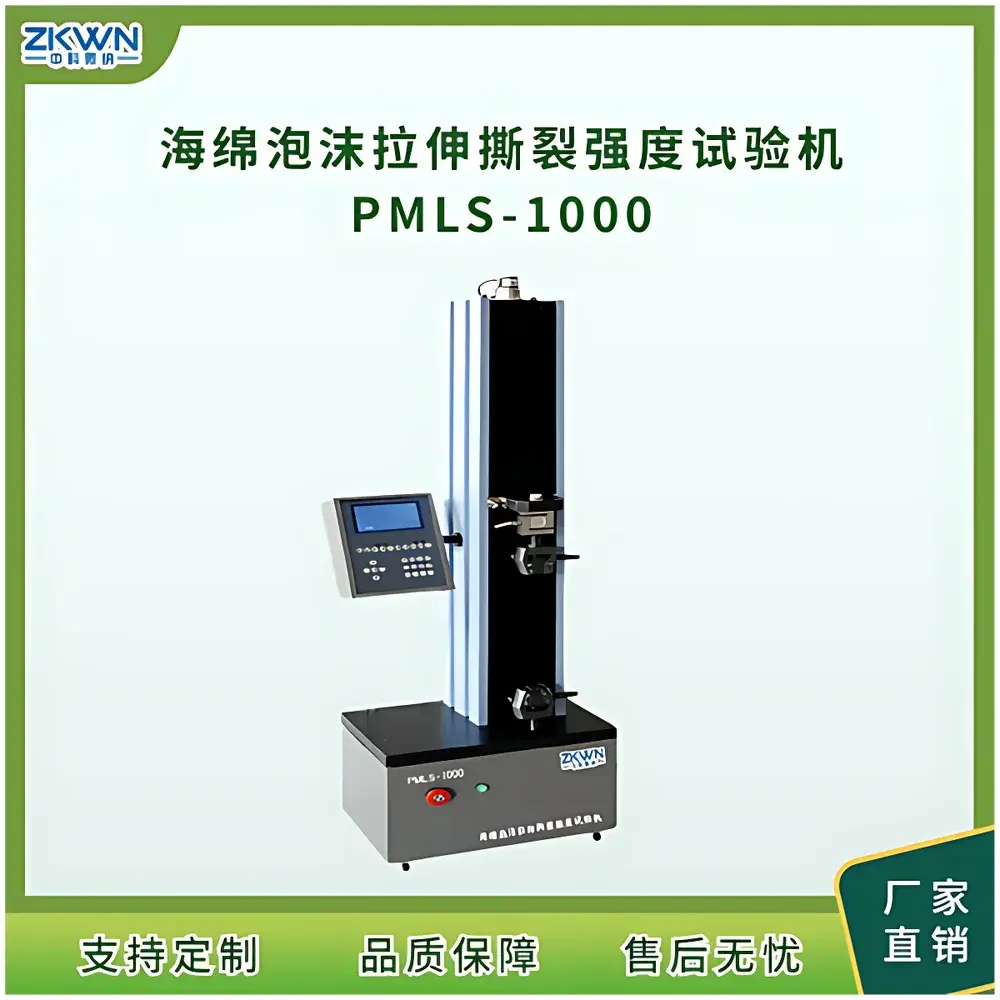
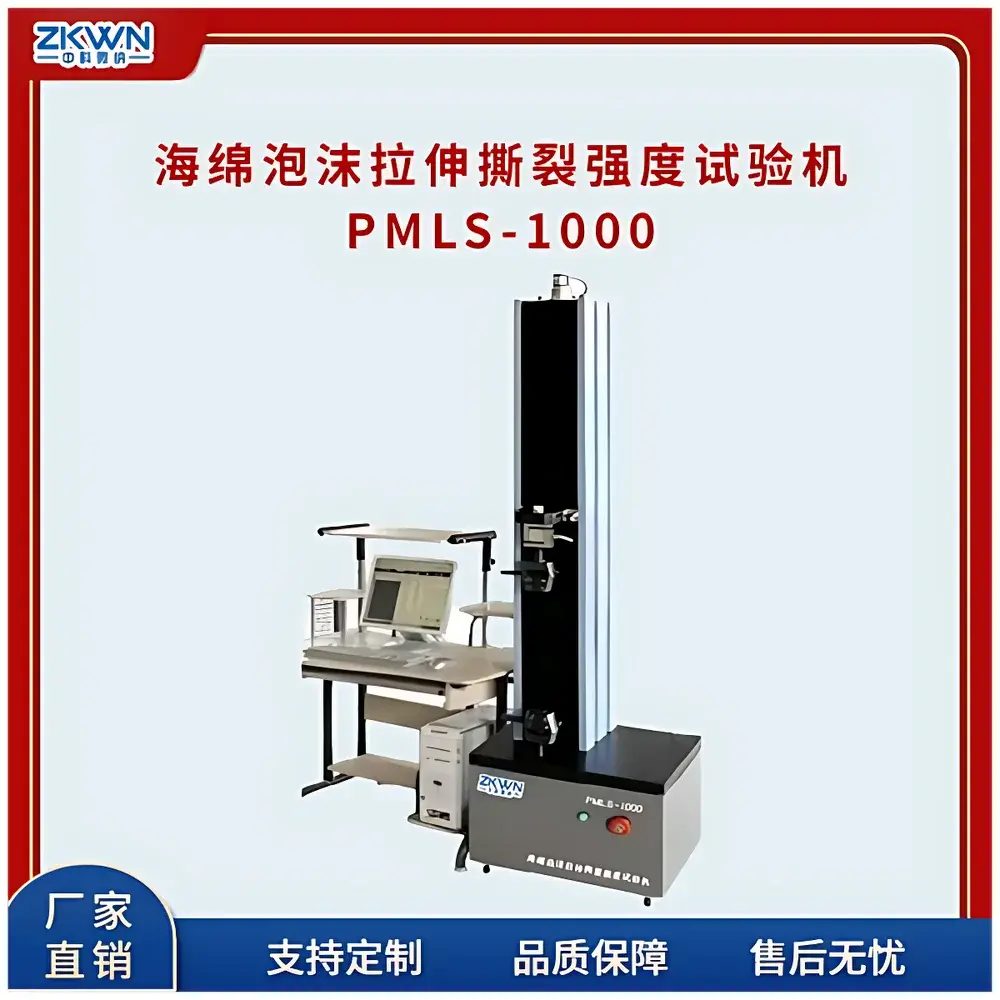
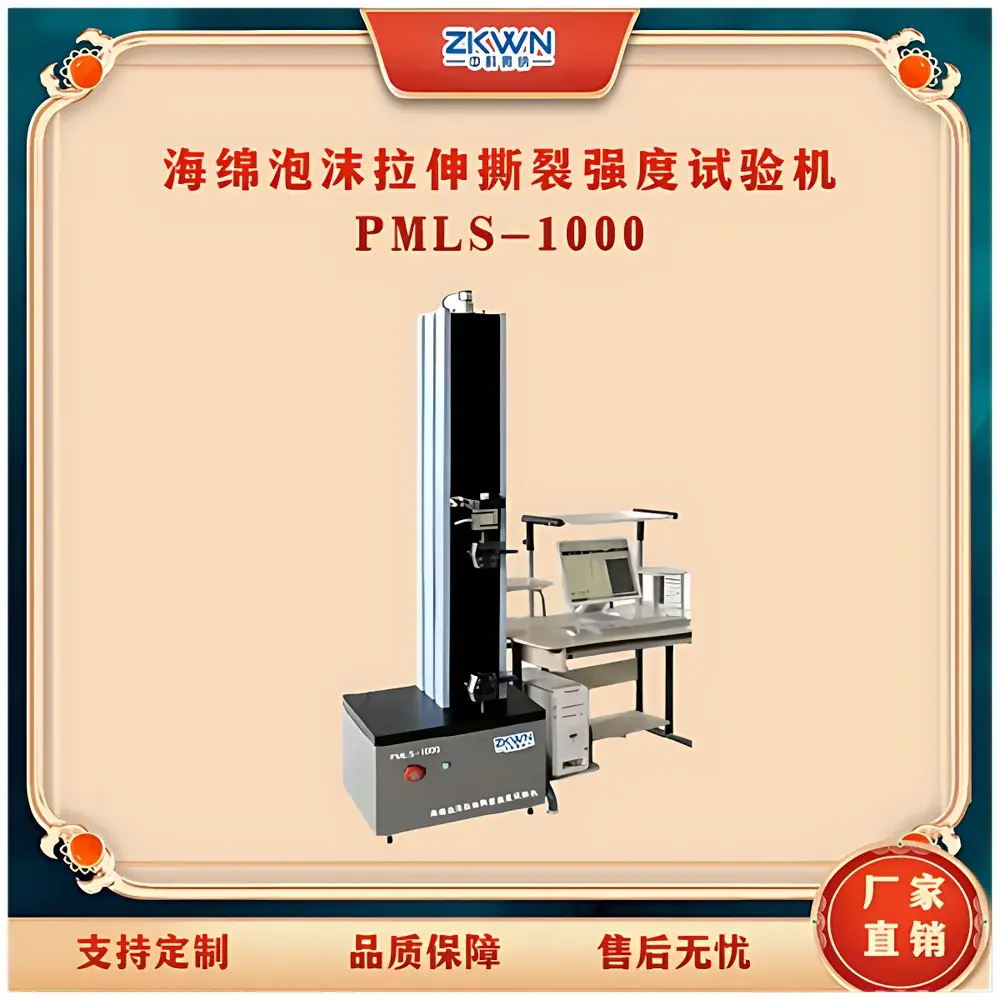
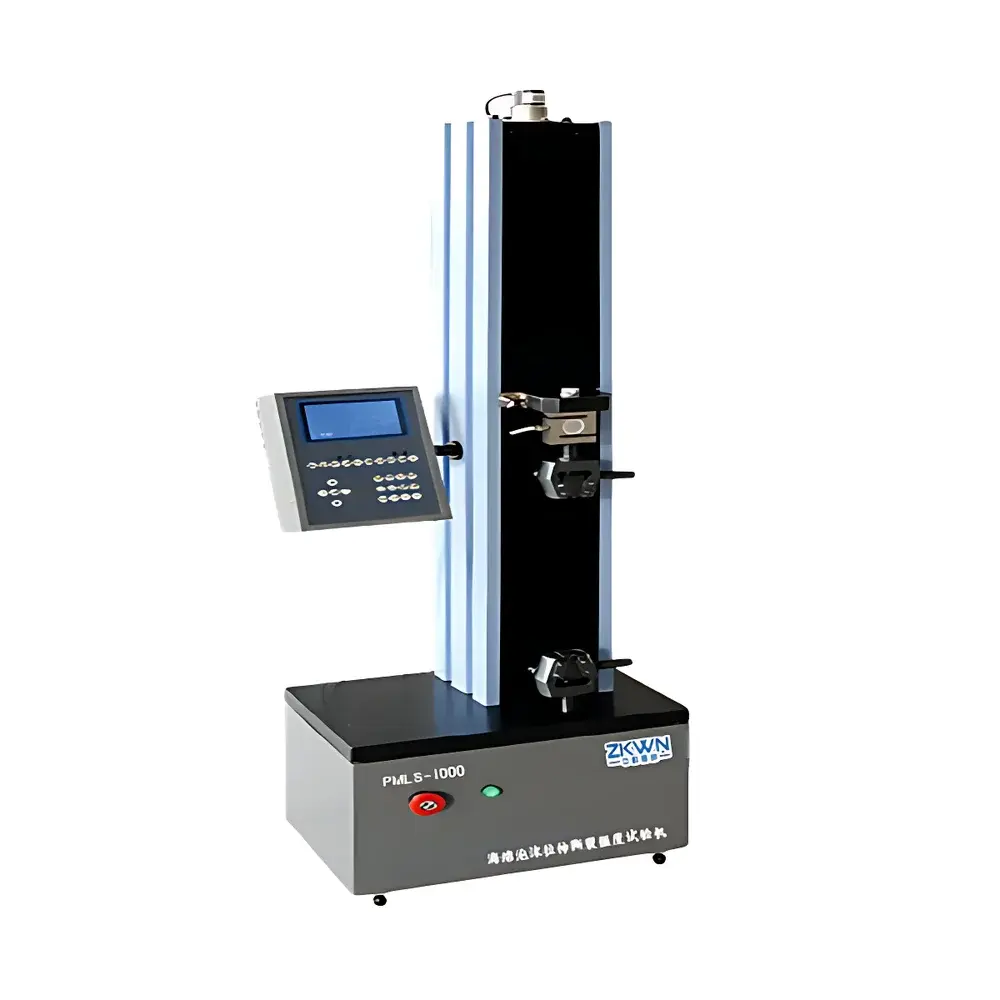
ZKWN PMLS-1000 Foam & Sponge Tensile and Tear Resistance Tester
| Brand | ZKWN |
|---|---|
| Origin | Beijing, China |
| Model | PMLS-1000 |
| Max. Load Capacity | 0–1000 N |
| Load Accuracy | ±1% of reading |
| Displacement Resolution | 0.01 mm |
| Displacement Accuracy | ±1% of reading |
| Crosshead Speed Range | 0.05–300 mm/min |
| Speed Accuracy | ±1% |
| Test Stroke | 0–800 mm (excluding fixtures) |
| Dimensions (L×W×H) | 435 × 275 × 1700 mm |
| Power Supply | 220 V, 50 Hz |
| Compliance | GB/T 6344–2008, GB/T 10808–2006, ISO 1798–1997 |
Overview
The ZKWN PMLS-1000 Foam & Sponge Tensile and Tear Resistance Tester is a dedicated mechanical testing instrument engineered for the precise quantification of tensile strength, elongation at break, and tear resistance in flexible polymeric foam materials—including polyurethane (PU), ethylene-vinyl acetate (EVA), latex, and reticulated foams used in packaging, automotive seating, medical cushioning, and bedding applications. Based on uniaxial quasi-static tensile and trouser-tear principles per ASTM D3574, ISO 1798, and GB/T 10808, the system applies controlled force via a high-resolution electromechanical actuator while continuously monitoring load and displacement. Its single-column, rigid frame architecture ensures minimal deflection under load, supporting repeatable measurements across low-force regimes typical of soft cellular materials. The instrument operates within defined mechanical limits—0–1000 N maximum capacity, sub-1% load linearity, and micrometer-level positional resolution—to meet technical requirements for QC laboratories performing routine conformance verification against industry specifications.
Key Features
- Full-digital AC servo motor drive with closed-loop speed control, enabling seamless crosshead velocity adjustment from 0.05 to 300 mm/min with ±1% accuracy
- High-precision load cell calibrated to ±1% of full scale, integrated with real-time digital signal conditioning and filtering
- Optical encoder-based displacement measurement with 0.01 mm resolution and traceable linear accuracy
- Large-format LCD touchscreen interface with embedded firmware—supports bilingual (English/Chinese) operation, real-time curve plotting, and parameter configuration without external PC dependency
- Triple-speed switching function: pre-programmed velocity transitions during test execution to accelerate initial loading, stabilize at test rate, and decelerate prior to failure—reducing total cycle time without compromising data fidelity
- Integrated safety architecture including dual-limit protection (mechanical end-stops + programmable software limits) and automatic overload shutdown at 103–105% of rated capacity
- Auto-return functionality post-test, synchronized with peak-load capture and digital zero-reset for consecutive specimen testing
Sample Compatibility & Compliance
The PMLS-1000 is validated for standardized testing of low-modulus, highly compressible foam specimens per internationally recognized methods: GB/T 6344–2008 (tensile properties of flexible cellular plastics), GB/T 10808–2006 (tear strength of polymer porous elastic materials), and ISO 1798–1997 (tensile and elongation behavior of flexible foam). Specimen geometries include dumbbell-shaped tensile bars (Type I or IV per ISO 1798) and trouser-tear configurations (ASTM D3574 Method A). Fixture sets accommodate standard widths (e.g., 25 mm) and thicknesses up to 50 mm, with optional pneumatic or wedge-action grips available for high-repeatability clamping. All calibration procedures align with JJG 475–2018 (Chinese national metrological verification regulation for universal testing machines), ensuring traceability to national standards.
Software & Data Management
While the PMLS-1000 operates autonomously via its onboard controller, optional USB export enables raw data transfer (force vs. displacement, time-stamped event logs) in CSV format for post-processing in third-party analysis tools (e.g., MATLAB, Origin, or Excel). The display firmware supports GLP-compliant data retention: each test record stores operator ID, date/time stamp, sample ID, test parameters, peak load, elongation at break, tear propagation force, and full stress–strain curve metadata. Though not natively 21 CFR Part 11 compliant, the system supports audit-ready documentation when deployed with external lab information management systems (LIMS) that enforce electronic signature, version control, and change history tracking.
Applications
- Quality assurance of molded PU foam blocks used in protective packaging inserts and transit cushioning
- R&D evaluation of tear initiation and propagation resistance in open-cell foams for filtration media
- Batch-to-batch consistency verification of viscoelastic memory foams in mattress and pillow manufacturing
- Regulatory submission support for medical device packaging per ISO 11607–1, where foam integrity under simulated handling stresses must be documented
- Supplier qualification testing for automotive interior trim foams subjected to long-term compression set and dynamic flex fatigue
FAQ
What standards does the PMLS-1000 directly support?
It is configured and verified for GB/T 6344–2008, GB/T 10808–2006, and ISO 1798–1997. ASTM D3574 compliance is achievable with appropriate fixture selection and procedural alignment.
Is external computer software required for basic operation?
No—the built-in touchscreen interface handles setup, execution, display, and local printout. A PC is only needed for advanced data archiving or statistical process control integration.
Can the machine perform cyclic or creep tests?
No—it is designed exclusively for monotonic tensile and tear tests. Dynamic or time-dependent mechanical characterization requires a dedicated servo-hydraulic or electrodynamic testing platform.
What maintenance intervals are recommended?
Lubrication of the precision lead screw and inspection of belt tension are advised every 6 months or after 500 test cycles; load cell recalibration is recommended annually or after impact events.
Is the system suitable for testing non-foam elastomers?
Yes—within its 0–1000 N range and stroke limits—but results may lack comparability to foam-specific standards unless specimen geometry and grip conditions follow relevant ISO or ASTM protocols for solid elastomers.






