

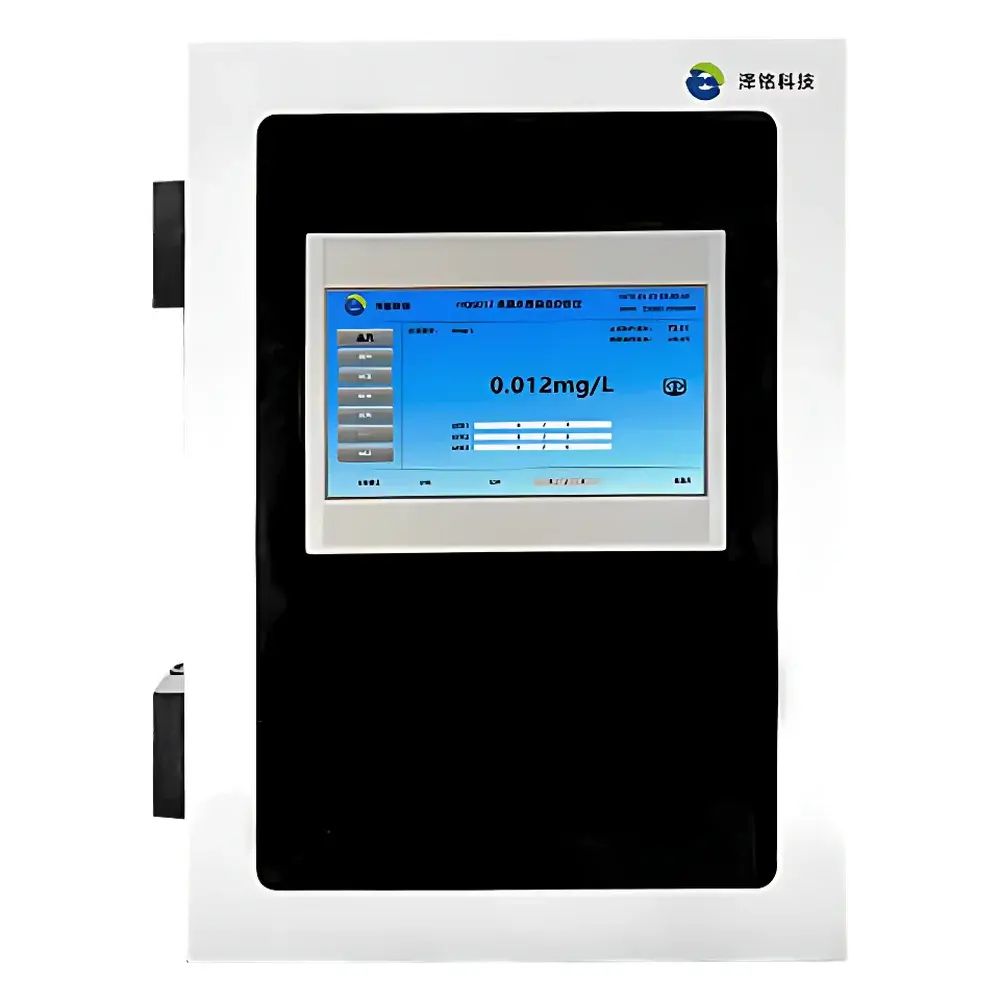
Zming Environmental HQ-6017 Online Residual Chlorine Analyzer
| Brand | Zming Environmental Technology Co., Ltd. |
|---|---|
| Origin | Jiangsu, China |
| Manufacturer Type | Authorized Distributor |
| Product Category | Domestic |
| Model | HQ-6017 |
| Instrument Type | Online Analyzer |
| Measurement Principle | DPD Spectrophotometry |
| Measured Parameter | Free Chlorine |
| Measurement Range | (0–2) mg/L, (0–5) mg/L, or (0–20) mg/L (customizable) |
| Output Interfaces | RS485 Modbus RTU, 4–20 mA analog output |
| Operating Modes | Single-shot, Continuous, Cyclic, and Time-scheduled measurement |
| Compliance | ASTM D1253, ISO 7393-2, GB/T 5750.11–2023 (China Standard for Free Chlorine Determination) |
Overview
The Zming Environmental HQ-6017 Online Residual Chlorine Analyzer is a dedicated photometric instrument engineered for continuous, real-time quantification of free chlorine in aqueous matrices using the standardized N,N-diethyl-p-phenylenediamine (DPD) spectrophotometric method. It operates on a microfluidic flow cell architecture, minimizing reagent consumption while maintaining analytical rigor and long-term stability. Unlike benchtop or portable DPD kits, the HQ-6017 integrates sample aspiration, reagent dosing, mixing, reaction timing, optical detection at 515 nm, and signal processing into a single compact chassis—enabling unattended operation in demanding industrial and municipal environments. Its design conforms to core principles of process analytical technology (PAT), supporting regulatory expectations for data integrity, traceability, and consistent performance under variable hydraulic conditions.
Key Features
- Microfluidic reaction manifold reducing DPD reagent consumption by >65% compared to conventional flow-through analyzers—extending reagent cartridge life and lowering operational cost per analysis.
- Triple-range configurable optical detection: factory-calibrated options for (0–2) mg/L (high sensitivity for distribution systems), (0–5) mg/L (standard utility range), and (0–20) mg/L (industrial disinfection validation).
- Integrated self-diagnostic suite including LED intensity monitoring, flow path pressure sensing, reagent depletion alerts, and photodiode baseline drift compensation—each triggering configurable relay outputs or Modbus status codes.
- Four programmable measurement modes: single-point verification, continuous streaming (1–60 min intervals), cyclic sampling (e.g., hourly during peak demand), and time-scheduled acquisition (e.g., pre- and post-flushing events).
- Modular hardware layout with tool-free access to the optical module, peristaltic pump head, and reagent reservoir—facilitating field maintenance without specialized technicians.
- Dual-output interface architecture: isolated 4–20 mA analog output (HART-compatible) for PLC integration and RS485 serial port supporting Modbus RTU protocol for SCADA-level data logging and remote configuration.
Sample Compatibility & Compliance
The HQ-6017 is validated for use with potable water, treated wastewater effluent, swimming pool recirculation streams, cooling tower make-up water, and low-turbidity process water (≤5 NTU). It meets the methodological requirements of ASTM D1253 (Standard Test Method for Free Chlorine in Water), ISO 7393-2 (Water Quality — Determination of Free and Total Chlorine — Part 2: Colorimetric Method), and China’s GB/T 5750.11–2023 (Standard Examination Methods for Drinking Water — Disinfectants). While optimized for free chlorine, its reagent delivery system supports optional method adaptation for total chlorine (via iodide catalysis), chlorine dioxide (using chlorophenol red), and ozone (via indigo trisulfonate)—subject to firmware update and separate calibration protocols. All internal wetted materials comply with NSF/ANSI Standard 61 for drinking water system components.
Software & Data Management
The embedded firmware implements a non-volatile event log with timestamped entries for calibration events, fault conditions, reagent replacement, and manual interventions—retaining ≥12 months of audit trail data. When connected to a supervisory system via Modbus RTU, the analyzer transmits primary measurement values, temperature-compensated absorbance readings, diagnostic flags (e.g., “Low Flow”, “Reagent Empty”, “Optical Fault”), and uptime statistics. Optional cloud gateway modules enable secure TLS 1.2 transmission to MQTT-based platforms for dashboard visualization and alarm escalation. The device does not store raw spectral data but records calibrated concentration values with ±0.01 mg/L resolution and retains calibration coefficients per range—supporting GLP-aligned documentation workflows and FDA 21 CFR Part 11 readiness when deployed with external electronic lab notebook (ELN) integration.
Applications
- Municipal water treatment: Real-time monitoring at clearwell outlets, booster station inlets, and distribution network endpoints to verify residual disinfectant persistence.
- Healthcare facilities: Continuous surveillance of sterilization loop water in dialysis centers and hospital hot water systems where chlorine decay impacts biofilm control.
- Food & beverage production: In-line verification of chlorine residuals in CIP rinse cycles, bottle washer final rinses, and process water used for ingredient dilution.
- Pharmaceutical manufacturing: Monitoring of purified water (PW) and water-for-injection (WFI) distribution loops per USP guidance on microbial control strategies.
- Industrial cooling systems: Detection of chlorine depletion in open-recirculating towers to prevent Legionella proliferation and corrosion acceleration.
- Swimming pool & spa management: Automated dosing feedback control based on dynamic free chlorine demand modeling derived from bather load estimation algorithms.
FAQ
Does the HQ-6017 require daily manual calibration?
No. The analyzer performs automatic zero and span checks at user-defined intervals (e.g., every 6 or 24 hours) using factory-supplied standard solutions. Manual calibration is only required after sensor replacement or major maintenance.
Can it operate reliably in high-humidity outdoor enclosures?
Yes. The housing meets IP66 ingress protection rating and operates continuously within –5 °C to +45 °C ambient temperature, provided condensation is mitigated via desiccant or heated cabinet integration.
Is reagent preparation required on-site?
No. The system uses pre-filled, vacuum-sealed DPD reagent cartridges with integrated stabilizers—designed for 30 days of continuous operation at standard measurement frequency (once per hour).
How is temperature compensation handled?
An integrated Pt100 RTD measures sample temperature in real time and applies algorithmic correction based on the Arrhenius kinetics of DPD–chlorine reaction, referenced to 20 °C per ISO 7393-2 Annex A.
What cybersecurity safeguards are implemented?
The device operates as a Modbus slave only; it has no web interface, remote login capability, or writable firmware over the network—minimizing attack surface per IEC 62443-3-3 Level 1 recommendations for field instrumentation.







