
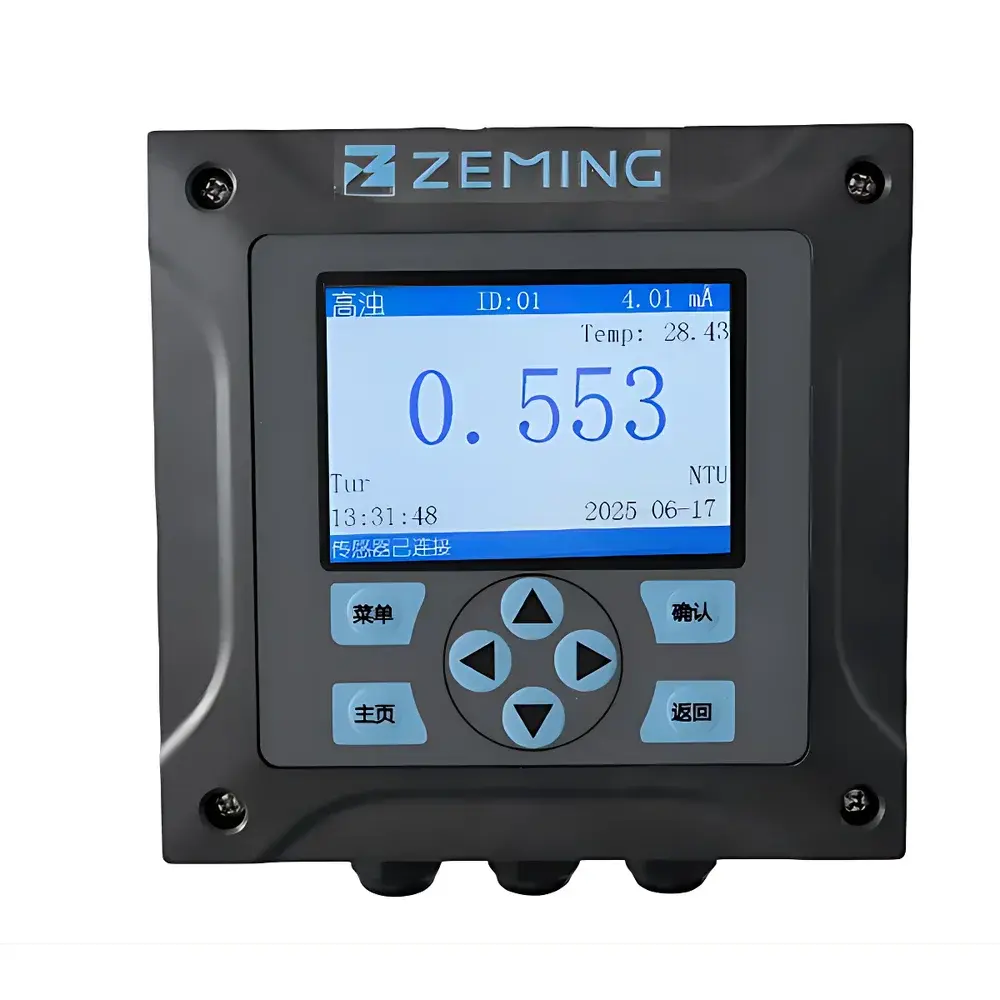
Zming Environmental HQ10-ZMT Universal Digital Sensor Controller (Transmitter Head)
| Brand | Zming Environmental Technology Co., Ltd. |
|---|---|
| Origin | Shanghai, China |
| Manufacturer Type | Authorized Distributor |
| Regional Classification | Domestic (China) |
| Model | HQ10-ZMT |
| Instrument Type | Online Water Quality Analyzer |
| Detection Principle | Electrochemical Sensing |
| Measurable Parameters | Dissolved Oxygen (DO), pH, Ammonia Nitrogen (NH₃-N), Residual Chlorine, Ozone (O₃), Turbidity, Conductivity, COD |
| Measurement Range | Customizable per sensor module |
| Repeatability | Customizable per sensor module |
| Display | 3.5″ TFT-LCD, 320×480 px, LED backlight, transflective |
| Dimensions (Controller) | 162.4 × 145.5 × 178.7 mm |
| Power Supply | (100–240) VAC, 50/60 Hz or 24 VDC |
| Operating Temperature | −20 to +60 °C |
| Storage Temperature | −20 to +70 °C |
| Relative Humidity | 0–95% RH (non-condensing) |
| Analog Outputs | Two isolated 4–20 mA outputs, max. load 500 Ω |
| Relay Outputs | Two SPDT relays |
| Communication Interface | MODBUS RTU over RS-485 |
| Enclosure Material | Polycarbonate with aluminum powder fill + stainless steel mounting hardware |
| Mounting Options | Wall-mount, panel-mount, and pipe-mount configurations |
Overview
The Zming Environmental HQ10-ZMT Universal Digital Sensor Controller (Transmitter Head) is an industrial-grade, protocol-agnostic interface designed for continuous online water quality monitoring in municipal, industrial, and environmental applications. Engineered around the MODBUS RTU communication standard, it serves as a centralized acquisition and control unit for digital sensors employing electrochemical detection principles—including but not limited to pH, dissolved oxygen (DO), ammonia nitrogen (NH₃-N), residual chlorine, ozone (O₃), turbidity, conductivity, and chemical oxygen demand (COD). Unlike proprietary transmitter platforms, the HQ10-ZMT decouples sensor intelligence from signal conditioning by accepting raw digital data streams directly from compliant field sensors via RS-485, eliminating analog signal degradation and enabling high-fidelity, noise-immune data transmission over distances up to 1,200 meters. Its modular architecture supports real-time parameter aggregation, alarm-triggered relay actuation, and dual-channel analog retransmission—making it suitable for integration into SCADA systems, PLC-based process control loops, and distributed environmental monitoring networks.
Key Features
- Protocol-compliant universal interface: Fully supports MODBUS RTU over RS-485, enabling interoperability with third-party digital sensors from multiple manufacturers without firmware modification.
- Intuitive human-machine interface (HMI): 3.5-inch transflective TFT-LCD display with LED backlight ensures legibility under direct sunlight and low-light conditions; on-screen calibration prompts and step-by-step diagnostics reduce operator dependency and minimize commissioning time.
- Robust industrial enclosure: IP66-rated polycarbonate housing with aluminum powder filler and stainless steel mounting components provides resistance to UV exposure, corrosion, dust ingress, and mechanical impact—validated for deployment in wastewater treatment plants, cooling towers, and outdoor surface water stations.
- Dual independent analog outputs: Two isolated 4–20 mA current loops support redundant signal routing to DCS systems or local chart recorders, each configurable for any measured parameter with user-defined scaling and zero/span adjustment.
- Configurable relay logic: Two SPDT relays support fail-safe or latching operation modes, programmable for high/low limit alarms, sensor fault indication, or automated dosing pump control—fully compliant with IEC 61508 functional safety guidelines for SIL-1 applications.
- Flexible power architecture: Accepts wide-range AC (100–240 VAC, 50/60 Hz) or DC (24 VDC) input, allowing seamless integration into both legacy plant infrastructure and modern low-voltage instrumentation cabinets.
Sample Compatibility & Compliance
The HQ10-ZMT is designed exclusively for use with digital sensors conforming to MODBUS RTU register mapping conventions (e.g., function codes 03h and 06h). It does not perform signal conditioning for analog sensors and requires external sensor modules with embedded microprocessors and calibrated transduction algorithms. Compatible sensor families include amperometric DO probes, ISFET-based pH electrodes, membrane-covered ammonia-selective electrodes, and optical turbidity cells. The controller itself complies with electromagnetic compatibility standards EN 61326-1 (industrial environment) and safety standard EN 61010-1. While not certified for intrinsic safety, its enclosure meets NEMA 4X requirements for outdoor use. For regulated environments, audit trails generated during calibration events can be exported manually to support GLP/GMP documentation workflows—though native 21 CFR Part 11 electronic signature functionality is not implemented.
Software & Data Management
Configuration and diagnostics are performed locally via the front-panel touchscreen interface; no PC software or proprietary drivers are required. All operational parameters—including measurement units, alarm thresholds, relay hysteresis, and MODBUS slave ID assignment—are stored in non-volatile memory with write-protection options. Data logging is not performed onboard; however, the MODBUS interface enables seamless polling by supervisory systems supporting standard register reads (e.g., holding registers 40001–40064). Timestamped event logs—including sensor disconnect alerts, calibration initiation, and relay state changes—are retained in volatile RAM and viewable on-screen for up to 72 hours. Firmware updates are delivered via microSD card slot (not included), following Zming’s documented versioning protocol and SHA-256 checksum verification.
Applications
- Municipal drinking water distribution networks: Continuous monitoring of residual chlorine and pH at booster stations and reservoir outlets.
- Industrial effluent discharge compliance: Real-time tracking of NH₃-N and COD in pre-treatment basins prior to municipal sewer release.
- Aquaculture and hydroponic systems: Multi-parameter DO/pH/turbidity control for closed-loop recirculating aquaculture systems (RAS).
- Cooling water management: Ozone and conductivity trending in HVAC chillers to prevent biofilm formation and scale deposition.
- Environmental river monitoring stations: Solar-powered deployments using 24 VDC input and low-power sleep-mode coordination with external data loggers.
FAQ
Does the HQ10-ZMT support HART or Profibus communication protocols?
No. The device implements MODBUS RTU exclusively over RS-485. HART and Profibus require separate hardware layers and are not supported.
Can it be used with analog (4–20 mA) sensors?
No. The HQ10-ZMT accepts only digital sensor inputs via MODBUS RTU. Analog sensors require an external signal converter or a dedicated analog-input transmitter.
Is remote configuration possible via Ethernet or Wi-Fi?
No. Remote access is limited to MODBUS master polling over RS-485. No built-in Ethernet, cellular, or wireless connectivity is provided.
What is the maximum number of digital sensors that can be connected simultaneously?
Up to 32 MODBUS slave devices may be daisy-chained on a single RS-485 bus, subject to cable length, termination, and electrical load constraints per EIA-485 specifications.
Does the controller provide temperature compensation for all measured parameters?
Temperature compensation is handled entirely by the individual sensor modules. The HQ10-ZMT displays and relays compensated values but does not apply additional algorithmic correction.
Related Products







