
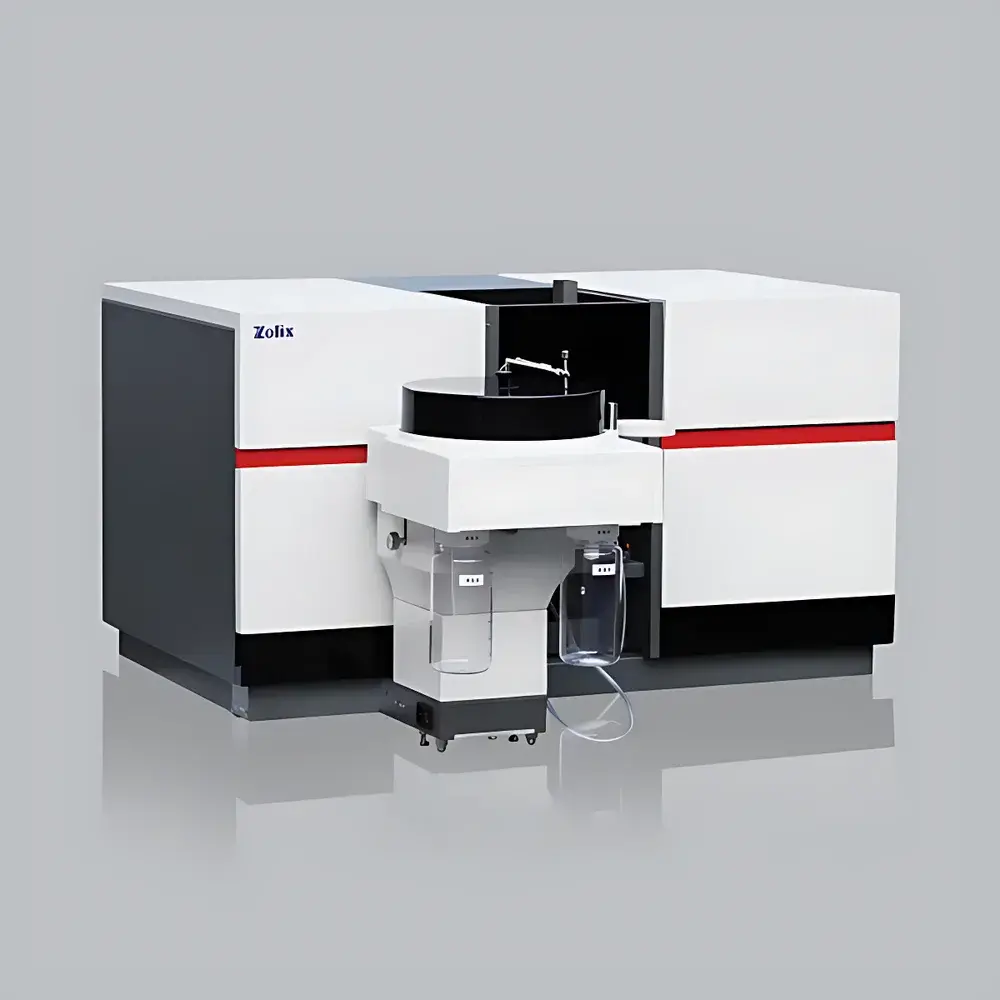
ZOLIX AA-9000 Series Flame-Graphite Furnace Atomic Absorption Spectrometer
| Brand | ZOLIX |
|---|---|
| Origin | Beijing, China |
| Manufacturer Type | Original Equipment Manufacturer (OEM) |
| Instrument Type | Flame-Graphite Furnace Hybrid AAS |
| Background Correction | Dual-mode Deuterium Lamp + Longitudinal AC Zeeman |
| Optical Grating | 1800 lines/mm |
| Wavelength Range | 190–900 nm |
| Spectral Bandwidth | 0.1/0.2/0.4/1.0/2.0 nm (auto-switchable) |
| Flame Cu Detection Limit | ≤0.003 µg/mL |
| Graphite Furnace Cd Characteristic Mass | 0.5×10⁻¹² g |
| Graphite Furnace Detection Limit | 10×10⁻¹² g |
| Max Graphite Furnace Temp | 2700 °C |
| Heating Rate | ≥2500 °C/s |
| Background Correction Capacity | >60× (flame, D₂), >100× (GF, Zeeman at ~2.0 Abs) |
| Auto-sampler Compatibility | AS-600 Integrated Flame/GF Autosampler |
| Software Compliance | Audit Trail, Electronic Signature, Role-Based Access Control, 21 CFR Part 11 Readiness |
Overview
The ZOLIX AA-9000 Series Flame-Graphite Furnace Atomic Absorption Spectrometer is a dual-atomization platform engineered for high-precision elemental quantification in complex matrices. It operates on the fundamental principle of atomic absorption spectroscopy—measuring ground-state atom concentration in a flame or graphite furnace by monitoring attenuation of element-specific hollow cathode lamp radiation at characteristic wavelengths (190–900 nm). Its core innovation lies in the longitudinal alternating-current (AC) Zeeman background correction system with continuously variable magnetic field strength (0.6–1.1 T in 0.1 T increments), eliminating polarization optics and doubling optical throughput versus transverse Zeeman designs. This architecture delivers superior linearity, sensitivity, and robustness against spectral interferences—especially critical for geological digests, metallurgical slags, environmental extracts, and biological tissues where non-specific absorption exceeds 1.5 Abs. Coupled with deuterium-lamp correction for flame mode and hybrid dual-mode correction in graphite furnace operation, the AA-9000 meets ISO 8288, ASTM D1688, and USP requirements for trace metal analysis in regulated environments.
Key Features
- Suspended optical bench design isolates the monochromator from mechanical vibration and ambient thermal drift, ensuring baseline stability ≤0.002 A/30 min (static) and ≤0.003 A/30 min (dynamic).
- High-efficiency Czerny-Turner monochromator with 1800 lines/mm holographic grating (blazed at 250 nm) provides resolution <0.1 nm and ample radiant flux—even for low-energy transitions such as As 193.7 nm and Se 196.0 nm.
- Integrated flame/graphite furnace atomizer module housed within a single chassis (1000 × 640 × 580 mm; 150 kg), minimizing optical path length and maximizing signal-to-noise ratio.
- Motorized, software-controlled burner head vertical positioning enables reproducible height optimization per element—stored as method parameters to eliminate manual re-alignment during multi-element sequences.
- Real-time graphite furnace video monitoring system allows visual validation of sample injection, drying, charring, and atomization phases—critical for method development and troubleshooting matrix effects.
- Intelligent gas management: automatic argon purge shutoff between analyses extends cylinder life; integrated water-level sensing, N₂O pressure monitoring, acetylene leak detection, and graphite furnace overtemperature protection comply with IEC 61010-1 safety standards.
Sample Compatibility & Compliance
The AA-9000 supports aqueous, organic, and acid-digested samples across diverse matrices—including soils (EPA Method 6010D), alloys (ASTM E3061), food extracts (AOAC 999.10), and clinical specimens (CLSI EP28-A3c). Its dual-background correction modes accommodate both broad-band molecular absorption (e.g., CaPO₄ in bone ash) and structured spectral overlaps (e.g., Fe 248.3 nm interfering with Cr 248.3 nm). Optional HG-01 hydride generation module enables sub-pg detection of As, Se, Hg, Sb, Bi, Pb, Sn, and Te per ICH Q2(R2) validation guidelines. The system conforms to GLP and GMP data integrity requirements: audit trail logs all parameter changes, electronic signatures are cryptographically secured, and role-based access control enforces separation of duties. Full 21 CFR Part 11 readiness includes time-stamped operator authentication, immutable raw data storage, and configurable retention policies.
Software & Data Management
Powered by Windows-based ZOLIX AAS Control Suite, the instrument features automated wavelength scanning, slit width selection, lamp current optimization, and Zeeman/D₂ mode switching—all executed within 40 seconds per element. An 8-lamp turret with encoded lamp recognition eliminates manual lamp mapping errors. Multi-element methods support sequential calibration, standard addition, and non-linear curve fitting (quadratic, cubic). QA/QC protocols include real-time SD/RSD monitoring, correlation coefficient validation, baseline drift correction, and automatic re-injection upon outlier detection. Data export complies with ASTM E1382 for LIMS integration. All reports—calibration curves, peak area integrals, instrument conditions, and QC summaries—are customizable and PDF-exportable. Backup archives retain method files, raw spectra, and audit logs with versioned recovery points.
Applications
The AA-9000 serves as a primary quantitative tool in accredited environmental labs analyzing heavy metals in wastewater per ISO 11885; in metallurgical QA/QC for impurity screening in Ni-base superalloys; in agricultural research measuring micronutrient uptake (Zn, Cu, Mn) in plant tissue; and in pharmaceutical manufacturing verifying catalyst residues (Pd, Pt, Rh) in API intermediates. Its 70-µL maximum graphite furnace injection volume enables precise dilution series for ultra-trace Pb in drinking water (≤1 µg/L), while the 2500 °C/s heating ramp ensures complete volatilization of refractory oxides in ceramic powders. The AS-600 autosampler enables unattended overnight runs of 133 samples with integrated standard dilution and modifier addition—reducing analyst variability and increasing throughput by >300% versus manual operation.
FAQ
Does the AA-9000 support regulatory-compliant data archiving?
Yes. The software implements full 21 CFR Part 11 functionality—including electronic signatures, audit trails with immutable timestamps, permission-tiered user roles, and encrypted backup restoration.
Can the Zeeman magnetic field be optimized per element?
Yes. Field strength is adjustable from 0.6 T to 1.1 T in 0.1 T steps via software; optimal values are saved per method to maximize correction linearity and minimize Zeeman reversal artifacts.
Is hydride generation fully integrated into the control software?
Yes. HG-01 parameters (reaction coil temperature, NaBH₄ flow rate, Ar carrier gas timing) are embedded in AAS method files and synchronized with furnace temperature programs.
What safety certifications does the system meet?
The AA-9000 complies with IEC 61010-1 (electrical safety), ISO 13849-1 (PL e functional safety for gas interlocks), and EN 61326-1 (EMC immunity).
How is graphite tube alignment ensured during replacement?
The pivot-mounted graphite holder incorporates mechanical keying and self-centering injection port geometry—eliminating manual alignment and reducing setup time to <60 seconds.
Related Products




