
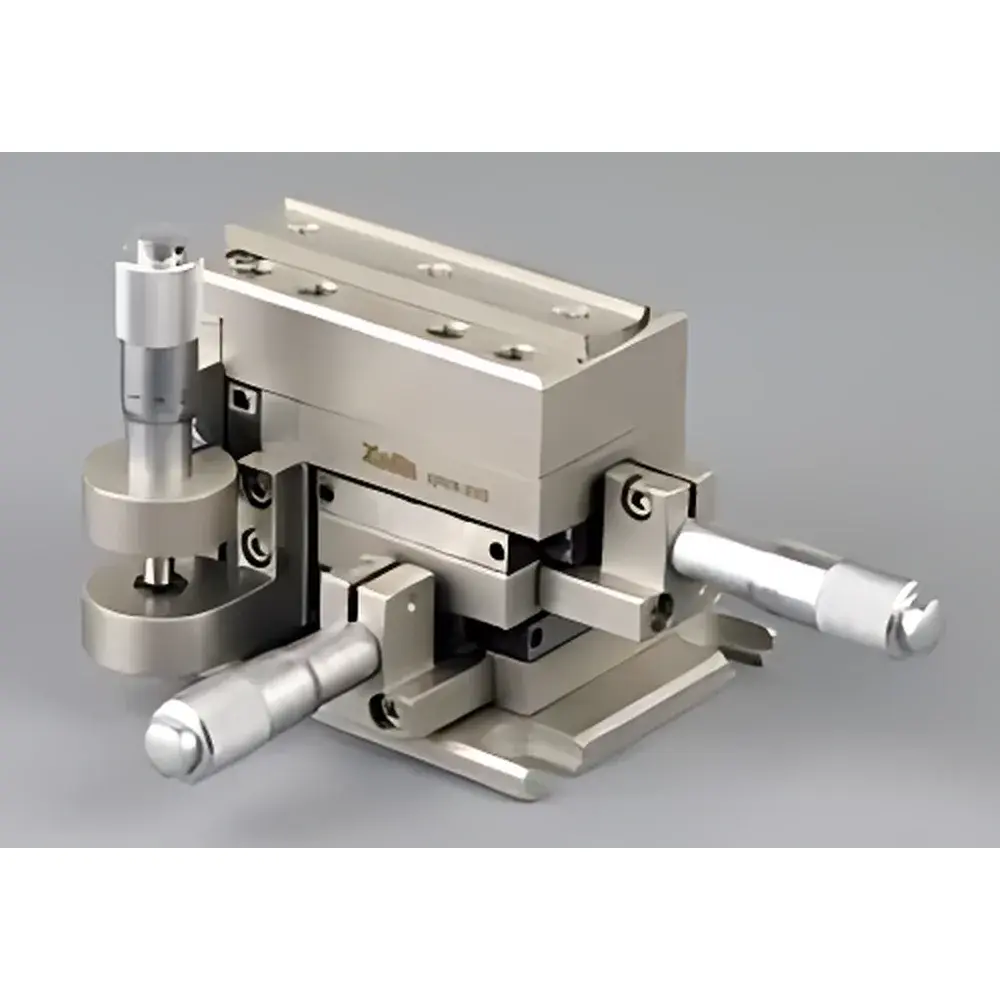
ZOLIX APFP-XYZ Precision XYZ Translation Stage for Optical Alignment
| Brand | ZOLIX |
|---|---|
| Model | APFP-XYZ |
| Type | Manual Three-Axis Translation Stage |
| Travel (X/Y) | 12 mm |
| Travel (Z) | 6 mm |
| Tilt Error (Pitch/Yaw) | <100 µrad |
| Load Capacity | 2.3 kg |
| Optical Center Height | 79 mm |
| Mounting Interface | Standard燕尾座 (Dovetail Base) |
| Handedness | Right-Handed (Left-Handed Variant: APFP-XYZL) |
| Origin | Beijing, China |
| Manufacturer | ZOLIX Optics |
Overview
The ZOLIX APFP-XYZ is a high-stability, manually operated three-axis translation stage engineered for precision optical alignment in research-grade and industrial optical laboratories. Designed around a robust dovetail-based mechanical architecture, it enables independent, orthogonal fine positioning along the X, Y, and Z axes—critical for iterative beam steering, lens centering, interferometer cavity alignment, and fiber coupling optimization. Its motion principle relies on calibrated micrometer-driven lead screws with hardened stainless-steel bushings and low-backlash nuts, ensuring repeatable sub-microradian angular stability and minimal parasitic motion during translation. Unlike motorized or piezoelectric stages, the APFP-XYZ prioritizes mechanical rigidity, thermal stability, and long-term positional retention—making it especially suitable for static or semi-static alignment tasks where electronic actuation introduces unnecessary complexity or electromagnetic interference.
Key Features
- Precision XYZ motion with independent micrometer controls: 12 mm travel in X and Y, 6 mm in Z—each axis equipped with engraved 0.01 mm graduations and lockable knurled knobs for tactile feedback and drift resistance.
- Ultra-low angular deviation: Pitch and yaw errors maintained below 100 µrad across full travel—verified via autocollimator measurement per ISO 10110-7 standards for optical component mounting systems.
- Dovetail base interface (standard 25 mm width) compatible with ZOLIX’s modular optical rail system and third-party breadboards featuring M4 or 1/4″-20 tapped holes.
- Optical center height fixed at 79 mm above base mounting surface—designed to align with standard optical tables (e.g., Newport TS-series, Thorlabs PT-series) and facilitate rapid integration into multi-stage kinematic chains.
- Bidirectional handedness configuration: Standard right-handed version (APFP-XYZ) and left-handed variant (APFP-XYZL) enable symmetrical setup in dual-beam or polarization-divided optical paths without custom adapters.
- Load capacity of 2.3 kg distributed evenly—sufficient to support mounted components such as kinematic mirror mounts (e.g., KM100), lens tubes (up to Ø50 mm), or compact diode laser modules while maintaining positional fidelity under gravitational loading.
Sample Compatibility & Compliance
The APFP-XYZ is intended for use with passive and active optical elements including mirrors, lenses, waveplates, polarizers, and fiber collimators. Its non-magnetic aluminum alloy housing (6061-T6 anodized) ensures compatibility with magnetic-sensitive environments (e.g., near NMR spectrometers or electron optics). The stage conforms to general mechanical safety requirements outlined in ISO 14122-3 for adjustable equipment used in laboratory settings. While not certified to specific regulatory frameworks (e.g., CE or UL), its construction adheres to RoHS-compliant material sourcing and meets dimensional tolerances referenced in ANSI/OPI B1.12-2018 for optical instrument mounting interfaces. No electrical or pneumatic connections are required; therefore, no EMC or intrinsic safety certification applies.
Software & Data Management
As a purely manual mechanical stage, the APFP-XYZ does not incorporate embedded electronics, sensors, or digital interfaces. Consequently, it requires no firmware, driver installation, or software dependency. Positional data is recorded manually using the integrated micrometer scales or external metrology tools (e.g., dial indicators, laser interferometers). For labs operating under GLP or GMP protocols, users may document stage settings within their existing electronic lab notebooks (ELN) or LIMS platforms—consistent with FDA 21 CFR Part 11 guidelines when paired with appropriate audit-trail-enabled software. ZOLIX provides calibration certificates upon request (traceable to CNAS-accredited labs), including measured tilt error profiles and repeatability test reports.
Applications
- Alignment of free-space optical cavities in laser spectroscopy setups (e.g., Pound–Drever–Hall locking).
- Iterative optimization of coupling efficiency between single-mode fibers and photonic integrated circuits (PICs).
- Positional registration of multi-element objectives in confocal or super-resolution microscopy test benches.
- Kinematic adjustment of retroreflectors in heterodyne interferometry systems requiring sub-arcsecond angular control.
- Integration into OEM optical assemblies where long-term mechanical reliability outweighs automation needs—such as environmental monitoring spectrometers or field-deployable ellipsometers.
FAQ
Is the APFP-XYZ compatible with vacuum environments?
No—its lubricants and anodized surface are not rated for UHV or HV conditions. For vacuum applications, ZOLIX offers the APFP-XYZ-V variant with dry-film lubrication and vacuum-compatible fasteners.
Can I mount this stage directly onto a 1-inch optical post?
Yes—the base includes four M4 threaded holes arranged in a 25 mm square pattern, enabling secure attachment via standard post holders (e.g., Thorlabs PH3, Newport UH1).
What is the maximum recommended torque for the micrometer knobs?
Do not exceed 0.3 N·m; over-torquing may deform the brass nut or damage the lead screw thread geometry, compromising repeatability.
Does ZOLIX provide mounting plates for Ø25.4 mm lens tubes?
Yes—accessory plate AP-MT25 is available separately, featuring centering bores and kinematic dowel pins for coaxial alignment.
How is thermal drift managed in extended-duration experiments?
The stage’s aluminum structure exhibits a CTE of ~23.6 × 10⁻⁶ /°C; for sub-micron stability over >1 hour, ambient temperature should be stabilized within ±0.5 °C, consistent with ISO 230-3 recommendations for precision positioning equipment.




