
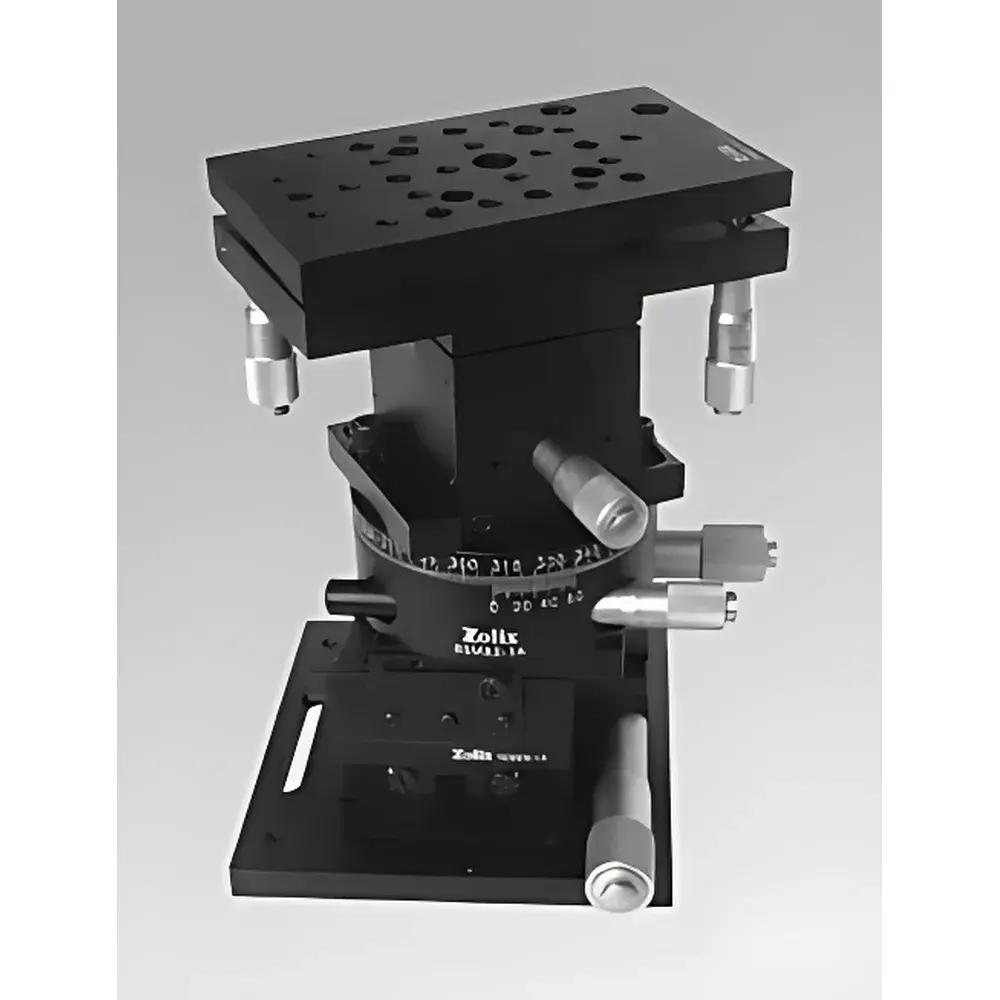
ZOLIX ASM-XYZθΤ-1A Six-Axis Precision Motion Stage
| Brand | ZOLIX |
|---|---|
| Origin | Beijing, China |
| Manufacturer | Yes |
| Type | Domestic |
| Model | ASM-XYZθΤ-1A |
| Price | Upon Request |
| Translation Axes (Tx, Ty) | ±25 mm |
| Vertical Axis (Tz) | ±5 mm |
| Rotation about Z-axis (θz) | 360° continuous |
| Tilt Axes (θx, θy) | ±5° each |
| Integrated Substages | TSM25-1A (x/y linear), TSMV5-1A ×2 (z-lift), RSM82-1A (azimuthal rotation), TSMT5-1A (dual-axis tip/tilt) |
Overview
The ZOLIX ASM-XYZθΤ-1A is a fully integrated six-degree-of-freedom (6-DOF) precision motion stage engineered for demanding optical alignment, interferometric setup, beam steering calibration, and multi-axis optomechanical prototyping. Unlike stacked or modular solutions requiring manual integration and alignment compensation, this stage delivers factory-aligned kinematic coupling between its constituent high-precision subassemblies — enabling deterministic, repeatable positioning across all six axes (Tx, Ty, Tz, θx, θy, θz) without cumulative mechanical drift or orthogonalization error. Its architecture follows classical parallel-kinematic design principles optimized for minimal Abbe offset and thermal path symmetry, making it suitable for applications where sub-microradian angular stability and sub-micrometer translational repeatability are critical — including cavity mirror alignment in ultra-stable laser resonators, fiber coupling optimization in free-space photonic interconnects, and metrology-grade collimator calibration.
Key Features
- Integrated six-axis motion capability: independent, motorized control of three orthogonal translations (Tx, Ty, Tz) and three rotational degrees of freedom (θx, θy, θz), with coordinated motion programming support via standard motion controllers.
- High-precision mechanical substage integration: built around ZOLIX’s proven TSM25-1A (25 mm travel, 0.5 µm resolution linear stage), dual TSMV5-1A vertical lift modules (5 mm stroke, backlash-free lead-screw drive), RSM82-1A 360° continuous rotation stage (encoder-resolved to 0.001°), and TSMT5-1A dual-axis tilt platform (±5° range per axis, orthogonal pivot geometry).
- Rigid aluminum alloy baseplate with stress-relieved mounting interface, CNC-machined to ISO 2768-mK tolerances; all sliding surfaces utilize recirculating ball-bearing guides with preloaded anti-backlash nuts for consistent hysteresis < 0.5 µm in translation and < 2 arcsec in angular axes.
- Standard M6 and 1/4″-20 threaded mounting patterns on all top and side surfaces; compatible with Thorlabs, Newport, and Standa optical rails and post holders without adapter plates.
- Optional integration-ready interfaces: RS-485 and USB 2.0 communication ports; support for ZOLIX MotionSuite software and third-party drivers (LabVIEW, MATLAB, Python via ASCII command protocol).
Sample Compatibility & Compliance
The ASM-XYZθΤ-1A accommodates payloads up to 3.5 kg distributed over its central 100 × 100 mm aperture region, maintaining specified performance within rated load limits. It complies with CE marking requirements for electromagnetic compatibility (EN 61326-1) and low-voltage safety (EN 61000-6-2/6-3). Mechanical design adheres to ISO 10110-7 surface quality referencing for optical mounting surfaces and conforms to RoHS 2015/863/EU material restrictions. While not certified for cleanroom use (ISO Class 5 or better), its non-outgassing anodized finish and sealed bearing housings make it suitable for Class 7–8 environments when operated with appropriate particulate mitigation practices.
Software & Data Management
ZOLIX MotionSuite v3.x provides native GUI-based control, trajectory planning (point-to-point, linear interpolation, circular arc), and real-time position logging at up to 100 Hz sampling rate. All motion commands generate timestamped audit trails compliant with GLP documentation standards. The system supports 21 CFR Part 11–ready configurations when deployed with optional user-role authentication, electronic signature capture, and encrypted local database storage (SQLite with AES-256). Export formats include CSV, HDF5, and XML for traceable data exchange with MATLAB, Python (NumPy/Pandas), or LabVIEW-based analysis pipelines.
Applications
- Precision alignment of laser cavities, spatial filters, and wavefront sensors in metrology-grade interferometers (e.g., Twyman–Green, Mach–Zehnder).
- Active stabilization platforms for adaptive optics testbeds requiring simultaneous tip/tilt correction and focus adjustment.
- Calibration fixtures for coordinate measuring machines (CMMs) and autocollimators requiring traceable angular displacement references.
- Multi-axis scanning stages for confocal microscopy sample positioning where axial focus and lateral registration must be decoupled yet synchronized.
- Education and R&D labs conducting hands-on experiments in optical engineering, photonics, and precision mechanics — particularly where students require exposure to industrial-grade DOF coordination logic.
FAQ
What is the maximum payload capacity while maintaining specified angular repeatability?
The stage maintains ±2 arcsec angular repeatability (θx/θy) and ±0.002° (θz) up to 2.8 kg centered load; above this, angular hysteresis increases gradually but remains within ±5 arcsec up to 3.5 kg.
Can the stage be operated in vacuum environments?
No — standard configuration uses lubricated ball bearings and polymer seals not rated for vacuum. Vacuum-compatible variants (UHV-rated grease, stainless steel construction, vented motors) are available under custom order (lead time: 12–14 weeks).
Is encoder feedback provided on all six axes?
Yes — all axes feature integrated incremental optical encoders with 1 µm linear and 0.001° angular resolution; closed-loop operation is supported via optional ZOLIX MC-6D controller.
Does the system support scripting for automated alignment routines?
Yes — MotionSuite includes Python API bindings and exposes full command set via ASCII serial protocol, enabling integration into custom alignment algorithms using image-based feedback from CCD/CMOS cameras.
What maintenance schedule is recommended for long-term positional stability?
Biannual inspection of preload torque on lead screws and recalibration of encoder zero points is advised; no routine lubrication is required under normal ambient lab conditions (20–25°C, RH < 60%).





