
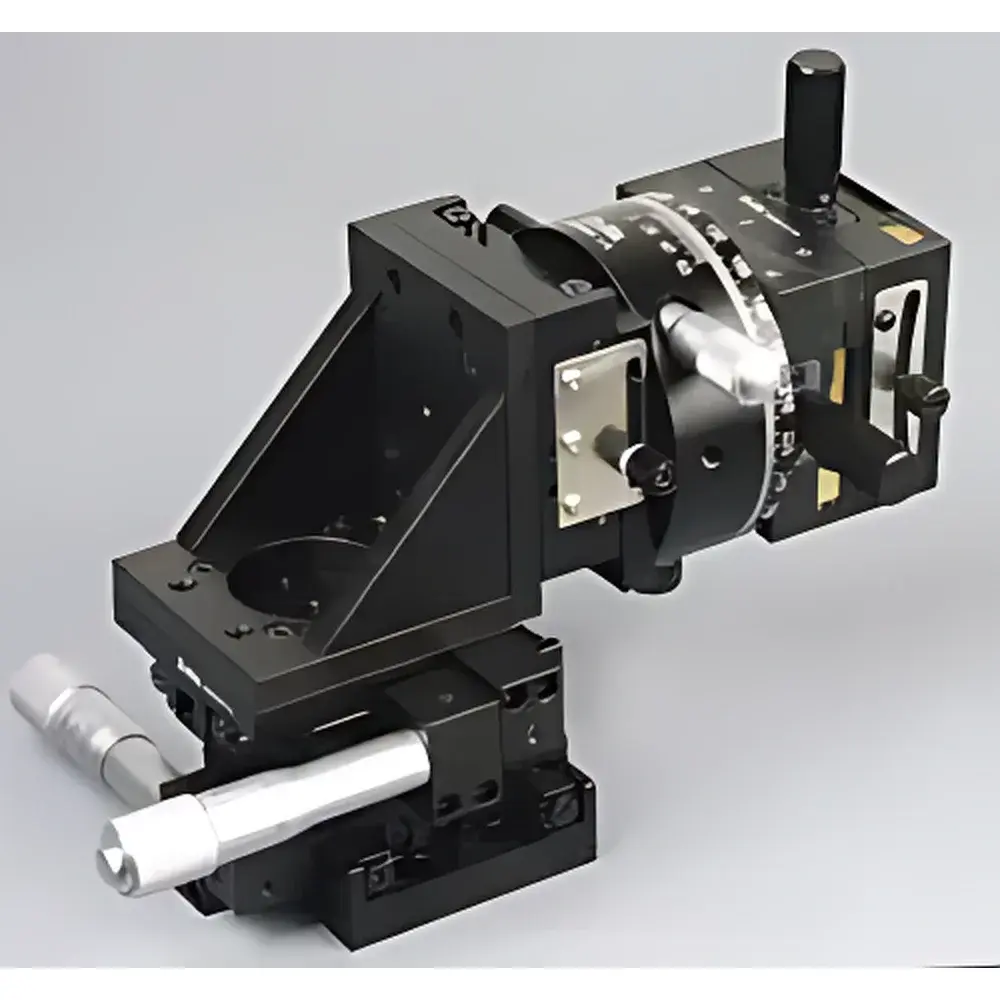
ZOLIX ASM25XYZ-RG2 Six-Axis Precision Translation and Rotation Stage
| Brand | ZOLIX |
|---|---|
| Origin | Beijing, China |
| Manufacturer Type | Direct Manufacturer |
| Product Origin | Domestic (China) |
| Model | ASM25XYZ-RG2 |
| Pricing | Upon Request |
| Degrees of Freedom | 6 (X, Y, Z, θx, θy, θz) |
| Linear Travel Range (X/Y/Z) | ±25 mm |
| Angular Adjustment Range (θx/θy) | ±10° |
| Rotational Range (θz) | 360° continuous |
| Integrated Subsystems | ASM25-XYZ-1A 3D translation stage + RSM82-1A rotation stage + two TSMG10-series precision angular goniometers (TSMG10-1W & TSMG10-2W) |
Overview
The ZOLIX ASM25XYZ-RG2 is a fully integrated six-degree-of-freedom (6-DOF) precision positioning stage engineered for demanding optical alignment, interferometric setup calibration, and multi-axis beam steering applications. It combines orthogonal linear displacement (X, Y, Z) with three independent rotational degrees of freedom (roll θx, pitch θy, yaw θz) within a rigid, thermally stable mechanical architecture. Unlike stacked or modular assemblies requiring external alignment, the ASM25XYZ-RG2 is factory-aligned and pre-integrated—ensuring intrinsic orthogonality between translation and rotation axes, minimal crosstalk (<0.5 arcsec coupling under full load), and repeatable sub-microradian angular positioning. Its design adheres to principles of kinematic constraint and low-hysteresis motion transmission, utilizing high-precision crossed-roller bearings, differential micrometer drives, and backlash-free worm-gear mechanisms for angular stages. This stage is not intended for high-speed automation but for static or quasi-static optical configuration where absolute angular fidelity and spatial repeatability are critical—such as in cavity mirror alignment for ultra-stable lasers, collimation of multi-element optical engines, or angular calibration of thin-film ellipsometers.
Key Features
- Six independently controllable axes: three orthogonal translations (±25 mm each) and three rotations (±10° for θx/θy; continuous 360° for θz)
- Pre-aligned monolithic integration: eliminates cumulative tolerance stack-up typical of bolt-together multi-stage systems
- Dual precision angular goniometers (TSMG10-1W and TSMG10-2W) provide high-resolution angular adjustment with <5 µrad minimum incremental motion and <15 µrad bidirectional repeatability
- RSM82-1A azimuthal rotation stage enables full 360° yaw control with center-of-rotation coincident with the optical axis
- ASM25-XYZ-1A base platform delivers smooth, low-wobble linear motion via hardened stainless steel leadscrews and PTFE-coated dovetail guides
- Black anodized aluminum construction ensures dimensional stability across ambient lab conditions (15–30 °C) and minimizes thermal drift during extended experiments
- Standard M6 and 1/4″-20 threaded mounting holes on all top and side surfaces support direct integration with optical posts, lens mounts, and vacuum-compatible adapters
Sample Compatibility & Compliance
The ASM25XYZ-RG2 is compatible with optical components ranging from Ø12.7 mm to Ø75 mm in diameter and up to 2.5 kg in mass—sufficient for most laser mirrors, waveplates, pellicles, and miniature optical engines. Its non-magnetic aluminum frame and absence of ferromagnetic fasteners permit use in environments sensitive to magnetic interference (e.g., near electron optics or atomic physics setups). While not certified to ISO 9001 for production-line deployment, the stage complies with mechanical tolerancing standards per ISO 2768-mK and surface finish specifications per ISO 1302. All adjustment mechanisms meet RoHS 2011/65/EU directives. No electrical or pneumatic interfaces are included; manual operation aligns with GLP-compliant optical alignment workflows where traceable, operator-controlled adjustments are required.
Software & Data Management
The ASM25XYZ-RG2 operates exclusively via manual micrometer drives and does not include motorized actuators or digital encoders. Consequently, it requires no firmware, drivers, or proprietary software—making it inherently compatible with any laboratory environment, including air-gapped networks and Class 100 cleanrooms. For documentation and traceability, users may log positional settings using standardized alignment logs compliant with ISO/IEC 17025 Annex A.2 guidelines. Optional accessories—including engraved angular scales with 0.1° resolution and removable digital readout adapters (e.g., Mitutoyo 543 series)—can be retrofitted without structural modification. No data export, audit trail, or 21 CFR Part 11 compliance is applicable, as the device performs no electronic data acquisition.
Applications
- Alignment of multi-element optical engines in projection systems and laser scanning modules
- Fine-tuning of incidence angle and polarization orientation in thin-film optical characterization (e.g., spectroscopic ellipsometry, reflectometry)
- Co-alignment of reference and measurement arms in Mach-Zehnder and Michelson interferometers
- Positioning of fiber collimators and photonic integrated circuit (PIC) test fixtures
- Calibration of angular response in optical sensors and position-sensitive detectors (PSDs)
- Stabilization of optical paths in gravitational-wave detector prototype benches requiring sub-arcsecond pointing stability
FAQ
Is the ASM25XYZ-RG2 compatible with vacuum environments?
No—standard configuration uses lubricated micrometer threads and polymer-based bearing seals unsuitable for UHV. Vacuum-compatible variants (with dry-lubricated leadscrews and metal-sealed goniometers) are available upon engineering consultation.
What is the maximum payload capacity at full angular extension?
2.5 kg when centered on the stage’s geometric origin; payload must be symmetrically distributed to maintain angular balance and avoid torque-induced hysteresis in θx/θy axes.
Can individual sub-stages (e.g., RSM82-1A) be purchased separately?
Yes—ZOLIX offers all constituent stages (ASM25-XYZ-1A, RSM82-1A, TSMG10-1W, TSMG10-2W) as standalone units with full dimensional and performance datasheets.
Does the stage include locking mechanisms for each axis?
Yes—each micrometer-driven axis features dual-action locking knobs that secure both translational and rotational degrees of freedom without inducing deformation or axis shift.
What is the typical lead time for custom modifications (e.g., tapped hole patterns, blackened surfaces)?
Standard lead time is 4–6 weeks; custom mechanical revisions require formal engineering review and NDA execution prior to quotation.





