
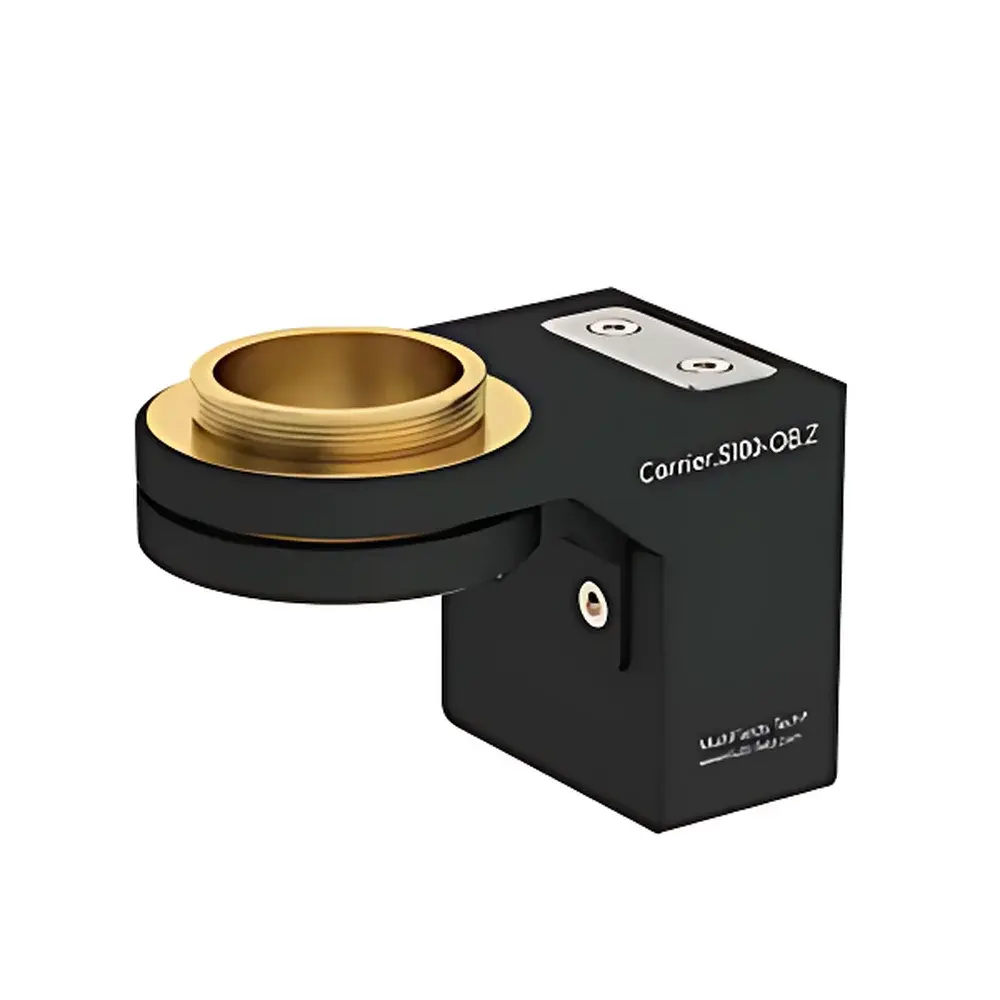
ZOLIX Carrier.S100-OB.Z Objective Auto-Focus Scanning Stage
| Brand | ZOLIX |
|---|---|
| Origin | Beijing, China |
| Manufacturer Type | Direct Manufacturer |
| Product Category | Motorized Translation Stage |
| Model | Carrier.S100-OB.Z |
| Motion Axes | X-Y-Z (Z-axis primary focus axis) |
| Scan Range (XY) | 200 µm × 200 µm |
| Z-Travel | 100 µm |
| Closed-Loop Positioning Accuracy | < 1 nm |
| Maximum Load Capacity | 500 g |
| Linearity Error | 0.02% of full scale |
| Tilt/Pitch | ≤ 30 µrad |
| Sensor Type | Integrated Capacitive Sensor |
| Sensor Noise | 0.3 nm RMS |
| Open-Loop Z Resolution | 0.1 nm |
| Settling Time (to 90% of target position) | 15 ms |
| Stiffness | 0.4 N/µm |
| Resonant Frequency (unloaded) | 650 Hz |
| Resonant Frequency (150 g load) | 275 Hz |
| Total Mass | 270 g |
| Housing Materials | 304 Stainless Steel and Aluminum Alloy |
| Optional Configurations | .NM (Non-Magnetic), .UHV (Ultra-High Vacuum), .HV (High Vacuum) |
Overview
The ZOLIX Carrier.S100-OB.Z Objective Auto-Focus Scanning Stage is a high-precision, piezo-driven triaxial positioning system engineered for dynamic optical focusing and nanoscale sample scanning in advanced microscopy applications. Designed specifically for integration with upright and inverted optical microscopes—including super-resolution platforms such as STED, PALM, and STORM—the stage delivers sub-nanometer closed-loop stability in the Z-axis while enabling synchronized XY raster scanning over a 200 µm × 200 µm field. Its core actuation relies on low-hysteresis piezoelectric ceramics coupled with monolithic flexure guidance, ensuring minimal parasitic motion and thermal drift. Unlike stepper-motor or voice-coil-based alternatives, the Carrier.S100-OB.Z employs direct-drive capacitive position sensing for real-time feedback, eliminating reliance on external interferometers or encoder strips. This architecture supports both open-loop high-speed stepping (0.1 nm resolution) and closed-loop servo control (<1 nm repeatability), making it suitable for time-resolved z-stack acquisition, adaptive optics correction loops, and automated focus maintenance during long-duration live-cell imaging.
Key Features
- Sub-nanometer closed-loop Z-axis positioning accuracy (<1 nm RMS repeatability) with integrated capacitive displacement sensor
- Simultaneous high-bandwidth XY scanning (200 µm × 200 µm range) and precise Z-focus adjustment (100 µm travel)
- Low tilt error (≤30 µrad) and exceptional linearity (0.02% FS), critical for maintaining optical conjugacy across large scan fields
- Robust mechanical design featuring hybrid construction: structural frame in 304 stainless steel for vacuum compatibility and thermal stability; moving elements in lightweight aluminum alloy for optimized resonant performance
- High stiffness (0.4 N/µm) and unloaded resonant frequency of 650 Hz—enabling rapid settling (15 ms to 90% of target) even under 150 g payload
- Modular configuration options: .NM (non-magnetic version for MRI-compatible or electron microscopy environments), .UHV (ultra-high vacuum rated to 1×10⁻¹⁰ mbar), and .HV (high-vacuum compatible)
Sample Compatibility & Compliance
The Carrier.S100-OB.Z is fully compatible with standard microscope nosepieces (including Nikon CFI60, Olympus UIS2, and Leica HCX objectives) and integrates seamlessly via M27×0.75 or M32×0.75 objective mounting threads. Its compact footprint (≤80 mm × 80 mm base) and low mass (270 g) minimize inertial coupling with vibration-isolated optical tables. For regulated environments, the stage complies with ISO 9001 manufacturing standards and supports GLP/GMP workflows through deterministic motion logging and traceable calibration protocols. Optional UHV versions meet ASTM E595 outgassing requirements and are certified for use in ultra-high vacuum chambers compliant with ISO 10109-2. Non-magnetic (.NM) variants are tested per IEC 61000-4-8 for magnetic field immunity up to 1 mT, ensuring operational integrity near MRI scanners or cryogenic magnet systems.
Software & Data Management
The stage is controlled via ZOLIX’s proprietary ZSControl SDK (Windows/Linux/macOS), offering native support for LabVIEW, MATLAB, Python (PyVISA, NumPy), and C/C++ APIs. All motion commands include timestamped position feedback with 1 kHz sampling rate, enabling synchronization with camera triggers, laser pulses, or external DAQ systems. Audit trails—including command history, sensor output logs, and thermal drift compensation records—are exportable in HDF5 or CSV format for FDA 21 CFR Part 11–compliant documentation. Firmware updates preserve calibration coefficients and support field recalibration using NIST-traceable step-height standards.
Applications
- Automated z-stack acquisition in confocal, light-sheet, and structured illumination microscopy (SIM)
- Real-time focus stabilization during extended time-lapse imaging of live biological specimens
- Nanoscale topographic mapping in optical profilometry and interference microscopy
- Alignment and focus tuning of multi-objective array systems in parallelized single-molecule detection setups
- In-situ characterization of semiconductor wafers and photonic crystal devices under ambient, high-vacuum, or non-magnetic conditions
FAQ
Is the Carrier.S100-OB.Z compatible with third-party microscope control software such as Micro-Manager or MetaMorph?
Yes—ZOLIX provides documented DLL wrappers and example scripts for seamless integration with Micro-Manager (v2.0+), MetaMorph (via ActiveX), and Nikon NIS-Elements (through OEM SDK licensing).
What is the maximum recommended objective weight for stable Z-axis performance?
The stage maintains specified linearity and settling time up to 500 g static load; however, optimal dynamic performance (e.g., <20 ms settling at 100 Hz update rate) is guaranteed for objectives ≤300 g.
Can the .UHV version be baked out? If so, what are the temperature limits?
The .UHV configuration supports bake-out up to 150 °C for 24 hours, consistent with standard UHV chamber conditioning protocols. All internal cabling uses polyimide-insulated wires rated to 200 °C.
Does the capacitive sensor require periodic recalibration?
No—capacitive sensors are factory-calibrated against NIST-traceable interferometric references and exhibit zero long-term drift under normal operating conditions (20–25 °C, 85% RH for >72 hours.
How is thermal drift compensated during extended acquisitions?
The stage firmware implements real-time temperature-compensated offset correction using embedded thermistors (±0.1 °C resolution); users may also apply custom polynomial drift models via the SDK’s “ThermalMap” interface.





