
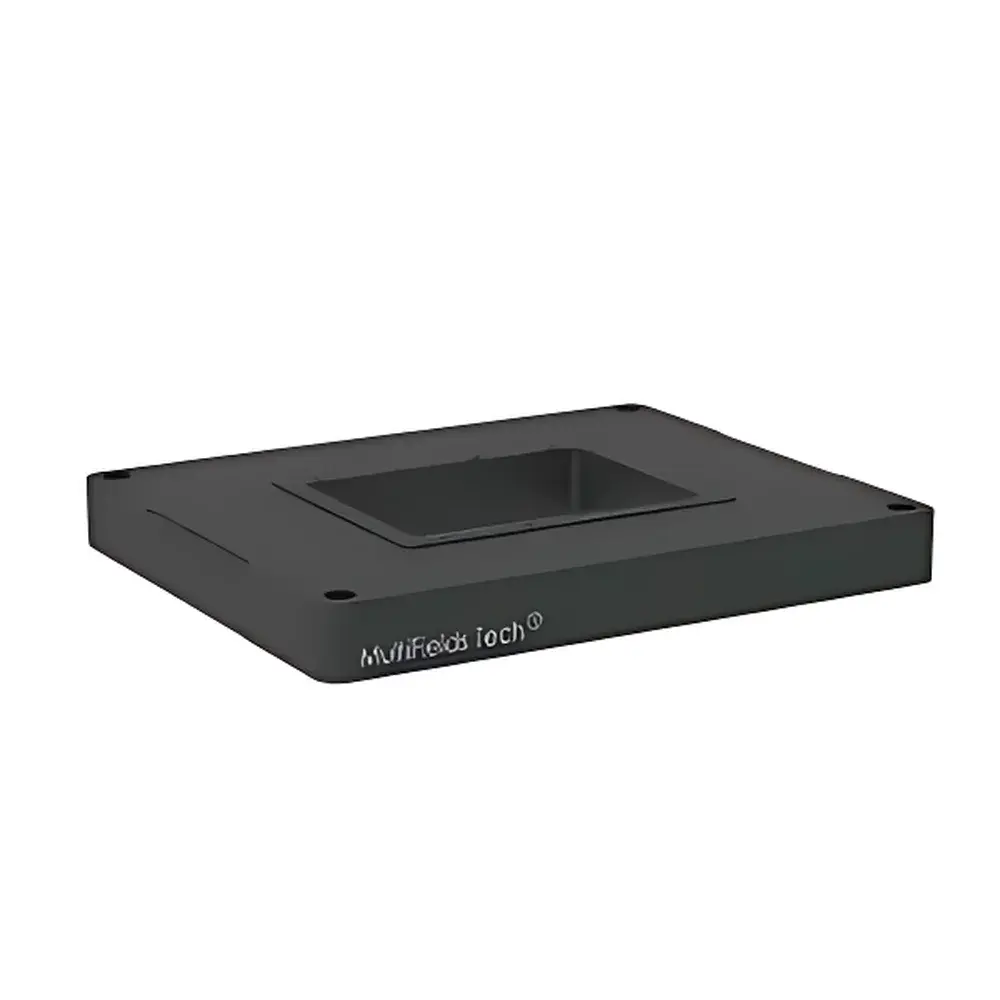
ZOLIX Carrier.S200.XY High-Resolution XY Piezo Scanning Stage
| Brand | ZOLIX |
|---|---|
| Model | Carrier.S200.XY |
| Travel Range | 200 µm × 200 µm |
| Closed-Loop Positioning Accuracy | <1 nm |
| Maximum Load Capacity | 500 g |
| Sensor Type | Capacitive |
| Sensor Resolution | 0.3 nm |
| Piezoelectric Capacitance (X/Y) | 6.5 µF |
| Operating Temperature Range | 15–40 °C |
| Mass | 1 kg |
| Base Dimensions × Height | 180 mm × 150 mm × 20 mm |
| Central Aperture | 80 mm × 60 mm |
| Material | Aluminum Alloy |
| Mounting Thread Compatibility | Carrier.L7550.XY Series |
| Optional Configurations | .NM (Non-Magnetic), .UHV (Ultra-High Vacuum), .HV (High Vacuum) |
Overview
The ZOLIX Carrier.S200.XY is a high-precision, closed-loop XY piezoelectric scanning stage engineered for demanding optical and nanoscale metrology applications. Designed around a monolithic flexure-guided architecture with integrated piezoceramic actuators, it delivers sub-nanometer motion control across a 200 µm × 200 µm planar scan range—enabling stable, drift-free positioning essential for super-resolution microscopy, optical trapping, semiconductor wafer inspection, and scanning probe techniques. Unlike stepper-motor or voice-coil-based translation stages, the Carrier.S200.XY operates on electrostrictive principles, eliminating mechanical backlash, hysteresis (compensated via real-time capacitive feedback), and wear-related degradation. Its compact footprint (180 mm × 150 mm × 20 mm) and central 80 mm × 60 mm aperture facilitate direct integration into inverted and upright microscope configurations, beamline end-stations, and vacuum-compatible optical benches.
Key Features
- True closed-loop XY scanning with <1 nm repeatability and <0.3 nm capacitive sensor resolution—traceable to NIST-traceable calibration protocols.
- Monolithic aluminum alloy body (6061-T6) optimized for thermal stability, rigidity, and low outgassing—validated for operation in ambient, cleanroom, and controlled-environment laboratories.
- Integrated high-capacitance piezo stacks (6.5 µF per axis) with low-voltage drive compatibility (0–120 V), minimizing EMI coupling and enabling synchronization with external TTL triggers.
- Standard M4 and M6 threaded mounting patterns compliant with ZOLIX Carrier.L7550.XY kinematic base interfaces—ensuring mechanical interoperability across multi-axis modular platforms.
- Configurable variants: .NM (non-magnetic version, <1 µT residual field), .UHV (ultra-high vacuum rated to 1×10⁻¹⁰ mbar, all-metal seals, no organics), and .HV (high vacuum, 1×10⁻⁷ mbar, baked at 150 °C).
- Thermally compensated design with operating range of 15–40 °C; performance specifications validated at 23 ± 1 °C per ISO 230-2 Annex A.
Sample Compatibility & Compliance
The Carrier.S200.XY supports payloads up to 500 g while maintaining specified dynamic stiffness (>2.5 N/µm in XY) and resonant frequency (>500 Hz unloaded). It is routinely deployed under ISO 14644-1 Class 5 cleanroom conditions and conforms to IEC 61000-6-2 (immunity) and IEC 61000-6-4 (emission) standards. For regulated environments—including GLP-compliant semiconductor process development labs—the stage’s closed-loop firmware supports audit-trail-enabled position logging (timestamped, user-ID tagged) compatible with FDA 21 CFR Part 11 requirements when paired with ZOLIX ControlSuite v4.x software. Mechanical interface geometry complies with SEMI E10-0706 (Equipment Automation Standards) for automated material handling integration.
Software & Data Management
Native control is provided via ZOLIX ControlSuite—a cross-platform (Windows/Linux) SDK supporting LabVIEW, MATLAB, Python (PyVISA, NumPy), and C/C++ APIs. Real-time position streaming at up to 10 kHz enables synchronized acquisition with sCMOS cameras, APD arrays, or lock-in amplifiers. All motion profiles (raster, Lissajous, spiral, custom waveform) are programmable with jitter <50 ns RMS. Data export formats include HDF5 (with metadata schema per NeXus standard), CSV, and TDMS—facilitating traceability in FAIR (Findable, Accessible, Interoperable, Reusable) data workflows. Firmware updates preserve calibration coefficients and support field recalibration using external interferometric references (e.g., Keysight 5530 or Zygo Verifire).
Applications
- Structured illumination microscopy (SIM) and STED nanoscopy requiring precise sample rastering with <5 nm pixel registration accuracy.
- In-line defect review in photomask and EUV lithography tool qualification—leveraging the stage’s vacuum-ready variants for contamination-sensitive metrology.
- Tip-enhanced Raman spectroscopy (TERS) and near-field optical scanning microscopy (NSOM), where thermal drift compensation and open-aperture design minimize signal attenuation.
- Automated wafer-level characterization of photonic integrated circuits (PICs), including grating coupler alignment and mode profiling.
- Multi-modal correlative imaging combining AFM, fluorescence, and electron channeling contrast—enabled by non-magnetic (.NM) configuration for simultaneous SEM operation.
FAQ
What vacuum levels are supported by the .UHV variant?
The .UHV configuration is rated for continuous operation down to 1×10⁻¹⁰ mbar, with all internal components qualified per ASTM E595 for total mass loss (TML) <1.0% and collected volatile condensable materials (CVCM) <0.1%.
Is the stage compatible with third-party controllers?
Yes—open analog input (±10 V, 16-bit DAC) and digital I/O (TTL/RS-422) interfaces allow integration with Newport ESP300, PI E-712, or Aerotech A3200 controllers without proprietary lock-in.
How is linearity error characterized and corrected?
Linearity deviation is measured using a heterodyne laser interferometer (Renishaw XL-80) per ISO 230-2 Clause 5.2; factory calibration applies 3rd-order polynomial correction stored in non-volatile memory.
Can the stage be used in cryogenic environments?
Not natively—the standard design is rated for 15–40 °C. Custom cryo-variants (4 K–77 K) are available under engineering consultation, featuring Invar flexures and low-temperature piezo stacks.
Does the closed-loop system support real-time trajectory following?
Yes—via streaming position setpoints at ≤10 kHz over USB 3.0 or Ethernet, with latency <200 µs from command issuance to physical response (verified with oscilloscope + quadrant photodiode feedback).





