
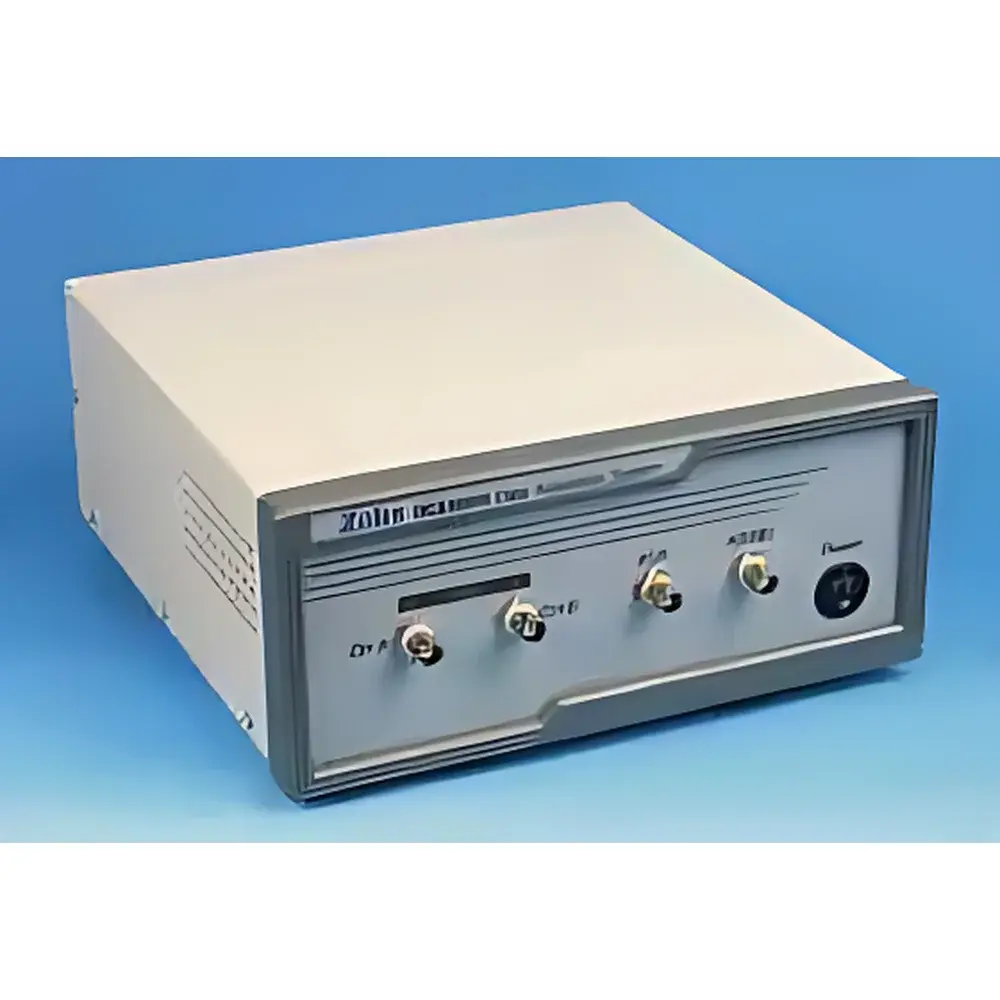
ZOLIX DCS300PA Dual-Channel Low-Level Signal Acquisition System
| Brand | ZOLIX |
|---|---|
| Model | DCS300PA |
| Origin | Beijing, China |
| Manufacturer | ZOLIX (Producer) |
| Input Channels | 2 × I/V (selectable voltage/current) |
| Voltage Input Range | ±100 µV to ±10 V (FS) |
| Current Input Range | ±100 nA to ±100 mA (FS) |
| Voltage Gain | 10²–10⁴ |
| Current Gain | 10³–10⁷ |
| Integration Time | 10 µs–10 s |
| AUX Input | 1 × DC 0–10 V |
| Temperature Input | AD950-compatible thermistor channel |
| A/D Resolution | 16 bits |
| D/A Outputs | 2 × DC 0–10 V, 12-bit resolution |
| Trigger I/O | TTL rising-edge input + programmable output |
| Digital I/O | 5 inputs, 2 TTL outputs |
| Interface | USB 2.0 |
| Compliance | CE |
| Power | DC 24 V, 0.3 A |
| Dimensions | 240 × 240 × 120 mm |
| Weight | 3.3 kg |
Overview
The ZOLIX DCS300PA Dual-Channel Low-Level Signal Acquisition System is a precision-engineered instrument designed for high-fidelity capture and conditioning of ultra-low-amplitude analog signals in spectroscopic, photometric, and electrochemical measurement environments. Built upon the proven architecture of the DCS103 series and significantly enhanced with dual high-gain, multi-range transimpedance and voltage amplifiers, the DCS300PA enables reliable digitization of signals as low as ±100 nA (current mode) or ±100 µV (voltage mode), making it especially suited for lock-in detection, photon counting preamplification, fluorescence lifetime decay analysis, and low-light Raman or photoluminescence signal acquisition. Its core measurement principle relies on precision analog front-end conditioning—featuring low-noise operational amplifiers, selectable gain stages, and synchronous integration—to preserve signal-to-noise ratio (SNR) across nine decades of dynamic range. The system operates under stable DC power and integrates seamlessly into modular optical benches and automated lab setups via standard USB 2.0 communication.
Key Features
- Dual independent, identically specified input channels—each configurable as either voltage-input (±100 µV to ±10 V FS) or current-input (±100 nA to ±100 mA FS)—supporting simultaneous or differential acquisition.
- Programmable gain architecture: voltage gain from 10² to 10⁴; current gain from 10³ to 10⁷—enabling optimal signal scaling without external hardware.
- Adjustable integration time from 10 µs to 10 s, supporting both transient pulse capture and long-term averaging for improved SNR in low-flux applications.
- 16-bit analog-to-digital conversion ensures >96 dB dynamic range and high linearity over full-scale operation—critical for quantitative spectral intensity calibration.
- Two 12-bit D/A output channels (0–10 V DC) allow closed-loop control of peripheral devices such as laser diode drivers, filter wheels, or stage positioners.
- Dedicated auxiliary analog input (0–10 V DC) and temperature sensor interface (AD950 thermistor compatible) enable synchronized environmental monitoring during spectral acquisition.
- Hardware-triggered acquisition via TTL rising-edge input and programmable TTL trigger output supports synchronization with pulsed light sources, shutters, or gated detectors.
- Five digital inputs and two TTL outputs provide flexible logic-level interfacing for experiment sequencing and safety interlocks.
Sample Compatibility & Compliance
The DCS300PA is optimized for use with low-output transducers common in spectroscopy—including photodiodes, PMTs, CCD/CMOS readout circuits, and electrochemical cells—where signal integrity at sub-microvolt or sub-nanoampere levels is essential. Its input impedance (>10¹² Ω in current mode, 10 MΩ in voltage mode) minimizes loading effects on high-impedance sensors. All analog signal paths are shielded and isolated to reduce ground-loop interference. The device complies with CE marking requirements for electromagnetic compatibility (EMC Directive 2014/30/EU) and low-voltage safety (LVD Directive 2014/35/EU). While not certified for medical or explosive environments, its robust construction and thermal stability support continuous operation in ISO/IEC 17025-accredited analytical laboratories adhering to GLP practices.
Software & Data Management
The DCS300PA is supported by ZOLIX’s cross-platform acquisition software (Windows/macOS/Linux), offering real-time waveform display, dual-channel ratio calculation (e.g., reference/sample normalization), timestamped data logging in HDF5 or CSV formats, and scriptable automation via Python SDK. The software implements hardware-timed acquisition scheduling, automatic gain-ranging based on signal headroom, and configurable post-processing filters (moving average, median, derivative). Audit-trail functionality records all parameter changes, user logins, and acquisition timestamps—facilitating compliance with FDA 21 CFR Part 11 when used in regulated QC workflows. Raw binary data streams are accessible for third-party integration with MATLAB, LabVIEW, or custom C/C++ applications using documented USB HID protocol commands.
Applications
- Time-resolved photoluminescence decay profiling in semiconductor and perovskite material characterization.
- Low-light Raman spectroscopy with back-illuminated CCD detectors requiring high-gain preamplification.
- Electrochemical impedance spectroscopy (EIS) and cyclic voltammetry with nanoampere-level current resolution.
- Fluorescence correlation spectroscopy (FCS) and single-molecule detection platforms.
- Calibration-grade reference signal monitoring in metrology-grade spectrometer systems.
- Multi-sensor environmental monitoring in vacuum chambers or cryogenic setups (via integrated AD950 temperature channel).
FAQ
What types of detectors is the DCS300PA compatible with?
It interfaces directly with photodiodes, photomultiplier tubes (PMTs), lock-in amplifier outputs, and any analog sensor delivering voltage or current signals within its specified input ranges.
Can the two input channels be used simultaneously for ratiometric measurements?
Yes—the firmware and software support real-time arithmetic operations including division, subtraction, and averaging between Channel A and Channel B.
Is galvanic isolation provided between input channels and USB interface?
No. The DCS300PA uses common-ground architecture; users requiring isolation must implement external isolated signal conditioners upstream.
Does the device support external clock synchronization?
It does not accept an external master clock, but its internal timing generator can produce precise trigger pulses synchronized to acquisition start/stop events.
What is the typical RMS noise floor in current mode at 10⁶ gain?
Measured noise is ≤1.2 fA/√Hz (referred to input) at 10⁶ gain with 100 ms integration, dependent on source impedance and ambient EMI conditions.






