
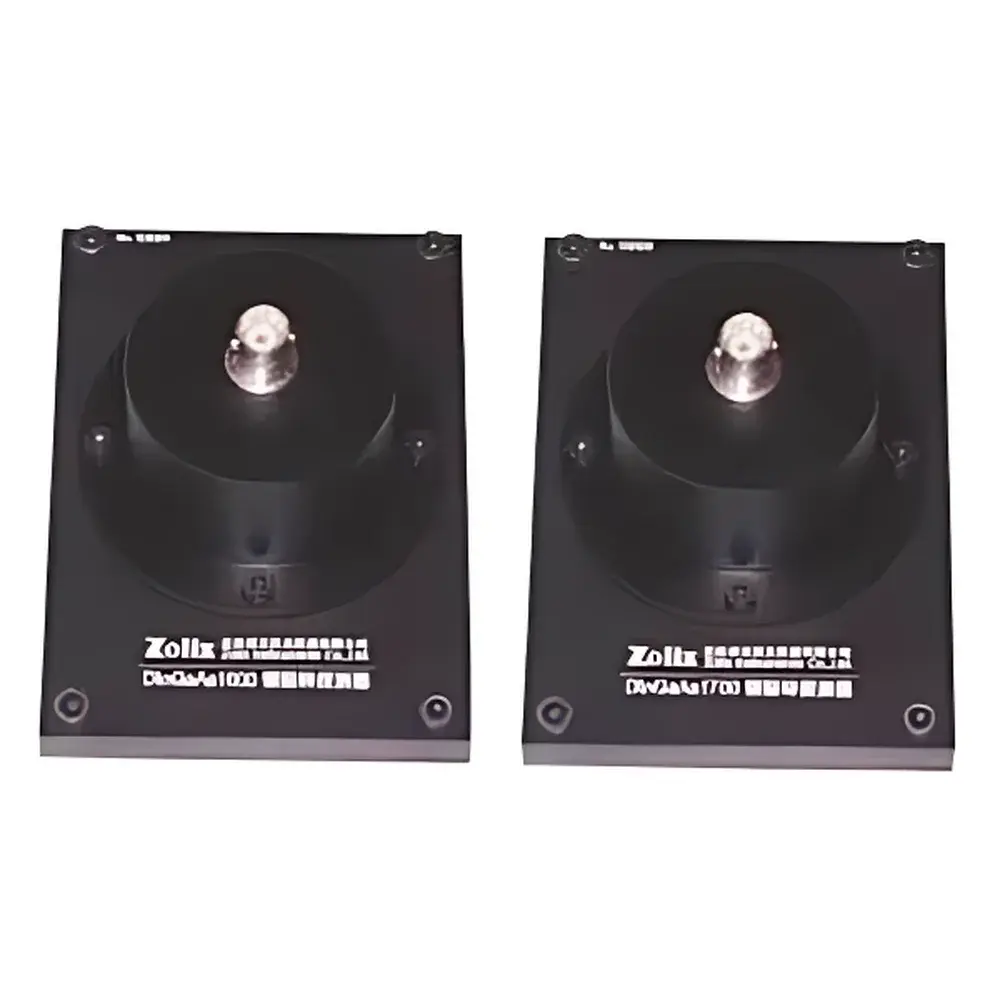
ZOLIX DInGaAs Series Room-Temperature InGaAs Photodetectors
| Brand | ZOLIX |
|---|---|
| Origin | Beijing, China |
| Manufacturer Type | OEM Manufacturer |
| Product Origin | Domestic (China) |
| Model | DInGaAs1650 / DInGaAs1700-R03M / DInGaAs2600-R03M |
| Pricing | Upon Request |
| Active Area Diameter | 3 mm |
| Spectral Range | 800–1700 nm (DInGaAs1650 & DInGaAs1700-R03M), 800–2600 nm (DInGaAs2600-R03M) |
| Peak Responsivity | ≥0.85 A/W (DInGaAs1650), ≥0.9 A/W (DInGaAs1700-R03M), ≥1.1 A/W (DInGaAs2600-R03M) |
| Max Dark Current | 200 nA (DInGaAs1650), 100 nA (DInGaAs1700-R03M), 1 mA (DInGaAs2600-R03M) |
| Typical D* | 2.3×10¹² cm·Hz¹ᐟ²/W (DInGaAs1650), 4.1×10¹⁰ cm·Hz¹ᐟ²/W (DInGaAs1700-R03M), — (DInGaAs2600-R03M) |
| Typical NEP | 1.2×10⁻¹³ W/Hz¹ᐟ² (DInGaAs1650), 6.5×10⁻¹² W/Hz¹ᐟ² (DInGaAs1700-R03M) |
| Shunt Resistance | 1 MΩ (DInGaAs1650), 1.5 MΩ (DInGaAs1700-R03M), 320 Ω (DInGaAs2600-R03M) |
| Capacitance | 1500 pF (DInGaAs1650), 800 pF (DInGaAs1700-R03M), 9000 pF (DInGaAs2600-R03M) |
| Rise Time | 160 ns (DInGaAs1650), 100 ns (DInGaAs1700-R03M), 1 μs (DInGaAs2600-R03M) |
| Output Mode | Photocurrent (unamplified, positive polarity) |
Overview
The ZOLIX DInGaAs Series comprises room-temperature-operated indium gallium arsenide (InGaAs) photodetectors engineered for high-fidelity spectral detection in the near-infrared (NIR) and short-wave infrared (SWIR) bands. Unlike cryogenically cooled alternatives, these detectors operate without thermoelectric or liquid-nitrogen cooling, significantly reducing system complexity, power consumption, and operational cost—while maintaining sufficient sensitivity for routine spectroscopic applications. Each variant employs a 3-mm-diameter active area and is optimized for use as a core detection element in FTIR spectrometers, dispersive NIR spectrometers, laser power monitoring setups, and process analytical technology (PAT) systems. The DInGaAs1650 utilizes domestically fabricated InGaAs photodiodes with extended responsivity up to 1700 nm; the DInGaAs1700-R03M integrates imported high-linearity InGaAs chips offering improved dark current performance; and the DInGaAs2600-R03M features a large-area, extended-range InGaAs diode enabling broadband detection from 800 nm to 2600 nm—critical for applications requiring full SWIR coverage, such as polymer identification, moisture analysis, and pharmaceutical raw material verification.
Key Features
- Room-temperature operation eliminates need for TE coolers or cryogenic infrastructure—reducing thermal drift and long-term maintenance overhead.
- Three model variants optimized for distinct spectral coverage and performance trade-offs: 1650 nm, 1700 nm, and 2600 nm cutoff wavelengths.
- High peak responsivity (≥0.85–1.1 A/W) ensures strong signal-to-noise ratio under low-light conditions typical of grating-based spectrometers.
- Low capacitance (800–1500 pF) and fast rise time (100 ns–1 µs) support high-speed scanning and real-time data acquisition in dynamic measurement environments.
- Standardized 3-mm circular active area enables direct mechanical and optical integration into existing spectrometer modules and custom optical breadboards.
- Positive-polarity photocurrent output simplifies interfacing with transimpedance amplifiers (TIAs) and lock-in detection circuits compliant with industrial analog I/O standards.
Sample Compatibility & Compliance
These detectors are compatible with solid, liquid, and gaseous samples when integrated into transmission, reflectance, or attenuated total reflectance (ATR) optical configurations. Their spectral response aligns with common NIR/SWIR analytical methods referenced in ASTM E1421 (standard guide for near-infrared quantitative analysis), ISO 14750 (optical properties of plastics), and USP (near-infrared spectroscopy for pharmaceutical identity testing). While the detectors themselves are not certified devices, their electrical and optical specifications meet baseline requirements for use in GLP-compliant laboratories and GMP-regulated environments—particularly when paired with validated data acquisition hardware supporting audit trail functionality per FDA 21 CFR Part 11.
Software & Data Management
The DInGaAs detectors interface seamlessly with third-party spectroscopy platforms—including Ocean Insight, Hamamatsu SDK, and LabVIEW-based custom DAQ systems—via standard BNC or SMA coaxial outputs. No proprietary driver software is required; users configure gain, offset, and sampling rate through external TIA or digitizer firmware. For traceable calibration, ZOLIX provides NIST-traceable spectral responsivity curves (800–2600 nm) and dark current temperature coefficients upon request. All models support synchronized triggering and multi-channel timing alignment, enabling synchronized multi-detector arrays in hyperspectral imaging or dual-beam referencing architectures.
Applications
- NIR and SWIR spectroscopy for agricultural product grading (e.g., grain moisture, fruit sugar content).
- In-line quality control in chemical manufacturing, including solvent composition monitoring and catalyst activity tracking.
- Pharmaceutical tablet coating thickness analysis and excipient uniformity mapping.
- Material science research involving semiconductor bandgap characterization and thin-film optical constant extraction.
- Laser wavelength stabilization and power feedback loops in fiber-optic communication test benches.
- Environmental gas sensing via tunable diode laser absorption spectroscopy (TDLAS) at characteristic absorption lines between 1300–2500 nm.
FAQ
Do these detectors require bias voltage or external power supply?
No—these are photovoltaic-mode InGaAs diodes and operate passively; no reverse bias is needed for standard operation.
Can the DInGaAs2600-R03M be used without cooling despite its higher dark current?
Yes—its design prioritizes broad spectral coverage over ultra-low noise; it is intended for applications where signal intensity compensates for elevated dark current, such as high-power laser detection or bright-source spectroscopy.
Is spectral calibration data provided with each unit?
Each detector ships with a factory-measured relative responsivity curve (±3% uncertainty); absolute NIST-traceable calibration is available as an optional service.
What is the recommended load resistance for optimal linearity?
For linear photocurrent readout, a transimpedance amplifier with ≥10⁶ V/A gain and ≤10 kΩ effective input impedance is advised to minimize voltage drop across the detector’s shunt resistance.
Are custom window materials or hermetic packaging options available?
Yes—ZOLIX offers optional AR-coated fused silica, CaF₂, or sapphire windows, as well as TO-8 or butterfly-style hermetic packages for harsh-environment deployment.




