
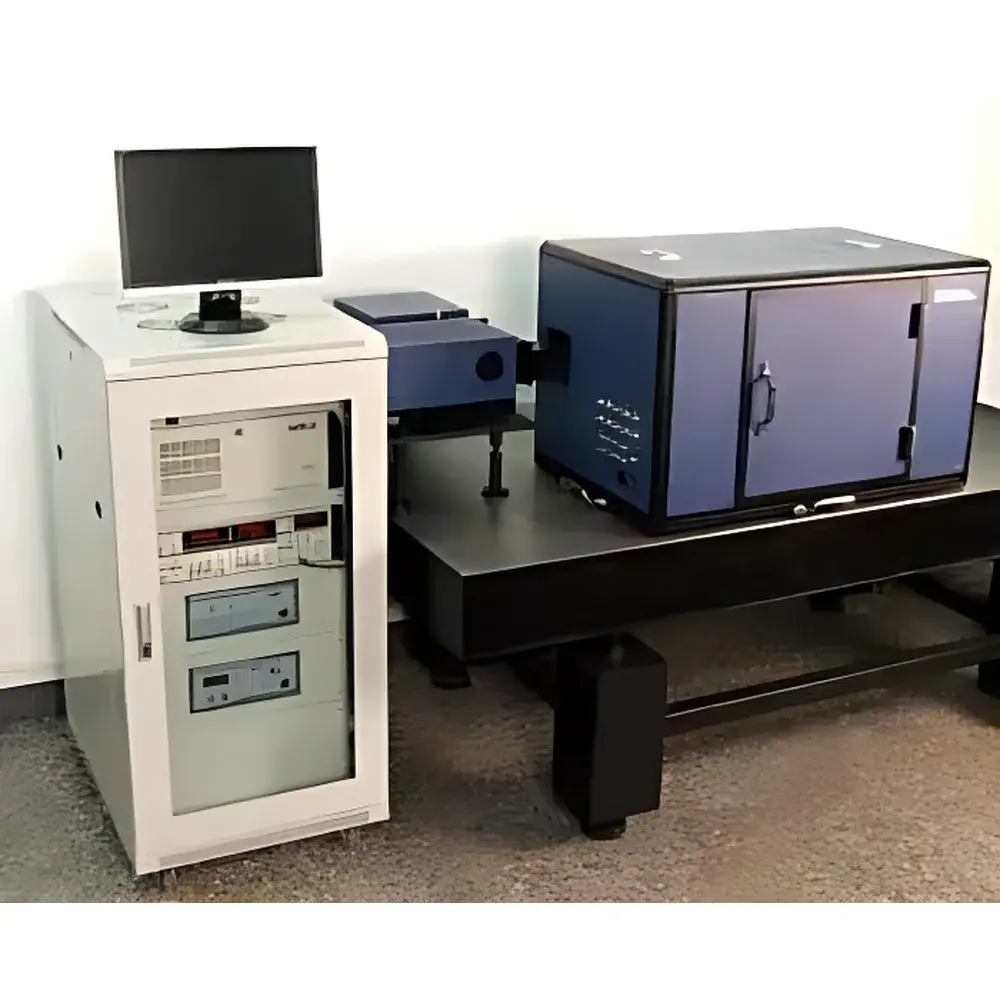
ZOLIX DSR100 Spectral Responsivity Measurement System
| Brand | ZOLIX |
|---|---|
| Origin | Beijing, China |
| Manufacturer Type | Original Equipment Manufacturer (OEM) |
| Product Category | Domestic |
| Model | DSR100 |
| Pricing | Upon Request |
| Wavelength Range | 200–2500 nm (UV-VIS-NIR) / 1–14 µm (MIR-FIR) |
| Beam Type | Uniform Collimated or Focused |
| Beam Diameter | Ø2–20 mm (collimated), Ø0.3–3 mm (focused) |
| Light Source | Deuterium + Tungsten-Halogen (UV-A/VIS-NIR) / Tungsten-Halogen + SiC (MIR-FIR) |
| Intensity Stability | ≤0.8% (UV-A/VIS-NIR), ≤2% (MIR-FIR) |
| Monochromator | Triple-Grating, Resolution: <0.1 nm @ 435.8 nm (1200 g/mm grating), <2.5 nm @ 2615 nm (75 g/mm grating) |
| Scan Step | Down to 0.005 nm |
| Output Bandwidth | <5 nm (UV-VIS-NIR), <10 nm (MIR-FIR) |
| Stray Light Suppression | Motorized Filter Wheel with Order-Sorting Filters |
| Modulation Frequency | 4–400 Hz |
| Detection | Lock-in Amplifier (2 nV sensitivity, 100 dB dynamic range) |
| Reference Detectors | NIST-traceable Si photodiode (200–1100 nm), Pyroelectric detector (1–14 µm) |
| Repeatability | ≤±1.5% (UV-VIS-NIR), ≤±5% (MIR-FIR) |
| Optical Center Height | 305 mm |
| System Dimensions | 1500 × 1200 × 560 mm |
| Control Enclosure | Standard 4U rack-mount cabinet with embedded industrial PC |
Overview
The ZOLIX DSR100 Spectral Responsivity Measurement System is a metrology-grade instrumentation platform engineered for absolute and relative spectral responsivity characterization of photodetectors, optoelectronic materials, and photonics devices across ultraviolet, visible, near-infrared, mid-infrared, and far-infrared spectral regions. Based on the substitution method—a primary standard technique endorsed by national metrology institutes—the DSR100 implements monochromatic, modulated irradiance traceable to SI units via calibrated reference detectors. Its all-reflective optical architecture eliminates chromatic aberration, enabling diffraction-limited beam uniformity and high spatial fidelity over its full 200–2500 nm or 1–14 µm operational range. The system integrates a triple-grating monochromator, thermally stabilized broadband sources, motorized stray-light suppression filters, and a high-dynamic-range lock-in amplifier optimized for low-signal photometric detection. Designed for compliance with ISO/IEC 17025 laboratory accreditation requirements, the DSR100 supports traceable calibration workflows aligned with ASTM E1377, ISO 11341, and IEC 60904-8 standards for photodetector performance evaluation.
Key Features
- All-reflective optical path ensures wavelength-independent beam quality—no chromatic distortion across UV to FIR spectra
- Turnkey operation with automated source switching, filter selection, wavelength scanning, and detector referencing
- Modulated illumination at 4–400 Hz coupled with 2 nV-sensitive lock-in detection achieves >100 dB signal-to-noise ratio for weak photocurrents
- Dual-beam configuration options: uniform collimated illumination (Ø2–20 mm) for large-area detectors; focused spot (Ø0.3–3 mm) for micro-devices and pixel-level mapping
- Modular wavelength coverage: DSR100UV-A/B variants cover 200–2500 nm using deuterium/tungsten-halogen composite source; DSR100IR-A/B variants extend to 1–14 µm with tungsten-halogen/silicon carbide sources
- Motorized, software-controlled filter wheel automatically engages order-sorting filters to suppress higher-order diffraction and stray light
- Large-access sample chamber with removable side panels accommodates cryogenic detectors (e.g., LN₂-cooled MCT), streak tubes, and custom optomechanical fixtures
- Optional real-time CCD imaging and laser alignment guidance enable sub-10 µm positioning accuracy for miniature or asymmetric active areas
Sample Compatibility & Compliance
The DSR100 supports planar, hybrid, and heterostructured optoelectronic components including silicon photodiodes, InGaAs photodetectors, HgCdTe (MCT) arrays, pyroelectric sensors, quantum dot films, perovskite photovoltaic cells, and fiber-coupled receivers. Sample mounting is facilitated by precision XYZ translation stages with <10 µm repeatability and vacuum-compatible or electrical feedthrough interfaces. All measurement protocols adhere to GLP-compliant data integrity principles: raw analog voltage traces, modulation phase metadata, and environmental timestamps are stored unaltered in binary format. Audit trails, user access logs, and electronic signatures meet FDA 21 CFR Part 11 requirements when configured with optional validation packages. Traceability is maintained through NIST-traceable reference detectors—calibrated Si photodiodes (200–1100 nm) and pyroelectric standards (1–14 µm)—with certificate validity traceable to national primary standards.
Software & Data Management
The proprietary ZOLIX SpectraControl Suite provides fully automated acquisition, real-time responsivity calculation (A/W), uncertainty propagation, and spectral normalization. Each measurement session generates timestamped HDF5 archives containing raw lock-in outputs, monochromator encoder positions, source intensity logs, and environmental sensor readings (temperature, humidity). Export modules support ASCII (tab-delimited .txt), Excel (.xlsx), and MATLAB (.mat) formats—enabling direct import into third-party analysis tools such as Python SciPy, OriginLab, or MATLAB Curve Fitting Toolbox. Batch processing scripts allow scheduled multi-sample runs with pass/fail thresholds based on user-defined tolerance bands. Software architecture complies with IEC 62304 for medical device software safety classification and includes built-in diagnostics for optical alignment verification and source stability trending.
Applications
- Calibration and verification of photodetectors used in space-based Earth observation spectrometers (e.g., hyperspectral imagers, atmospheric lidar receivers)
- Quantitative assessment of spectral mismatch errors in solar cell efficiency testing under AM1.5G and other reference spectra
- Characterization of emerging IR materials—including van der Waals heterostructures and 2D semiconductors—for thermal imaging and gas sensing applications
- Validation of optical coating performance on detector windows and cold shields in cryogenic infrared systems
- Development and QA of photonic integrated circuits (PICs) requiring wavelength-resolved responsivity mapping across chip facets
- Support for ISO 15739 noise modeling and EMVA 1288 standard compliance testing of scientific CMOS and sCMOS sensors
FAQ
What calibration standards does the DSR100 use for spectral responsivity traceability?
The system employs NIST-traceable reference detectors: a silicon photodiode calibrated from 200–1100 nm and a pyroelectric detector calibrated from 1–14 µm. Calibration certificates include expanded uncertainties (k=2) and are valid for 12 months under controlled lab conditions.
Can the DSR100 measure both absolute and relative spectral responsivity?
Yes. Absolute measurements follow the substitution method per ISO 11341, using calibrated reference detectors. Relative measurements compare unknown devices against a stable reference under identical optical conditions, supporting rapid production-line screening.
Is the system compatible with cryogenic detector characterization?
Yes. The open-frame sample chamber accommodates liquid nitrogen dewars, closed-cycle coolers, and vacuum feedthroughs. Optional thermal shielding and vibration-isolation mounts are available for sub-80 K operation.
How is stray light minimized at long infrared wavelengths?
DSR100IR variants integrate cooled baffles, gold-coated mirrors, and motorized order-sorting filters selected in real time based on monochromator grating position and output wavelength—reducing stray light to <10⁻⁵ of peak signal.
Does the software support automated compliance reporting for ISO/IEC 17025 laboratories?
Yes. The SpectraControl Suite generates audit-ready PDF reports with full metadata, uncertainty budgets, equipment calibration status, and operator authentication—fully compliant with Clause 7.8 of ISO/IEC 17025:2017.
Related Products






