
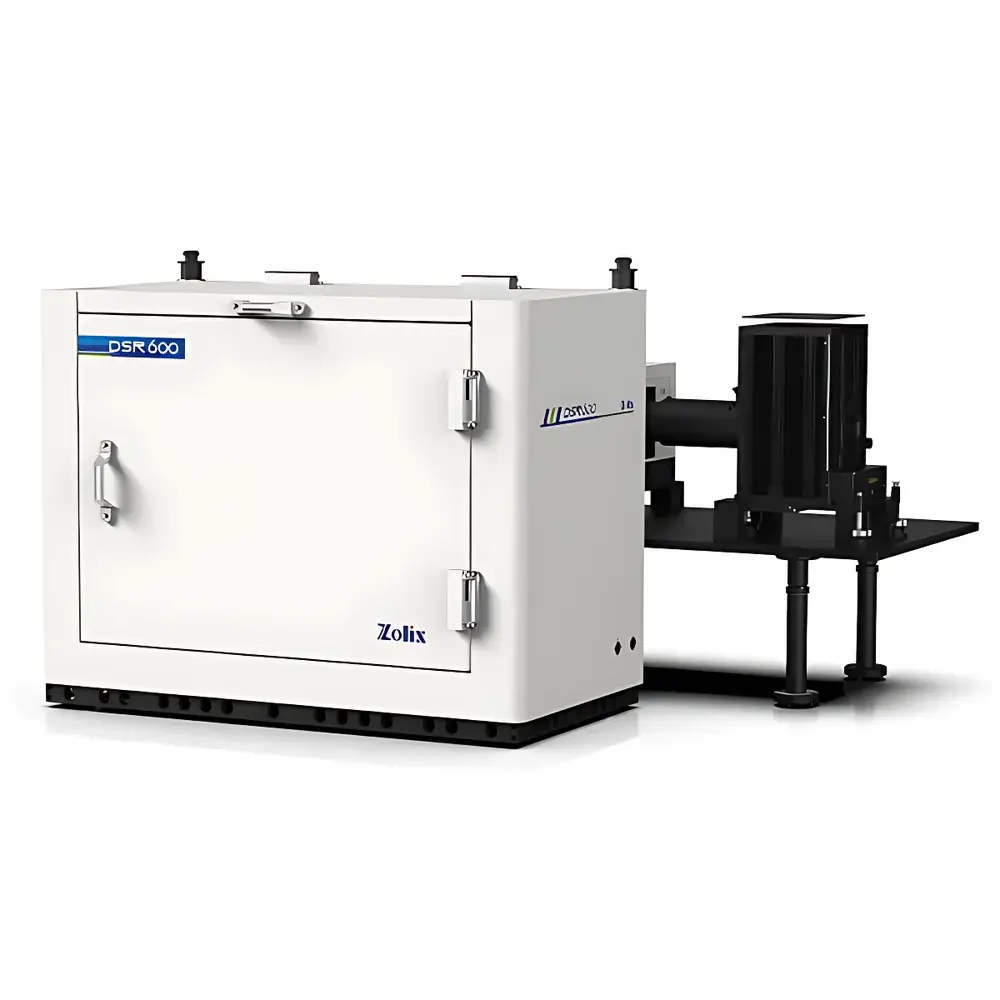
ZOLIX DSR600 Spectral Responsivity Calibration System
| Brand | ZOLIX |
|---|---|
| Origin | Beijing, China |
| Manufacturer Type | Manufacturer |
| Origin Category | Domestic (China) |
| Model | DSR600 |
| Pricing | Upon Request |
| Spectral Range | 200–2400 nm (configurable per variant) |
| Calibration Method | Substitution Method (NIM-traceable) |
| Optical Design | All-reflective, dual off-axis parabolic beam path |
| Spot Size | 1 mm (uniform across spectrum) |
| Measurement Capabilities | Spectral Responsivity (R(λ)), Bias-dependent R(λ), External Quantum Efficiency (EQE), Internal Quantum Efficiency (IQE), Reflectance/Transmittance, Short-Circuit Current Density (J<sub>sc</sub>), I–V Characterization |
| Light Sources | 150 W Xe lamp, 250 W Tungsten-Halogen lamp, EQ-99XFC broadband source |
| Detection | Lock-in amplifier (Stanford Research Systems SR240/SR830 compatible) |
| Imaging Aid | Integrated CCD-based monitoring optical path for real-time beam visualization and sample alignment |
Overview
The ZOLIX DSR600 Spectral Responsivity Calibration System is a NIM-traceable, all-reflective metrology platform engineered for high-accuracy, wavelength-resolved characterization of photodetectors and optoelectronic materials. It operates on the substitution method—a primary calibration technique endorsed by the National Institute of Metrology (NIM, China) and aligned with ISO/IEC 17025 requirements for accredited calibration laboratories. Unlike refractive optical systems, the DSR600 employs a dual off-axis parabolic mirror architecture that eliminates chromatic aberration across its full operational range (200–2400 nm), ensuring diffraction-limited spot uniformity (<1 mm diameter) and spatially stable illumination regardless of wavelength. This design is critical for minimizing systematic errors in responsivity measurements—especially for microscale and nanoscale devices where non-uniform quantum efficiency across the active area can introduce significant bias if the illuminated region varies spectrally. The system integrates calibrated reference detectors traceable to NIM standards and supports automated spectral scanning with sub-nanometer wavelength resolution (dependent on monochromator configuration), enabling reproducible R(λ) mapping under zero-bias or user-defined DC bias conditions.
Key Features
- All-reflective optical path eliminates chromatic aberration—ensures consistent 1 mm spot size from deep UV (200 nm) to mid-IR (2400 nm)
- Substitution-method calibration architecture compliant with JJG 1035–2008 (Chinese national metrological verification regulation for spectral responsivity)
- Modular light source selection: 150 W xenon arc lamp (DSR600-3112), 250 W tungsten-halogen lamp (DSR600-3111), or EQ-99XFC broadband plasma source (DSR600-3121/3111-DUV) for extended UV coverage down to 170 nm
- Real-time visual alignment via integrated CCD-monitored auxiliary optical path—enables precise positioning of sub-mm devices and heterostructured samples
- Simultaneous acquisition of spectral responsivity, external/internal quantum efficiency, reflectance/transmittance, Jsc, and full I–V curves at each wavelength step
- Lock-in amplifier interface (SR240/SR830 compatible) for low-noise, high-dynamic-range signal detection—essential for measuring weak photocurrents from low-absorptance nanomaterials
Sample Compatibility & Compliance
The DSR600 accommodates a broad class of optoelectronic devices and materials without mechanical reconfiguration. It supports photovoltaic-type detectors—including Si, GaAs, InGaAs, and perovskite-based photodiodes; photoconductive devices such as ZnO, AlN, and 2D transition metal dichalcogenides (e.g., MoS₂); and emerging micro/nanoscale architectures including TFT-based phototransistors, plasmonic-enhanced photodetectors, and quantum dot arrays. Device dimensions range from macroscopic (>1 mm²) wafers to sub-10 µm active areas. All measurement protocols adhere to internationally recognized standards: spectral irradiance calibration follows ISO 17025–accredited procedures; EQE calculations conform to ASTM E1021–22; and bias-dependent measurements are performed under controlled thermal conditions (optional Peltier stage integration). For regulated environments, audit trails, electronic signatures, and raw data export comply with FDA 21 CFR Part 11 requirements when used with validated software modules.
Software & Data Management
The DSR600 is delivered with ZOLIX SpectraCal™ v4.x—a modular, Windows-based application supporting fully automated spectral scans, multi-parameter synchronization, and GLP-compliant reporting. The software implements built-in uncertainty propagation per GUM (JCGM 100:2008), calculates combined standard uncertainties for R(λ) and EQE based on reference detector calibration certificates, lamp stability logs, and monochromator bandpass data. Raw time-series lock-in outputs, wavelength-stamped I–V sweeps, and reflectance-normalized responsivity curves are stored in HDF5 format for long-term archival and third-party analysis (MATLAB, Python, Origin). Export options include CSV, XML, and PDF reports with embedded metadata (instrument ID, operator, environmental conditions, calibration dates). Optional API access enables integration into laboratory information management systems (LIMS) and automated test sequences in high-throughput material screening workflows.
Applications
The DSR600 serves as a foundational metrology tool in academic and industrial R&D labs focused on next-generation optoelectronics. Its primary use cases include: benchmarking spectral response of novel wide-bandgap semiconductors (e.g., β-Ga₂O₃, AlGaN) for solar-blind UV detection; quantifying carrier extraction efficiency in perovskite and organic photovoltaic stacks; validating wavelength-selective responsivity of position-sensitive detectors (PSDs) and quadrant photodiodes used in adaptive optics; characterizing photoconductive gain mechanisms in low-dimensional materials under variable bias; and supporting ISO 11146-compliant laser-induced damage threshold (LIDT) pre-screening via calibrated photocurrent saturation analysis. It is routinely deployed in national metrology institutes, photovoltaic certification labs, and semiconductor process development centers requiring traceable, inter-laboratory comparable spectral data.
FAQ
What calibration standard does the DSR600 follow?
The system implements the substitution method per JJG 1035–2008 and is compatible with NIM-certified silicon photodiode standards (e.g., FZ-Si type) calibrated at 250–1100 nm and extended-range InGaAs detectors for NIR/MIR traceability.
Can the DSR600 measure devices under reverse bias?
Yes—it supports programmable DC bias from –10 V to +10 V (±1% accuracy) during spectral scanning, enabling dark current subtraction and junction capacitance analysis in photodiodes and avalanche devices.
Is vacuum or purged operation required for UV measurements?
For measurements below 190 nm, optional nitrogen-purged or vacuum-compatible configurations (DSR600-3111-DUV) are available to mitigate atmospheric O₂ absorption; standard operation from 200 nm upward requires no purge.
How is stray light minimized in the reflective optical train?
All optical surfaces are coated with protected aluminum (R > 88% from 200–2400 nm) and arranged in non-collinear, baffled paths with knife-edge apertures to suppress higher-order diffraction and scatter—typical stray light level < 10⁻⁵ relative to peak signal.
Does the system support time-resolved photocurrent measurement?
While optimized for steady-state spectral responsivity, the lock-in interface allows gated acquisition synchronized to chopped illumination; for true transient response (ns–µs), external integration with fast digitizers or TCSPC modules is supported via TTL trigger I/O.






