
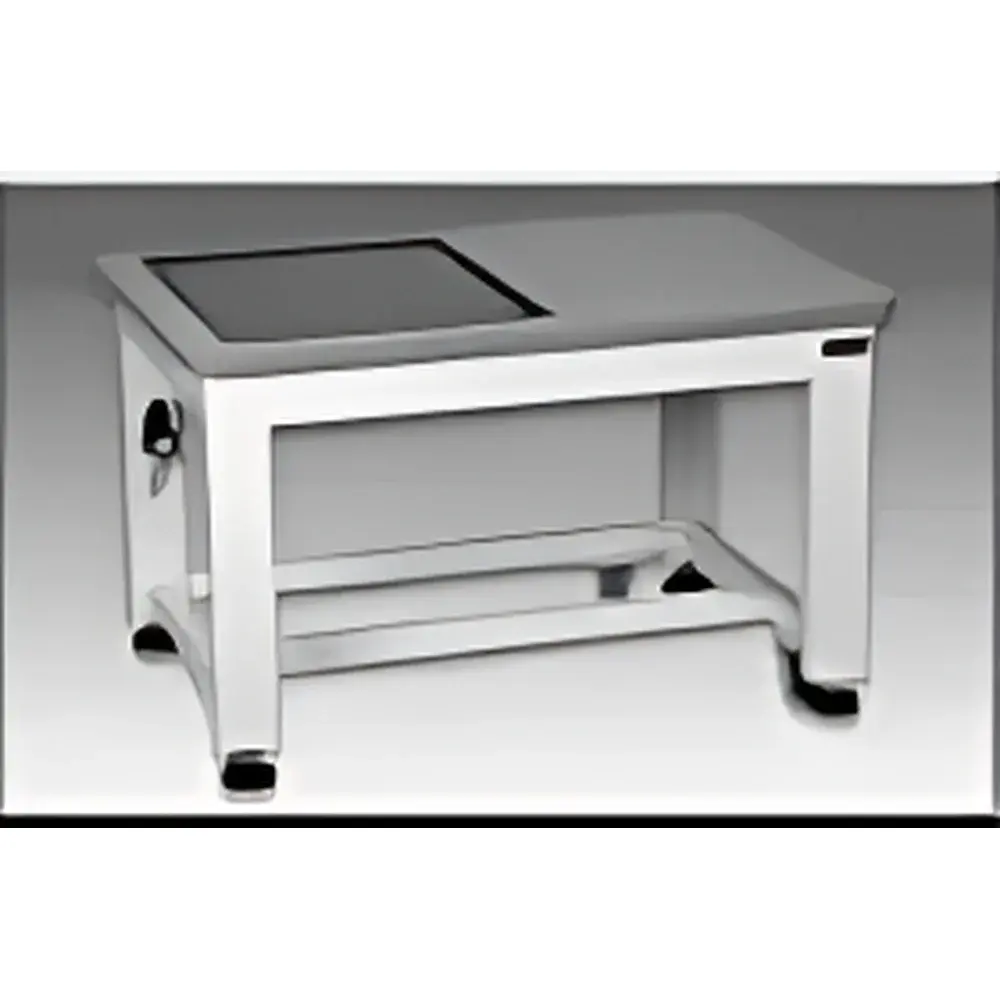
ZOLIX DVID-L Series High-Performance Active Vibration Isolation Platform
| Brand | ZOLIX |
|---|---|
| Model | DVID-L Series |
| Type | Active Pneumatic Vibration Isolation Platform |
| Origin | South Korea |
| Manufacturer | ZOLIX (Producer) |
| Natural Frequency | 1.2–2.0 Hz |
| Vibration Isolation Efficiency | 75–95% @ 10 Hz, 85–98% @ 20 Hz |
| Horizontal Re-centering Accuracy | ±0.05 mm |
| Static Load Capacity | 500 kg |
| Platform Weight | 150–250 kg |
| Top Surface Material | Polished Melamine Laminate + Precision Ground Steel Plate |
| Frame Material | Sandblasted Structural Steel Tubing |
| Operating Air Supply | 3–5 kg/cm² Compressed Air or Liquid Nitrogen |
| Compliance | Designed for ISO 20486 Class 2 and SEMI S2-0213 compatible environments |
Overview
The ZOLIX DVID-L Series High-Performance Active Vibration Isolation Platform is an engineered solution for ultra-stable optical and metrological instrumentation in research laboratories and precision manufacturing facilities. Utilizing a dual-axis pneumatic active isolation architecture—comprising vertically and horizontally decoupled air-spring modules with integrated electromagnetic force feedback actuators—the platform delivers broadband attenuation across critical low-frequency ranges where floor-borne disturbances (e.g., building resonance, HVAC-induced vibrations, footfall) most severely degrade measurement fidelity. Its patented horizontal isolation mechanism, first deployed in mainland China for academic and industrial R&D labs, enables sub-micron positional stability under dynamic loading conditions. The system operates on regulated compressed air or liquid nitrogen, ensuring zero-oil contamination and thermal drift minimization—critical for long-duration interferometric measurements, nanoscale surface profiling, and high-magnification optical microscopy.
Key Features
- Active dual-axis isolation: Independent real-time correction of vertical and horizontal motion via piezoelectric position sensors and proportional-integral-derivative (PID)-tuned electromagnetic actuators.
- Modular mechanical architecture: Separated working deck and isolation base allow independent servicing, recalibration, and load redistribution without compromising structural integrity.
- Precision top surface: 30 mm thick sandblasted steel frame with polished melamine laminate cover and optically flat, ground stainless steel plate (Ra < 0.2 µm) for direct optical component mounting.
- Mobility integration: Four swivel casters with locking brakes enable reconfiguration within ISO Class 5 cleanroom-compatible lab spaces while maintaining level tolerance ≤ ±0.02°.
- Scalable accessory ecosystem: Compatible with motorized translation stages (X-Y-Z, θx, θy), vacuum-compatible adapters, ESD-safe grounding kits, and custom optical breadboard inserts.
Sample Compatibility & Compliance
The DVID-L platform supports instruments requiring inertial stability at RMS displacement levels below 5 nm over 1–100 Hz bandwidths—including scanning white-light interferometers, atomic force microscopes (AFM), laser Doppler vibrometers, and coordinate measuring machines (CMM). It conforms to ISO 20486:2018 (Vibration isolation systems for precision equipment), meets SEMI S2-0213 safety requirements for pneumatic subsystems, and supports GLP/GMP-compliant validation protocols through traceable calibration certificates (available upon request). No internal electronics or batteries are housed within the isolation mass—ensuring electromagnetic compatibility (EMC) per IEC 61326-1 for use adjacent to sensitive RF or quantum sensing apparatus.
Software & Data Management
While the DVID-L operates as a hardware-isolated platform without embedded firmware, its pneumatic control manifold integrates seamlessly with third-party pressure monitoring systems (e.g., MKS Baratron series) and PLC-based facility management networks. Real-time air pressure, actuator displacement, and isolation performance metrics can be logged via analog 0–10 V outputs or Modbus RTU interface. Full documentation—including installation torque specifications, leveling procedure SOPs, and ISO 14644-1 cleanroom compatibility reports—is provided in English and aligned with FDA 21 CFR Part 11 audit-trail readiness for regulated QC environments.
Applications
- Surface metrology: Enables repeatable roughness (Ra, Rz) and roundness (ΔR) measurements per ISO 4287 and ISO 1101 using stylus profilometers and optical non-contact sensors.
- Vision-guided metrology: Stabilizes machine vision systems during sub-pixel edge detection in semiconductor wafer inspection and PCB alignment.
- Optical coherence tomography (OCT): Maintains coherence length integrity by suppressing path-length fluctuations in free-space interferometer arms.
- Materials testing: Provides stable support for universal testing machines during nanoindentation and creep testing under environmental chambers.
- Quantum optics setup: Serves as foundation for cavity ring-down spectroscopy (CRDS) and single-photon source alignment where <10 nm drift/hour is mandatory.
FAQ
What is the recommended compressed air quality for sustained operation?
ISO 8573-1 Class 2:2:2 compressed air (maximum 0.1 µm particles, dew point −40 °C, oil content ≤ 0.01 mg/m³) is required to prevent diaphragm clogging and ensure ≥10-year service life of pneumatic components.
Can the platform be retrofitted with vacuum-compatible isolators?
Yes—ZOLIX offers optional UHV-rated bellows isolators (1×10⁻⁹ mbar base pressure) with CF-63 flanges; full vacuum integration requires custom frame reinforcement and feedthrough routing analysis.
Is remote diagnostics supported?
No onboard diagnostics exist; however, analog voltage outputs from pressure transducers and displacement sensors are accessible via terminal blocks for integration into LabVIEW or Python-based SCADA frameworks.
Does the system require periodic recalibration?
Annual verification of natural frequency response and horizontal re-centering accuracy is advised per ISO/IEC 17025; ZOLIX provides certified calibration services with NIST-traceable accelerometers and laser Doppler vibrometers.
How does it perform under variable thermal loads?
Thermal expansion mismatch between steel frame and melamine top is mitigated via coefficient-of-thermal-expansion (CTE) matching design; measured drift remains ≤±0.1 µm/°C over 15–30 °C ambient range.




