
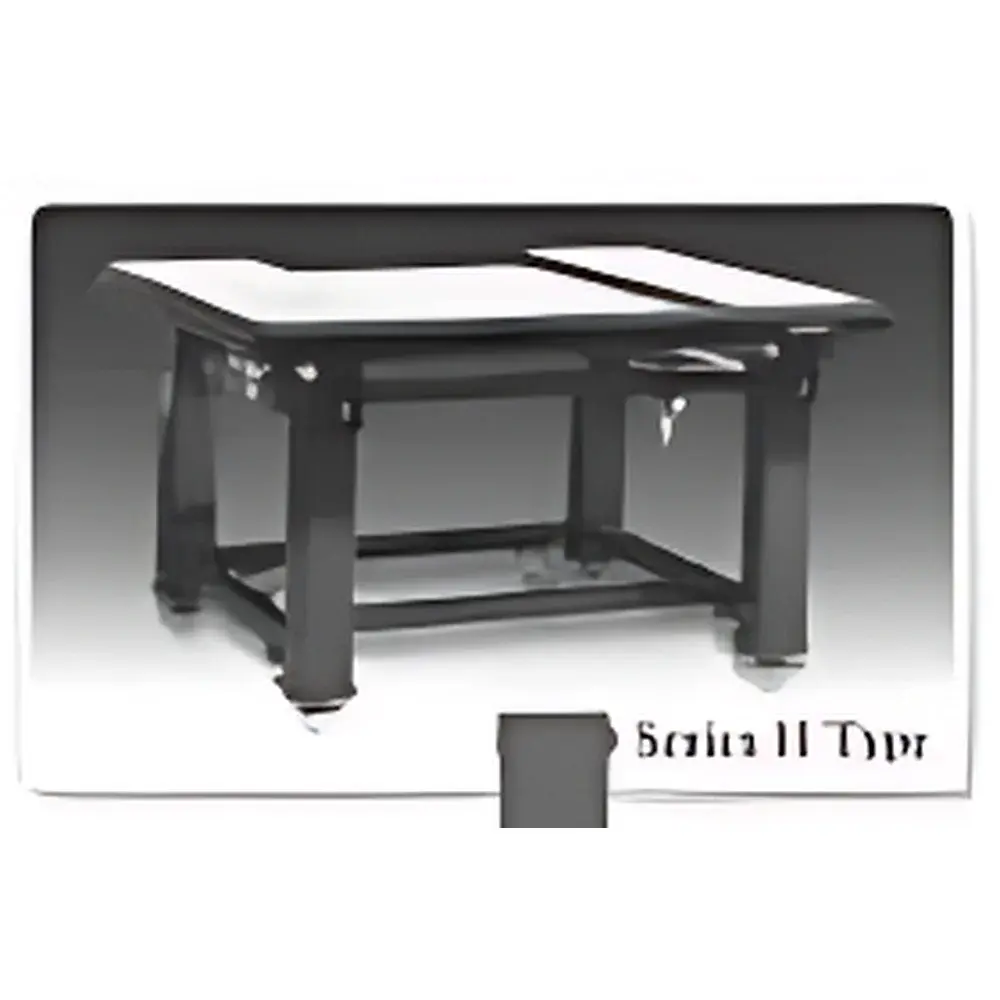
ZOLIX DVID-H Series High-Performance Pneumatic Optical Vibration Isolation Platform
| Brand | ZOLIX |
|---|---|
| Origin | South Korea |
| Manufacturer Type | OEM Manufacturer |
| Origin Category | Imported |
| Model | DVID-H Series |
| Vibration Isolation Natural Frequency | 1.2–1.5 Hz |
| Damping Mechanism | Orifice-Type Pneumatic Damping |
| Leveling System | 3-Axis Automatic Air-Leveling Valves |
| Leveling Repeatability | ±0.1 mm (static), ±1.2 mm (dynamic) |
| Static Load Capacity | 300–800 kg |
| Operating Air Supply | 3–5 kgf/cm² Compressed Air or Nitrogen |
| Top Plate Construction | 3-Layer Honeycomb Sandwich |
| Core Material | Reinforced Steel Foil Honeycomb (0.25 mm thickness, 3.2 cm² cell area) |
| Top Skin | 4.0 mm 430-Series Magnetic Stainless Steel, Sandblasted Finish |
| Bottom Skin | 4.0 mm Carbon Steel, Oxidized Surface |
| Surface Flatness | ±0.1 mm per 600 mm × 600 mm |
| Threaded Mounting Holes | M6 @ 25 mm Grid (Metric), 1/4"-20 @ 1" Grid (Imperial) |
| Edge Offset | 37.5 mm (Metric), 1.5" (Imperial) |
| Optional Top Plate Thickness | 50 mm or 100 mm |
| Mounting Pattern | Standard Optical Breadboard Layout |
Overview
The ZOLIX DVID-H Series High-Performance Pneumatic Optical Vibration Isolation Platform is engineered for ultra-stable optical and photonics applications requiring sub-micron positional integrity under dynamic and low-frequency environmental excitation. Built upon a rigid three-layer honeycomb sandwich architecture—comprising precision-welded steel foil core (0.25 mm foil, 3.2 cm² hexagonal cells), magnetically optimized 430-series stainless steel top skin (4.0 mm, sandblasted), and oxidized carbon steel base (4.0 mm)—the platform delivers exceptional stiffness-to-mass ratio and broadband mechanical decoupling. Its pneumatic isolation system operates with a natural frequency range of 1.2–1.5 Hz in both vertical and horizontal axes, enabling effective attenuation of ground-borne vibrations from building infrastructure, HVAC systems, and nearby equipment. The integrated orifice-type air damping mechanism—embedded within the pneumatic isolators—enhances transient response and accelerates settling time without compromising long-term static stability. Designed specifically for demanding optical laboratory environments, the DVID-H meets foundational mechanical stability requirements for interferometry, single-photon detection, confocal microscopy, and laser-based nanofabrication workflows.
Key Features
- Three-axis automatic air-leveling system with independent proportional control valves ensures rapid, repeatable leveling across variable payload distributions; repeatability maintained at ±0.1 mm under static conditions and ±1.2 mm during operational load shifts.
- Honeycomb-core breadboard surface conforms to ISO 10110-7 and ANSI/OPI-1.0 standards for optical mounting flatness: ≤±0.1 mm deviation over any 600 mm × 600 mm region.
- Dual-standard threaded grid pattern supports global instrumentation compatibility: metric M6 holes on 25 mm pitch (37.5 mm edge offset) and imperial 1/4″-20 UNC holes on 1-inch pitch (1.5-inch edge offset).
- Pneumatic isolators rated for continuous static loads between 300 kg and 800 kg, with pressure regulation compatible with standard industrial compressed air (3–5 kgf/cm²) or high-purity nitrogen supply lines.
- Top plate available in two structural depths—50 mm and 100 mm—to accommodate varying rigidity requirements for large-aperture optics, multi-axis translation stages, or hybrid opto-mechanical assemblies.
Sample Compatibility & Compliance
The DVID-H platform is compatible with all standard optical components including motorized translation stages (e.g., Thorlabs LTS series, Newport UTS line), kinematic mirror mounts, fiber launch systems, and microfluidic cell manipulation rigs used in live-cell imaging and patch-clamp electrophysiology. Its non-magnetic top skin and controlled surface finish minimize stray field interference and particulate adhesion—critical for vacuum-compatible or cleanroom-integrated setups. The platform complies with ISO 14644-1 Class 5 (ISO 5) particulate cleanliness thresholds when installed with filtered air supply and operated in controlled environments. Structural design adheres to ISO 22475-1 (vibration isolation performance testing) and supports GLP-aligned lab documentation through traceable leveling calibration logs and pressure-supply audit trails.
Software & Data Management
While the DVID-H is a passive mechanical system with no embedded electronics, its pneumatic interface integrates seamlessly with facility-wide compressed air monitoring networks via optional analog pressure transducers (0–10 V output) and digital I/O modules (e.g., NI cDAQ-9188). Real-time supply pressure, leveling valve actuation status, and differential pressure across damping orifices can be logged into LabVIEW, Python-based SCADA, or enterprise LIMS platforms for preventive maintenance scheduling and ISO 17025 audit readiness. All leveling and damping parameters are mechanically adjustable and documented in the OEM calibration certificate—no firmware updates or proprietary drivers required.
Applications
- High-resolution scanning spectrometry systems where spectral line width stability depends on platform-induced Doppler shift suppression.
- Microinjection and patch-clamp rigs requiring nanometer-scale stage positioning repeatability during intracellular probe insertion.
- Quantum optics experiments involving entangled photon sources, where path-length drift must remain below λ/20 over 1-hour acquisition windows.
- Confocal and STED microscopy platforms integrating multi-axis piezo stages, where residual platform vibration directly impacts point-spread function fidelity.
- Industrial metrology workstations performing NIST-traceable interferometric calibration of displacement sensors and encoder scales.
FAQ
What is the recommended compressed air quality for long-term operation of the DVID-H isolators?
ISO 8573-1 Class 2:2:2 (oil-free, dew point ≤ –40°C, particle size ≤ 0.1 µm) is strongly advised to prevent orifice clogging and diaphragm degradation.
Can the DVID-H support active feedback stabilization systems?
Yes—the platform’s rigid top plate and standardized mounting grid provide mechanical anchoring points for commercial active dampers (e.g., TMC Micro-g, Kinetics AVM-200) without compromising passive isolation performance.
Is the 430-series stainless steel top plate suitable for ultra-high vacuum (UHV) applications?
No—while corrosion-resistant and low-outgassing relative to standard steels, it is not certified for UHV (<10⁻⁹ mbar); users requiring UHV compatibility should specify optional electropolished 316L stainless steel cladding.
How often does the leveling system require recalibration?
Under stable environmental conditions and consistent loading, recalibration is recommended annually or after relocation; full factory recalibration includes verification against NIST-traceable inclinometers and laser interferometric flatness mapping.
Does the DVID-H meet FDA 21 CFR Part 11 requirements for regulated biophotonics labs?
As a Class I mechanical device, it falls outside electronic record/electronic signature scope; however, its pressure logging interface and calibration certificate support ALCOA+ data integrity principles when integrated into validated instrument control architectures.




